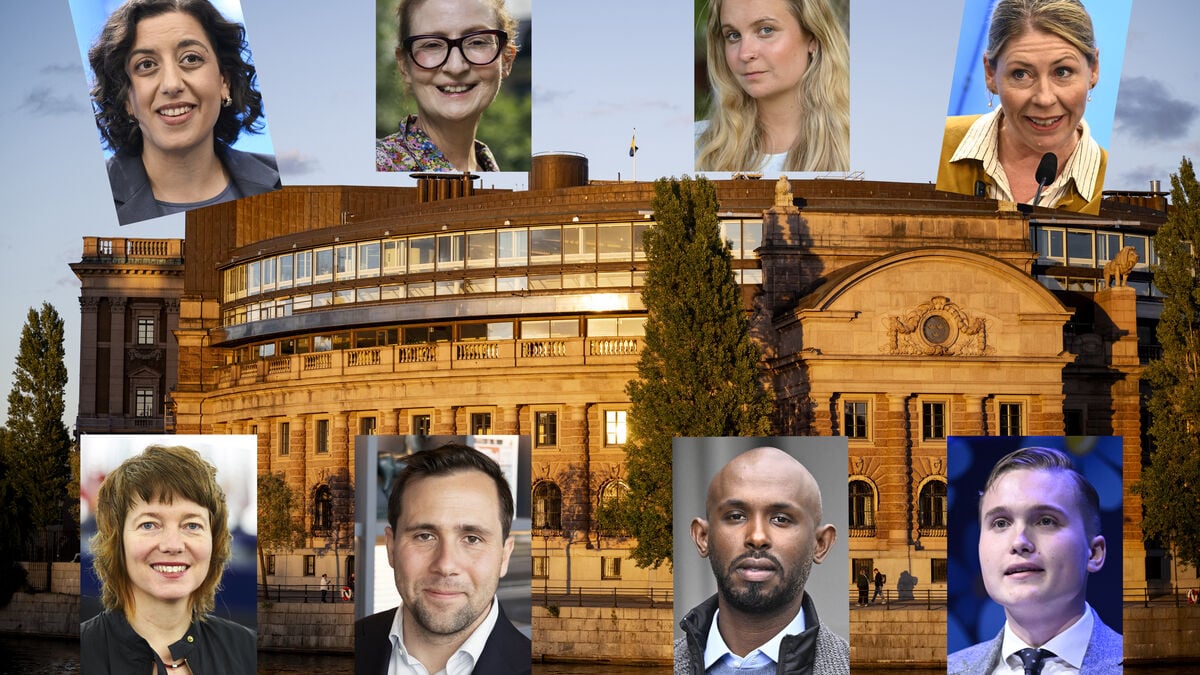
The 349 elected members will gather on Monday morning for a roll call. Of these, 97 are new to parliamentary work.
The Left Party's parliamentary group has the most new faces. Of the 30 V members, 17 are new, which corresponds to 57 percent. This can be compared with 21 percent after the 2022 election and 35 percent after the 2018 election.
Among the newly elected is Mohamed Ali from Borlänge, who according to V will take a "time out" from the Riksdag until the police investigation into possible election fraud in his constituency is complete.
Famous names
Among the newcomers in V's parliamentary group are also experienced politicians such as former EU parliamentarian Malin Björk, party secretary Maria Forsberg and Daniel Bernmar, municipal councilor in Gothenburg.
The Liberals (L) have the second largest proportion of new members in their parliamentary group, 42 percent or 8 out of 19 members. Among them are party leader and Minister of Education Simona Mohamsson and current Minister of Labor Johan Britz.
Next comes the Green Party (MP), where 8 out of 22, 36 percent, are new.
Of the 97 new faces in the Riksdag, five have gained their seats thanks to personal crosses on the ballot papers. In addition to Mohamed Ali (V), they are opposition councillor in Malmö Anfal Mahdi (V), regional politician on Gotland Filip Reinhag (S), Julia Algotsson (C), an expert at LRF, and the Green Party group leader in Eskilstuna Mohamed Abdukani (MP).
Take the place?
Among the better-known newly elected members of the Riksdag are several ministers in the outgoing government, Minister of Justice Gunnar Strömmer (M), Minister of International Development Cooperation Benjamin Dousa (M), Minister of Culture Parisa Liljestrand (M) and Minister of Health Elisabeth Lann (KD).
Those who are currently ministers will not participate in Monday's roll call, as they have replacements as long as they are in government. It is unclear who intends to continue their political careers in the Riksdag after a change of government.
That 28 percent of the 349 members of parliament are new after the 2026 election can be compared with 23 percent in 2022 and 34 percent in 2018.