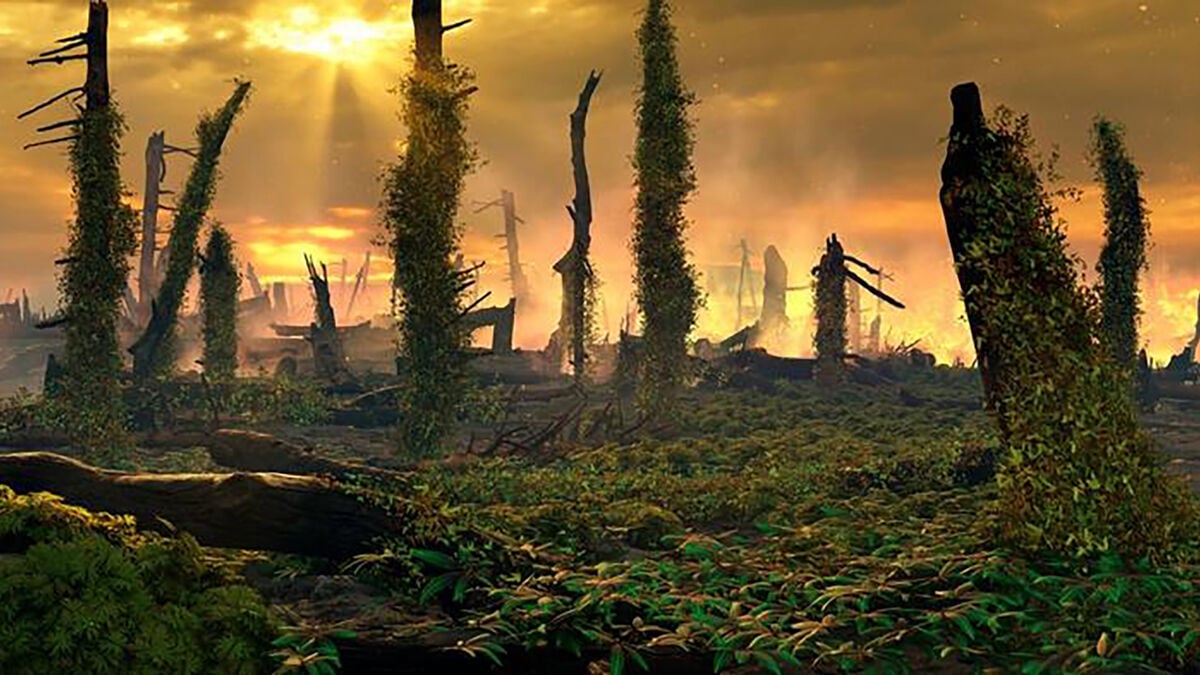
The catastrophe, which marked the end of the Triassic period, led to one of the worst mass extinctions to hit life on Earth, wiping out about 75 percent of all species.
The trigger was the separation of the North American and African continental plates and the formation of the Atlantic Ocean. A series of cracks in the Earth's crust appeared, triggering massive volcanic eruptions and an unprecedented flow of lava. Approximately 100,000 gigatons (100,000 billion tons) of carbon dioxide were released into the atmosphere - an unimaginable amount.
The temperature rose by up to four degrees on Earth. It became much warmer than before the disaster and much warmer than today, says Sylvain Richoz, a geologist at Lund University and co-author of the study, which is published in Nature Geoscience.
Burned for thousands of years
The result was huge forest fires. According to Sylvain Richoz, the fires raged in Europe for about 30,000 years.
"It's likely that large parts of the entire Earth burned, but we don't know for sure," he says.
When the forests were wiped out, they were replaced by ferns that came to dominate the vegetation for a very long time - a strange type of savannah that has no equivalent in the world today. These were also fire-prone, meaning that fires returned at frequent intervals.
Some trees survived, but only in small pockets in the landscape, Richoz says.
A world of ferns
The ferns continued to dominate even after the fires subsided, probably for hundreds of thousands of years.
The study is based on analyses of drill cores from sedimentary layers in four countries: the UK, Germany, Denmark and Luxembourg. Specifically, the presence of fossil charcoal and molecules formed in smoke from fires was studied. This was combined with data from pollen and spores, which vary in color depending on heat and pressure. They then discovered a “dark zone” that coincides exactly in time with the mass extinction, increasing occurrences of charcoal and the spread of ferns. In other words, the dark zone arose as a result of long-term and intense forest fires.
According to the researchers, there are lessons to be learned from the inferno 201 million years ago. Higher temperatures and drought lead to more forest fires and vegetation changes - something we can see on a smaller scale on Earth today.
Five mass extinctions, in which more than 50 percent of all animal and plant species died out, have occurred on Earth in the last 500 million years. The worst of them occurred at the end of the Permian period, when up to 90 percent of the Earth's species died out. The extinction at the end of the Triassic 201 million years ago led to the extinction of a long line of reptile groups, but the dinosaurs survived and were then able to dominate life on Earth until the end of the Cretaceous period 66 million years ago, when they themselves perished in a mass extinction.