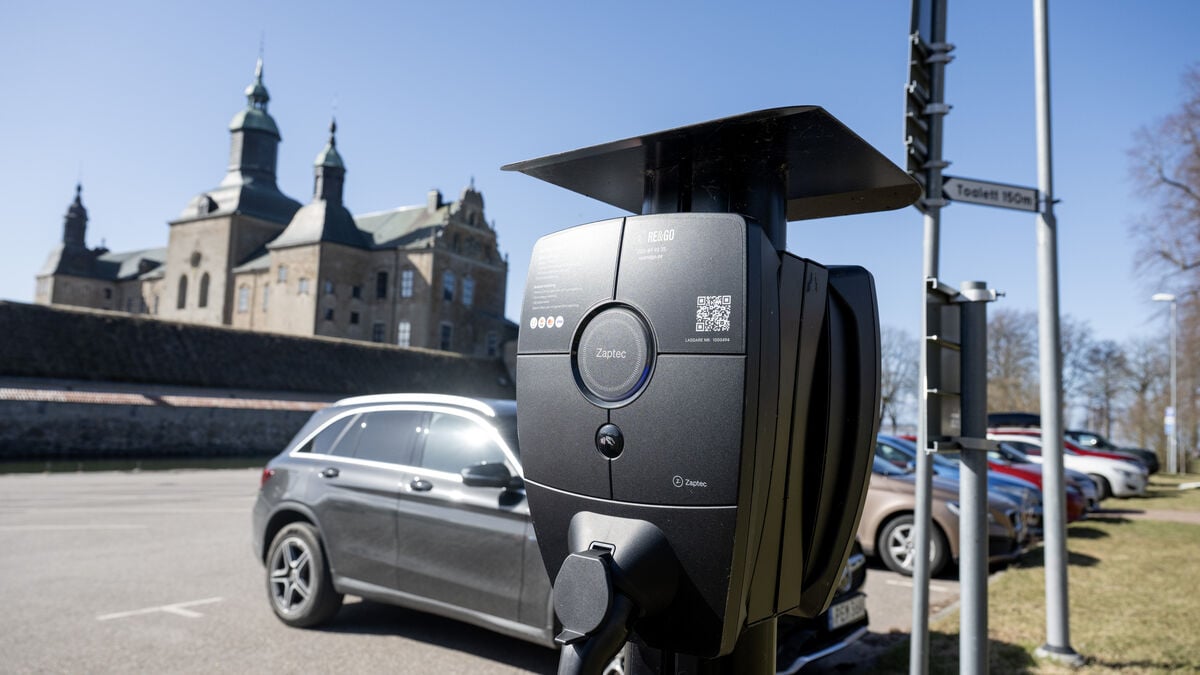
The spring sun makes Lake Vättern sparkle, and the sharp shadows of Vadstena Castle fall across the parking lot. The central location makes the parking lots attractive, but three of the four charging points for electric cars are empty. Stefan and Ulrika Montán have just parked at the fourth, and are trying to figure out how to charge their rental hybrid.
"It's great and important that there are charging stations. We didn't know it was here before, but since it was here, we thought we could charge," says Stefan Montán.
Rapid development
Anyone who has been away from Sweden for the past ten years would probably be struck by a new feature in parking lots and along the roads. Charging stations are everywhere, ready to fill the fleet of rechargeable vehicles with energy.
In 2016, charging stations were still a fairly exotic feature in Sweden. Back then, there were 600 stations with 2,000 charging points in the country. Fast forward a decade and the numbers are 9,100 and 61,000 respectively.
"There has been good coverage across the country," says David Mowitz at the advocacy organization Power Circle.
He says that it is rather the stagnant new-car sales of rechargeable vehicles that are the problem.
"Right now, the charging infrastructure is ahead of the vehicles."
Mostly empty
This is noticeable in some places when it comes to the use of fast chargers, which have higher capacity. In 120 municipalities, they have been idle more than 90 percent of the time, according to data compiled by the Swedish Energy Agency for TT.
"Too few electric cars charge at these public fast-charging stations," says Gustaf Länn at the authority.
Of the 11,000 fast chargers in the country, more than one in four - 2,900 - are used less than 10 percent of the time.
"Some are certainly bad locations. It could be poor service, too high a price - something that means they don't have a customer base," says Länn.
To some extent, chargers must be in place for people to dare to buy electric cars.
"But if in the end there are no customers in more peripheral areas, then it will not be viable to operate charging stations there," he says.
In addition, almost all fast charging stations involve public funds. If those stations are closed, the money is lost - but Sweden may also be forced to finance new stations to meet EU regulations.
"We are worried about this and need to find solutions for how we can handle it well."
Thomas Schölin at the industry organization Drivkraft Sverige agrees with the picture that many charging stations are underused. He sees a risk that operators will slow down their expansion plans when they see that the customer base is not there.
"When we talk to the charging operators affiliated with us, they say this is one of the biggest problems. One of the highest priorities is getting more cars on the roads. They need more customers," he says.
Big differences
Elsewhere, the situation is the opposite. Upplands Väsby's 30 fast chargers are busy 30 percent of the time. Since that figure is an average across 24 hours, there can be queues at times.
Anna Atterlöf, strategic community planning manager, says the chargers are placed along the E4 near both Stockholm and Arlanda, and that the high usage indicates they are well located.
"We have not received any indications from the commercial operators that their chargers are becoming a bottleneck, but it is natural that demand varies over the day and that queues can occur during peak times. We fundamentally see the high utilization as positive, as it shows the infrastructure is being used," she writes in an email.
Jesper Ekström is communications manager at OKQ8, which has one of the country's largest networks of public charging stations. He says that some widely used charging stations may help finance those that don't cover their own costs.
"When we built our charging network, we also built in places where electric cars are not yet common, such as Vittangi (in Kiruna municipality). We believe that if people are to dare to choose an electric car, the station network needs to be sufficiently developed," he says and continues:
"But we also see that the pace of electric car rollout is not what we perhaps expected four to five years ago when we started this."
At the same time, he does not expect that charging stations will need to be closed again.
"I believe there will still be a sufficient customer base as liquid fuels are phased out and electric car charging takes their place. I am not the least bit worried about that."
Don't want to remove
Hans-Petter Bjørkli Tryggvason, head of communications at competitor Recharge, agrees, writing in an email that the company is "in practice building an infrastructure for a demand that has not yet fully materialized."
"At the same time, it should be remembered that low utilization in the short term is not necessarily negative for users. It means good availability, basically no queues and in many cases also lower prices."
In the tourist town of Vadstena, land and development engineer Per Hallin says that in 2016 the municipality ensured that a number of normal chargers were built, including those outside the castle.
But demand has been lower than the municipality expected.
"It's striking that there are four central parking spaces to use when it's very crowded in the city in the summer. They're more often empty than used for charging," he says.
At the same time, he seems to be taking it all in stride.
"We make it easier for charging infrastructure companies to build here, so we absolutely don't want to take anything away," he says.
Facts: Rechargeable cars
At the end of 2025, there were more than 800,000 rechargeable cars in Sweden (433,000 electric cars and 374,000 plug-in hybrids). This is 16 percent of the 5 million passenger cars in traffic, 3 percentage points more than in 2024. Of the new car registrations, 172,510 passenger cars (63.2 percent) were rechargeable.
In Stockholm County, 30 percent of passenger cars are rechargeable, while the figure for Jämtland is 7.5 percent.
In a forecast from the Stockholm Chamber of Commerce in 2020, it was estimated that in an average scenario, Sweden would have almost 1.1 million rechargeable cars (22 percent) by 2025.
Source: Traffic analysis, Mobility Sweden, Stockholm Chamber of Commerce.
Public charging points are outlets where anyone can charge their electric car. In 2014, there were 876 points in Sweden. Now there are more than 60,000, of which 11,000 are fast chargers (DC).
Normal charging is done with alternating current (AC), most commonly between 3.7 and 22 kW, and it can take between 3 and 19 hours to charge a 70 kWh battery.
Fast charging is done with direct current (DC), where the power is usually at least 150 kW (older chargers can be below 50 kW, some super fast chargers reach 500 kW).
In addition to public chargers, there are semi-public (for example, for customers or hotel guests) and private ones, for example in villas and in housing association parking lots.