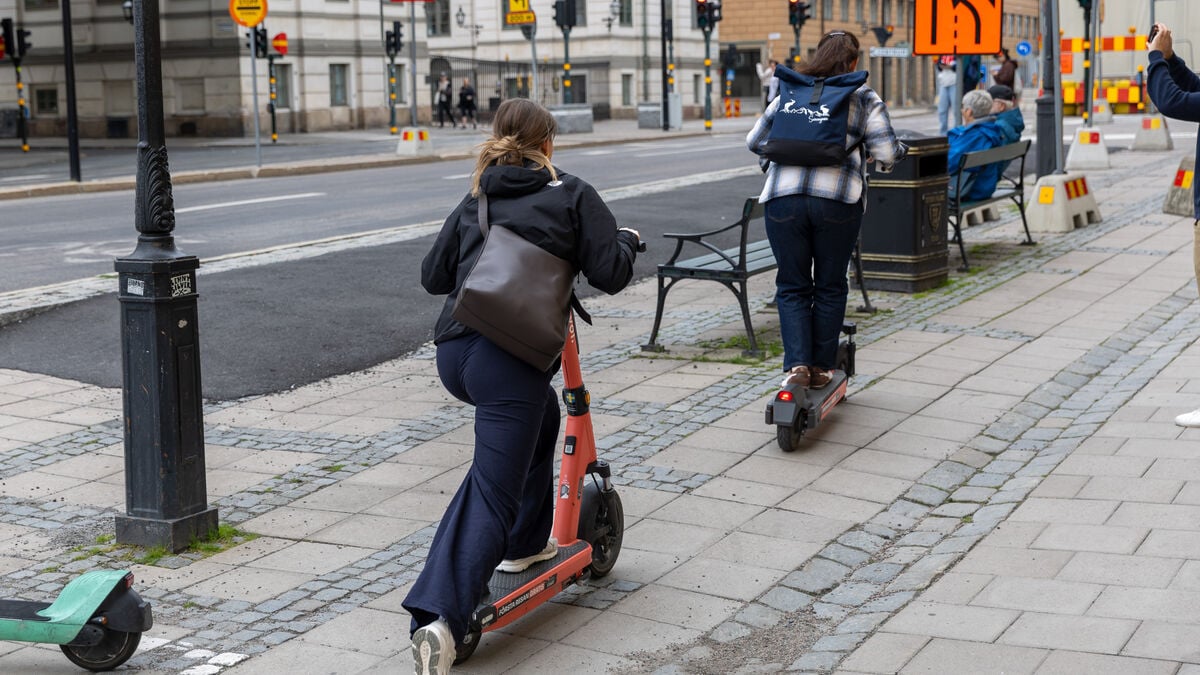
Accidents involving electric scooters are increasing dramatically, and new research from England and Wales shows that they also carry a high risk of serious injuries.
When researchers compared data from accident registries, they found that adult e-scooter riders had a 3.5-fold higher risk of traumatic brain injury and a 1.5-fold higher risk of internal organ damage compared with motorcyclists. They also had more than three times the risk of blood vessel damage. A total of 15,247 patients with moderate to severe traumatic injuries were included.
Higher than by bike
The risk of all three types of injury was higher for e-scooter riders compared with people who rode regular bicycles, although the difference was not as large. However, the risk of bone fractures was 20 percent lower for adult e-scooter riders than for motorcyclists.
Karin Jamil, an ear, nose and throat specialist at Karolinska University Hospital, is not surprised by the results.
"With motorcycles, it is accepted that you should protect yourself and follow the rules. With electric scooters, the experience is that you can ride a little however you want and not wear a helmet," she says.
She sees patients who may need surgery for facial fractures after electric scooter accidents. Some recover, but not all. If the fundus is damaged, vision can be impaired, and fractures in the facial bones and jaw can cause permanent difficulty opening and eating.
The brain injuries are the worst and they would probably be reduced with a helmet, but there are different degrees in hell, says Karin Jamil.
The researchers behind the new study, published in Scientific Reports, also believe that the low use of helmets among e-scooter riders compared with motorcyclists is behind the large difference in injuries. But the design of e-scooters, which makes it more likely that the rider will fall headfirst over the handlebars, is also cited as an explanation.
Time of day
The study also analyzed 23,000 driver-reported collisions and incidents, and found that women were at higher risk of collisions than men and more likely to report serious injuries.
This could be explained by the fact that more women report it but also that electric scooters are more often designed for male body proportions, they write.
Many accidents occur in the evening and at night, and those affected have often been drinking alcohol. Karin Jamil believes that a restriction where it was not possible to ride rented bicycles after a certain time and alcohol locks could reduce the risk of accidents.
I think many people don't understand how dangerous it can be.
Facts: Electric scooters and rules
In order for an electric scooter to be allowed to be driven in traffic, the following applies:
The electric scooter may have a maximum speed of no more than 20 km/h.
The electric motor may have a continuous rated power of maximum 250 watts.
You are not allowed to give others a ride on the electric scooter because it is only intended for one person.
Electric scooters, just like other bicycles, should primarily be ridden on cycle paths.
Electric scooters must have brakes and a bell (or equivalent sound signal).
The electric scooter should have front and rear lights and be equipped with reflectors if you ride in the dark.
Drivers younger than 15 years old must wear a helmet.
Source: Swedish Transport Agency
The number of accidents involving electric scooters increased by 38 percent in 2025, compared to the previous year.
A total of seven people died and 6,498 were injured.
Between 2016 and 2024, 204 people died in Sweden in accidents involving electric scooters, electric bicycles and regular bicycles.
Fatal accidents involving electric scooters stand out in several ways:
Approximately a quarter of the electric cyclists and cyclists who died were wearing helmets, while none of the electric scooter riders who died were wearing helmets.
The fatal electric bicycle accidents were largely single-vehicle accidents on weekends, evenings and nights, while regular bicycles and electric bicycles often involved collisions with motor vehicles on weekdays.
44 percent of e-scooter riders were under the influence of alcohol, compared to 27 percent of e-bike riders and 13 percent of those on regular bicycles.
The median age of the deceased e-scooter riders was 47.5 years, while that of both regular bicycles and electric bicycles was around 71 years.
Source: Chalmers University of Technology, Swedish Transport Agency