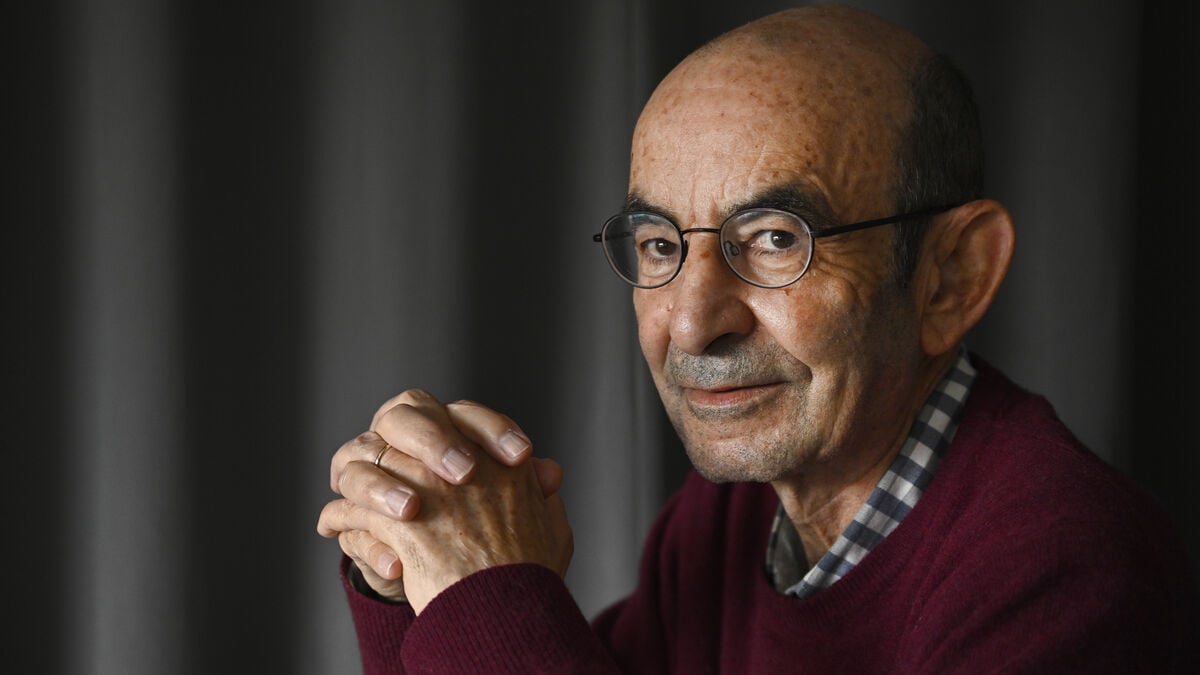
Since childhood, Raja Shehadeh has wandered the rolling hills around Ramallah in the West Bank. In his book "Strövtåg i Palestina" he has described how generations before him have lived their lives there. But the book also provides a picture of how everything has changed step by step.
"Now I can't go to the hills anymore. Not even the ones closest to Ramallah, because every time we try, settlers come and harass us and shoot at us. So we're trapped," he says.
Raja Shehadeh has been writing a diary every day since he was 16 and has now collected over 300,000 pages - a conscious act of resistance.
Colonialism works by colonizing the mind, which means erasing memories and changing history. By writing things down, I want to ensure that history is preserved as it was.
Untiringly
As a lawyer, Raja Shehadeh has also tried for decades to prevent Palestinian homes from being seized through legal processes.
There were so many violations of the law that needed to be documented. I started doing it myself but realized it was too much of a task.
In 1979, he founded a human rights organization, al-Haq. It collected evidence of Israel's violations of international law, but last year was hit by Trump's sanctions - one of many setbacks that Shehadeh's books are full of.
In the new "Why does Israel fear Palestine?" despair shines through at times. Raja Shehadeh has always had many Jewish friends, but suddenly they could no longer talk. Shehadeh believes that Hamas had the right to break through the barrier that imprisoned the people of Gaza on the fateful 7 October - but not to kill innocents.
It is inexcusable and it is a crime. But Israel could have taken action against those who did it and not against the entire population of Gaza. That reaction was disproportionate and unjust.
Don't give up.
Despite the now difficult situation, Raja Shehadeh refuses to give up.
The Israelis want everyone to believe that it is too late, that it is impossible, that there are so many settlements, "facts on the ground", they have been working to create that since 1979. But it is a psychological battle, he says.
He believes that Israel has gone too far, that the world is seeing the systematic violence more and more clearly.
Israel is becoming a pariah state. The oppressor is being deformed by his actions, you see. If you stop applying the law equally, then it's over.
Facts: Raja Shehadeh
Lives: In Ramallah, in the West Bank
Age: 75 years.
Occupation: Author and lawyer. Co-founded the award-winning Palestinian human rights organization al-Haq in 1979.
Current: With "Why is Israel afraid of Palestine?". A new edition of "Strövtåg i Palestina" was also recently released in Swedish.
Background: Debuted in 1982 with the diary "The Third Way: A Journal of Life in the West Bank". Has written several acclaimed books, including "Strangers in the House", "Occupation Diaries", "Language of War", "Language of Peace" and "Going Home".
His "We Could Have Been Friends, My Father and I" was shortlisted for the National Book Award, 2023. In 2008 he won the Orwell Prize, a British award for political writing.
In September, his entire personal archive of notes and documents was transferred to the University of Edinburgh, while the digital copies were transferred to the University of Exeter.
... that the "Nakba" (the expulsion of Palestinians in 1948) is the event that most influenced his life:
The Nakba is absolutely central, because that's when the Israelis began the strategy of getting the Palestinians out and not allowing them to return. Those who tried to come back were shot. The Israelis called the people who left "absent," as if it's our fault that we're absent. And the property becomes "absent property," and then it's "legitimately" taken by Israel.
... the use of the words "genocide" and "apartheid":
Apartheid is defined as two peoples living side by side with unequal access to resources and under different laws - which is exactly what is happening in the West Bank. Regarding genocide, lawyers and international bodies have found that the acts meet the criteria. But if Western governments acknowledge it, they are forced to take action under international law, which they want to avoid.