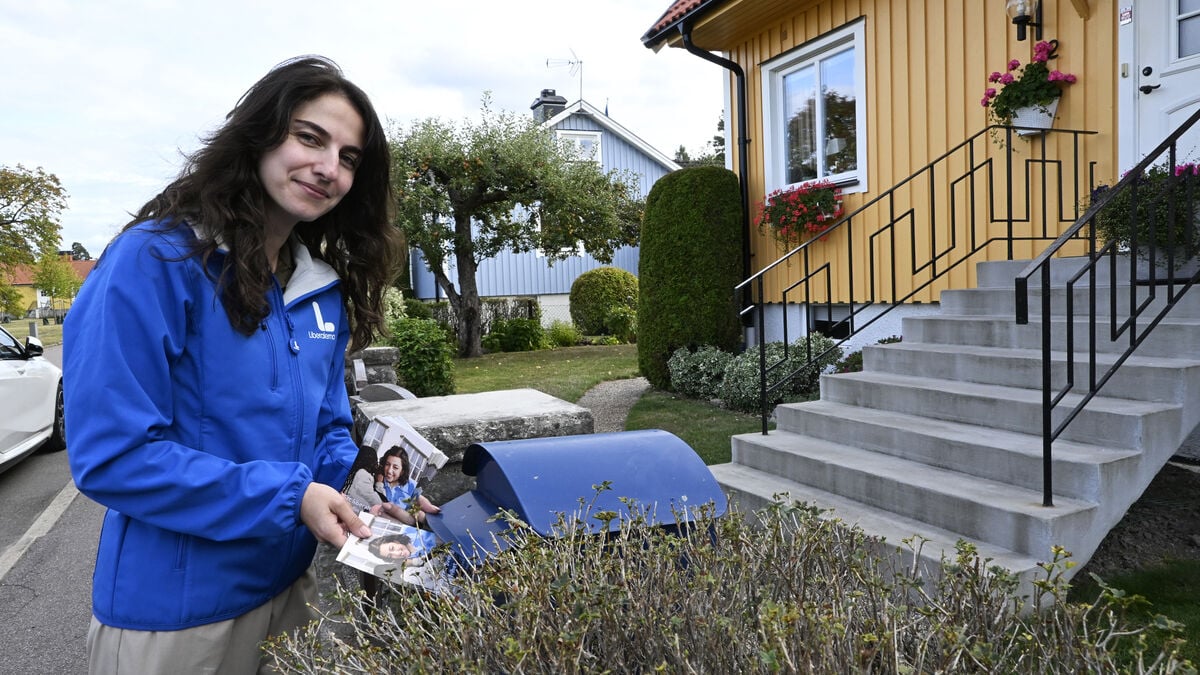
There are ten days left until the election when a group of local Liberals gather in a sleepy residential area in Linköping to knock on doors. Today they have the help of one of the party's top brass, cabinet minister Romina Pourmokhtari, who gathers the party members in a circle to draw up the strategy. It's about drumming home the message that there is no political centre - and hunting for votes.
"The middle" is just a political trick because KD wants attention - and that's smart of them. So the middle doesn't exist, and then you have to say that "we know it's really hard," says Pourmokhtari.
Many promised tactical voting
It has been a long and sweaty election campaign for the Liberals. In addition to arming herself with political arguments, Romina Pourmokhtari comes with a bag full of flapjacks, deodorant and dry shampoo.
So that you are presentable even if you haven't showered or washed in a long time.
Few party members dare to think about what would have happened if the party had won the election.
"Mentally, it's very difficult to be there. Imagine you're an elite athlete, then you can't focus on what would happen if you lose," says Pourmokhtari.
The croaking doomsday ravens were wrong again. In a rare election spurt, the Liberals once again clung to a margin above the threshold. Romina Pourmokhtari says she noticed during the door-knocking that many were planning to cast a tactical vote for the party.
I can see that there are right-wing winds blowing, people want us to continue and it is also visible in the opinion polls. We have the same feeling when we are out and about. I am genuinely convinced that we will get through this too.
Everyone becomes liberal
Liberalism has a long history in Sweden. The movement can take credit for reforms such as freedom of the press and speech, the introduction of elementary schools and women's suffrage. In recent decades, the People's Party and the Liberals have pushed for Father's Month, EU and NATO membership, the Partnership Act and more nuclear power.
Throughout the 20th century, the Liberals were in favor of free trade and a humanitarian refugee and immigration policy, says Anders Johnson, an author with a past within the party.
He says that before the 1920s, the party's predecessors leaned left. Then it spent 100 years as a centre party. For long periods, the People's Party, which was formed in 1934, did not even want to call itself bourgeois. In recent years, it has moved sharply to the right, according to him.
The fact that they now call themselves a right-wing party is a violation of tradition.
Li Bennich-Björkman is a professor of political science at Uppsala University. She says that the Liberals have been Sweden's social liberal party, pushing for a market economy while at the same time, like social democracy, protecting welfare. From being the second-largest party during the 1940s-1960s, the trend has been declining.
Bennich-Björkman says that parties like the Moderates, the Centre Party and even the Social Democrats are enthusiastic about liberal ideas. And Per Gahrton was a member of the People's Party when he formed the Green Party.
So there has been competition for that focus, she says.
Another reason for the decline is that the party has lost its social pathos, she believes, and that the Liberals have embarked on a journey towards what she describes as a relatively hardline nationalism.
The People's Party has historically been a party with heart, but also intellect, as well as heart and brain. Now it has neither heart nor brain.
Now that the party has once again passed the parliamentary threshold, she does not believe in any major changes, even though the result is actually far below what such a long-standing party should be able to hope for. Rather, the new line is being cemented.
Simona Mohamsson, who may have felt at times before the election that she no longer wanted to be the leader of this party, will get new strength, a second wind, says Li Bennich-Björkman.
Below the threshold
Two months after the 2022 parliamentary election, when the party made its worst election to date with 4.6 percent, the party slipped below the four percent threshold in opinion polls. Simona Mohamsson took over from Johan Pehrson as party leader in the summer of 2025, and began by first stating that the Sweden Democrats would not be allowed into a government. In the spring, the party's stance changed, culminating in her hugging SD leader Jimmie Åkesson.
"Back then it felt like the party was more or less going to break up. But now that I'm out, it feels like the party is intact," says former party leader Lars Leijonborg.
He received the question of standing on the ballot again with some surprise.
If they think I can help, why should I say no? And then it felt like this: It's hard to imagine a bigger challenge.
In the final stages of the election, he still feels the wind of public opinion.
It's been a while since I felt like something exciting might happen.
Fewer social liberals left
Birgitta Ohlsson was chairwoman of the Liberal Youth League, Minister for Democracy and sat in the Riksdag for 16 years for the Liberals, but left politics after losing the party leadership battle against Jan Björklund in 2017.
When several of us who were more social liberal politicians have left the party, there have been fewer left who have been strong voices to stand up for what has been classic People's Party ideology, she says.
In this year's election she ran for the Centre Party, and just days before the election she announced that she would lead a working group within the party to strengthen Swedish liberalism. The party wants to become a home "for those who believe in strong social liberalism" but who "do not cooperate with fringe groups". She leaves it unsaid what will happen to her former party.
But they have made this decision, now they get to own it, now they get to push for the policies they believe in. I think it was an extremely bleak choice.
Romina Pourmokhtari admits that it has been a painful process for the party, but that it was important. She believes that the party needs to reflect on its future - to become more uncomfortable and dare to stick its chin out.
I think it's important that we find a way back to the liberal voice that has the courage to say even what is unpopular and uncomfortable. I think voters will reward that.
She herself says she has never considered throwing in the towel.
I think the Liberals are a very good party when I get what I want and when I don't get what I want. We are the permanent strong force for liberalism in Sweden and I think the voters notice that too.
Facts: Liberal Prime Ministers
Louis De Geer, 1876–1880, non-partisan. Sweden's first Prime Minister.
Karl Staaff, 1905–1906 and 1911–1914, Liberal Coalition Party.
Nils Edén, 1917–1920, Liberal Coalition Party.
Louis De Geer (the younger), 1920–1921. Unbound.
Carl Gustaf Ekman, 1926–1928 and 1930–1932, Liberal People's Party.
Felix Hamrin, 1932, Liberal People's Party.
Ola Ullsten, 1978–1979, People's Party.
40.2 – The Liberals' highest election result (1911 parliamentary election).
24.4 – Highest result in a parliamentary election during the post-war period (1952 election).
81% – The party's loss in the post-war period (1952 election compared to 2022 election)
36 – Number of years in government since 1900. (Kristersson's government 2022–2026, Reinfeldt (2006–2014), Bildt (1991–1994), Fälldin/Ullsten (1976–1982), Coalition government (1939–1945), Ekman/Hamrin (1926–1928,1930–1932), Edén (1917–1920), Staaff (1905–1906, 1911–1914)).
1 – The number of municipalities where the Liberals were the largest in the 2022 municipal elections (Landskrona, 37.78 percent).
3 – The number of municipal boards where the Liberals held the chair position during the most recent term of office, according to SKR (Landskrona, Tjörn and Tidaholm).
4 – The number of regions that the Liberals have been involved in governing during the last term of office (at the mid-term follow-up in 2024), according to SKR.