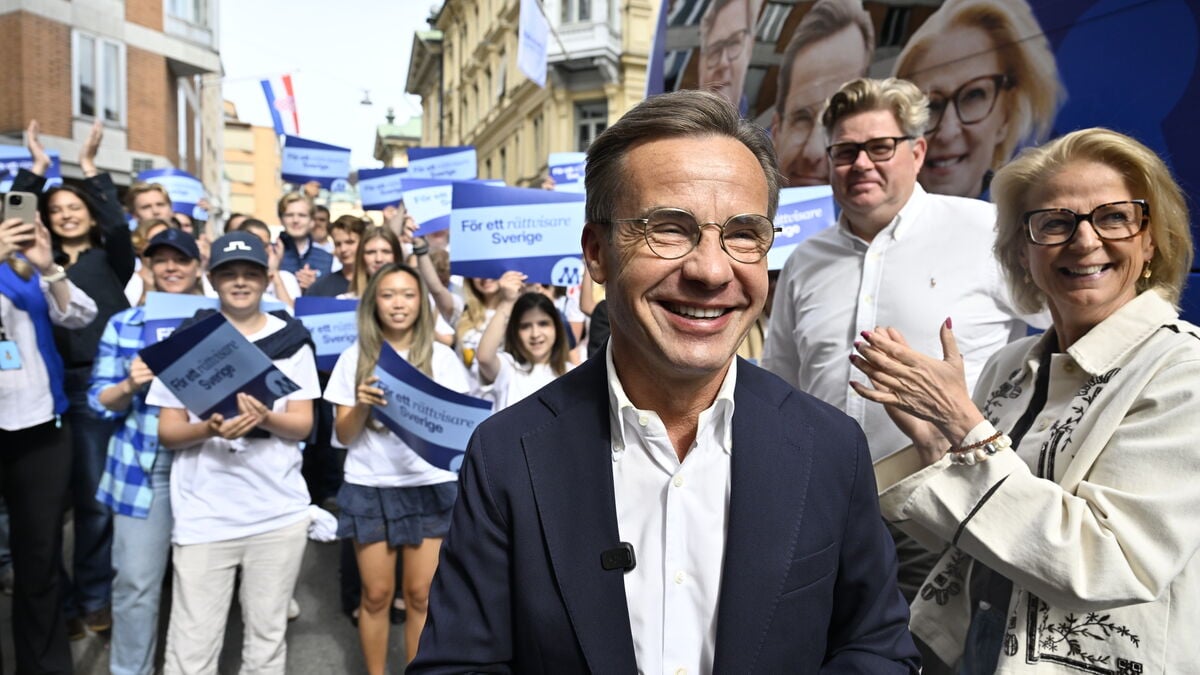
The election campaign got underway in earnest on Monday. Both the incumbent Prime Minister Ulf Kristersson (M) and his challenger, the Social Democrats' Magdalena Andersson, went on bus tours.
Now we are entering the second half, says Kristersson as he boards the election bus outside the Moderate Party's headquarters in Stockholm, on his way to Eskilstuna and Örebro.
Kristersson says the "second half" should clarify the differences between the two government alternatives - the Tidö coalition and the S-led red-greens.
I am convinced.
According to him, the red-green team wants to return to old policies with tax increases, a changed security policy, and less tough criminal and immigration policies.
When this becomes clear to Swedish voters, I am convinced that there is support for our line, says Kristersson.
According to Statistics Sweden's large party sympathy survey, conducted in late spring this year, the red-green parties S, V, MP and C had a clear advantage, a total of 55.2 percent compared with 42.6 for the government parties including SD.
S leader Magdalena Andersson counters that the Prime Minister's government alternatives do not seem to impress the Swedish people that much.
And we don't even know if his government alternative will enter the Riksdag, says Andersson, referring to the Liberals' struggle to clear the Riksdag threshold.
Many uncertain
Statistics Sweden's survey showed that approximately 20 percent of voters had not decided which party they would vote for.
The Moderate leader sees the sharply reduced number of shootings since 2022 as a major success for Tidö. In Eskilstuna, Kristersson pointed out to local media that the number of shootings in the municipality in 2022 was 32, but only two so far this year.
Collaborate with everyone
When Magdalena Andersson got on her tour bus, with the election motto "It's time to take Sweden seriously" on one side and "The Sossetour 2026" on the other, she had laid out some principles for how she wants to lead Sweden if she becomes prime minister. The policy should ensure external and internal security, welfare, benefit growth, low- and middle-income earners and increase cohesion.
But she does not say which parties Andersson wants to govern with. She is prepared to cooperate with everyone except SD.
"First we need to have an election result, then a government will be formed. It would be good if more parties opened doors instead of closing them," says Andersson, who held a town square meeting in Uppsala, visited the rescue services there and Furuviksparken south of Gävle.