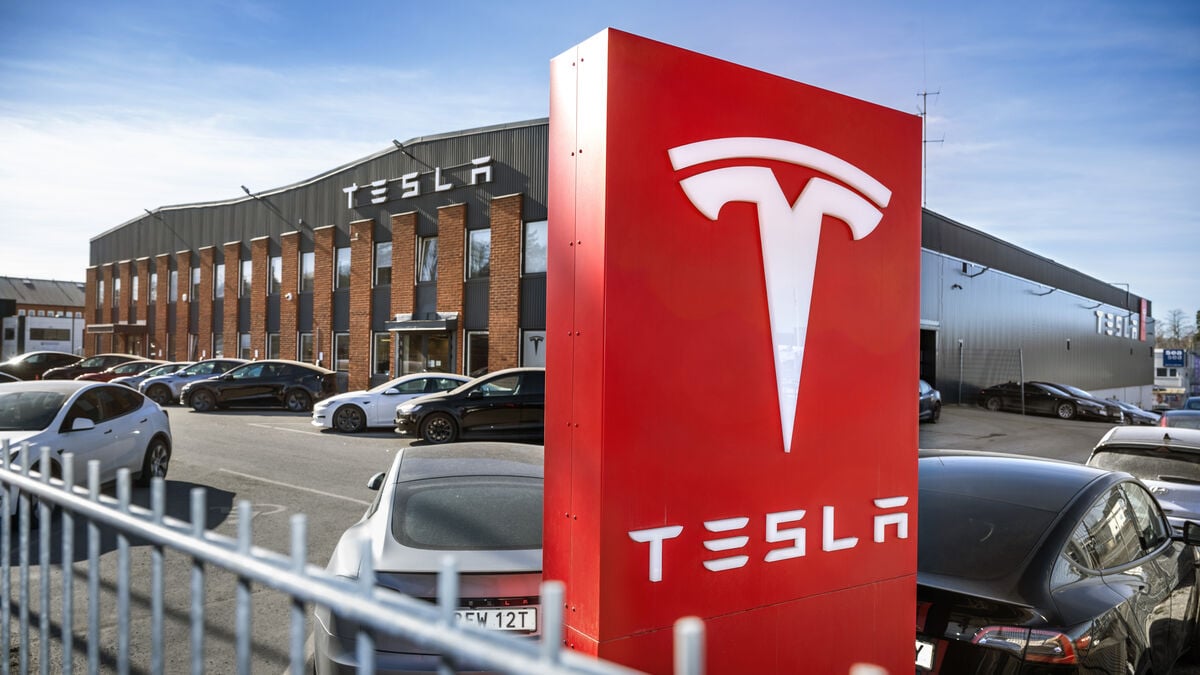
The reason the prolonged strike is now being called off is that Tesla has bought out the union members who were on strike at the company, a total of about 80 people, which means the conflict no longer has any effect.
"We can conclude that Tesla is so strongly opposed to collective agreements that they would rather buy out employees who are members of the union than give them safe conditions. This is unprecedented in the Swedish labour market - just like Tesla's systematic strikebreaking," says Simon Petersson, IF Metall's contract secretary, in a press release.
The strike began three years ago when the union IF Metall put Tesla's mechanics on strike after negotiations over a collective agreement stalled.
When Tesla did not give in, the conflict took a turn for the worse in the form of sympathetic measures from, among others, the Transport union, which blocked the loading and unloading of Tesla cars.
Risk of downward spiral
Veli-Pekka Säikkälä, contract secretary at LO, still believes that the strike was worth all the time.
"It's clear that it's a failure - there's no collective agreement in place. But what has been achieved is that Tesla has improved employment conditions during the strike," says Säikkälä.
As an example, he mentions that part-time pensions and insurance packages have been introduced.
Even though a world-leading company is now closing the door to the collective agreement norm, Veli-Pekka Säikkälä does not see the strike suspension as a setback for the collective agreement as an idea.
We have greater collective agreement coverage today in Sweden than when the strike began, he says, but emphasizes that employees have more insecure conditions without a collective agreement in place.
“Fair conditions”
He also sees a risk of a downward spiral.
The idea behind collective agreements is to have fair terms and conditions so that other companies cannot compete by undercutting them. Now companies may have to lower their terms and conditions to compete. If one company decides to lower wages, others may be pressured to do the same, says Säikkälä.
Maria Lantz, communications manager for Tesla Sweden, welcomes the announcement in a written comment to TT:
“Employment at Tesla includes all regular terms and conditions specified in Swedish laws and regulations, such as occupational pension, working hours and safe working conditions.”
Corrected: In a previous version, the title of one of the interviewees was incorrect.