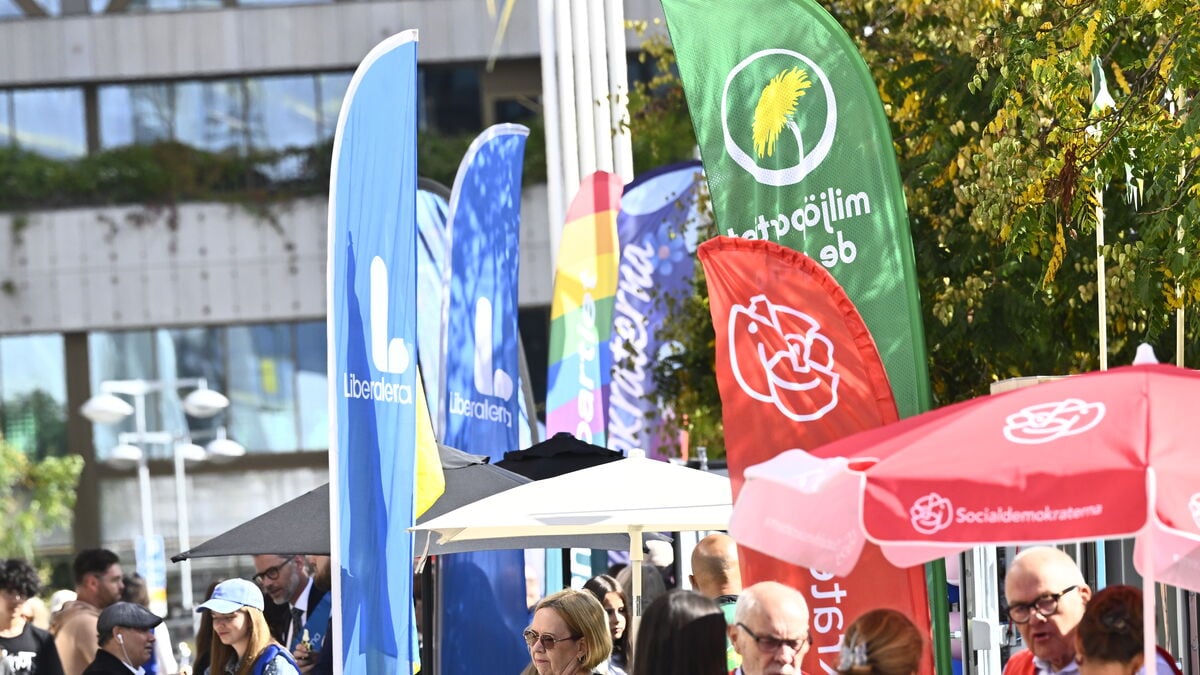
In a situation where EU politics has moved increasingly to the right in recent years, both anxious and hopeful eyes are turned towards Sweden.
Regardless of whether Ulf Kristersson (M) or Magdalena Andersson (S) becomes prime minister, Sweden's line will certainly remain firm on many tough EU issues. Sweden will remain one of Ukraine's main supporters, including on the issue of Ukrainian membership in the EU.
In the autumn and winter's big question of the next long-term budget, Sweden will continue to be among the countries pushing hardest for a significantly smaller budget than what the European Commission has proposed.
Even when it comes to the EU's handling of trade, migration, law enforcement and even the environment, the difference at EU level between an S-led or an M-led government is relatively small.
Get to the left
The Swedish election outcome is still far from unimportant - not least psychologically ahead of the "super election year" of 2027, when voting will take place again in key member states such as France, Italy, Spain and Poland.
Among the 27 heads of state and government attending EU summits, there are currently only three Social Democrats, no Greens and no leftists. This is the lowest number since 1992 - and a far cry from the situation in the early 2000s when two-thirds of the leaders were red rather than blue.
Instead, far-right parties have become increasingly strong, currently represented in almost every third EU government.
EU Member of Parliament Sebastian Tynkkynen from Sannfinländarna hopes that Sweden will also soon be included in that group - just like Finland.
"I hope that the Sweden Democrats enter the government, not just in the form of a Tidö agreement. I think it will be very interesting on Sunday," Tynkkynen tells TT in Brussels.
A turnaround in the making?
On the other hand, his German colleague Terry Reintke, group leader for the Greens in the EU Parliament, thinks she senses that a turnaround is underway.
"We see that there are governments in Europe that are shifting from right-wing to more progressive left-leaning. We are hopeful that this will be part of a shift," says Reintke.
However, she is not sure.
"It is a worrying situation. We see that far-right parties are on the rise in some member states."
Tynkkinen is also nervous - but for the opposite reason.
"I know that the Social Democrats in Sweden have tightened their migration policy, but I don't trust that they will do it enough if they take over the government," says the True Finn.
Among the 27 heads of state and government participating in EU summits, there are currently only three from the Social Democratic party family: Denmark's Mette Frederiksen, Spain's Pedro Sánchez and Malta's Robert Abela.
The Christian Democratic conservatives have the clear majority with eleven leaders, including Ulf Kristersson.
Further to the right are three prime ministers from parties in the SD's European party family (Italy's Giorgia Meloni, Belgium's Bart De Wever and Latvia's Andris Kulbergs) and one (Czech Republic's Andrej Babis) from the party group that also includes, for example, the National Rally in France and Hungary's Fidesz.
In total, eight countries have governments that include various far-right parties: Belgium, Finland, Italy, Croatia, Latvia, Lithuania, Slovakia and the Czech Republic. In addition, minority governments in Sweden and Slovenia rely on support from far-right parties.