The report "European State of the Climate", produced by the EU's Earth observation program Copernicus and the UN's weather agency WMO, takes stock of Europe's climate.
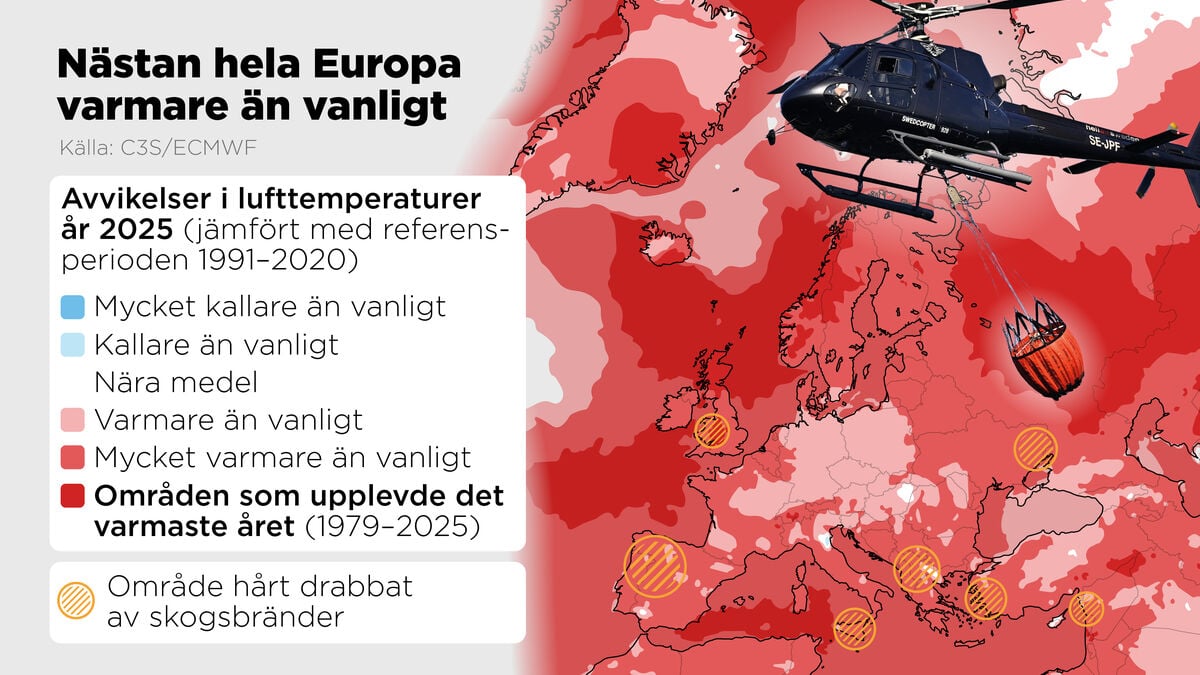
As expected, the continent - which is warming the fastest in the world - has a fever, and several records were broken last year:
+ In Sweden, Finland and Norway north of the 60th parallel (roughly north of Uppsala), it was exceptionally warm throughout the year. This summer's heat wave was the most extensive to date, with temperatures exceeding 30 degrees north of the Arctic Circle in places.
The heat wave in July lasted 21 days, which is a record, said Samantha Burgess of the Copernicus Climate Change Service (C3S) at a press conference.
100 pools per hour
+ In Silopi, Turkey, a temperature of 50.5 degrees was recorded, the first time Turkey has exceeded 50 degrees. Geographically, the city is located in Asia.
+ For the first time, more than one million hectares of land were burned, mainly in Portugal and Spain. Emissions from the fires were at a record high.
+ Glaciers melted throughout the area. Greenland lost 139 billion tons of ice.
That's the equivalent of 100 Olympic-sized swimming pools every hour, and 2025 was the 29th consecutive year that the Greenland ice sheet has shrunk, says Burgess.
+ Soil moisture was one of the three lowest since 1992 and 70 percent of Europe's rivers had lower than normal flows. There were significantly fewer rivers flooding than in the previous two years, and the second lowest figure since 1992.
+ Sea surface temperatures were the highest on record for the fourth year in a row. 86 percent of the surface was affected by a marine heatwave classified as severe.
Cleaner air
At the same time, the share of renewable electricity reached record levels. Solar and wind together accounted for 30.5 percent, which was more than fossil fuels. The share of solar power rose from 10.3 to 12.5 percent.
Solar power had a particularly notable year, Burgess says.
This is partly due to the expansion of solar power and partly to the fact that the weather was sunny. The latter is also influenced by cleaner air.
"When we get cleaner air, we get fewer aerosols that form low clouds. That means more solar radiation hits the surface," says Burgess.
At the same time, there is a risk that dry conditions will affect hydropower.
As we build resilience into our future energy mix, we must take climate conditions into account, says Burgess.
“European State of the Climate” - “European Climate Overview 2025” - is an annual report from the EU's Earth observation programme Copernicus, the European Centre for Medium-Range Weather Forecasts (ECMWF) and the UN World Meteorological Organisation WMO.
Around 100 researchers have participated in the work on the report, which is based on 45 different datasets, and addresses weather events in 2025 and the consequences that global warming will have in the region.