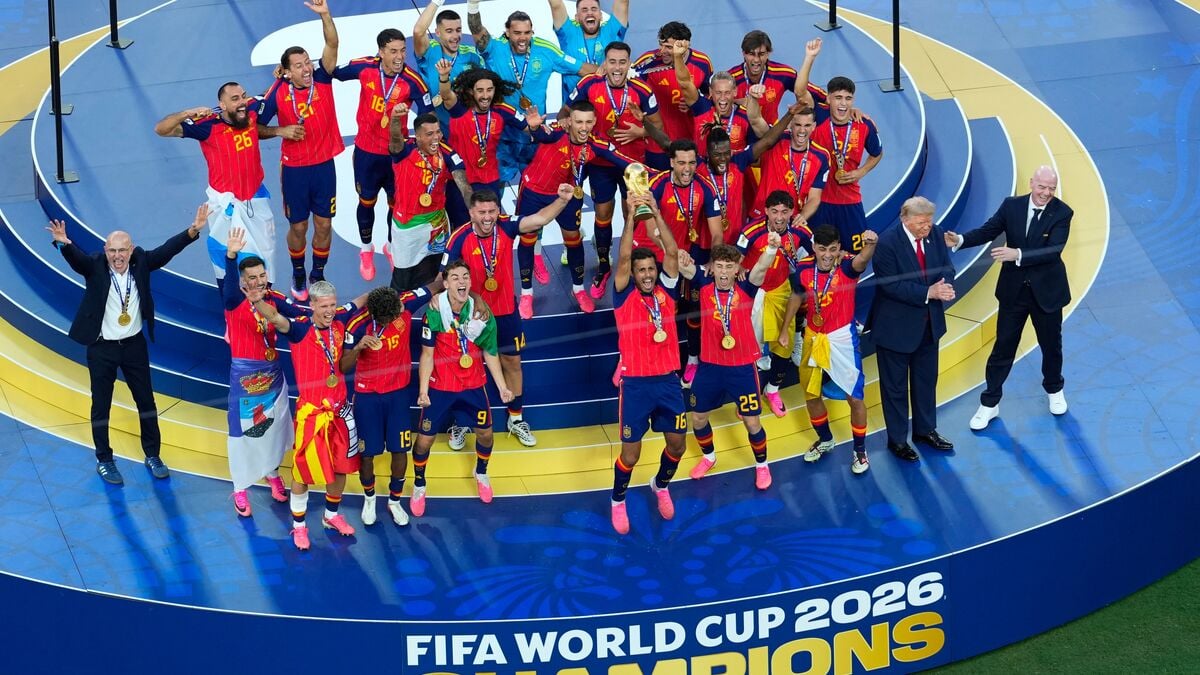
FIFA President Gianni Infantino opened the door for the 2030 World Cup to be played with 64 teams, compared with this year's 48. Infantino argued that a World Cup should not just be for Europe and South America.
All nations should be able to dream of playing in the World Cup, Infantino said in an interview with Swiss television company Blue News during the World Cup.
The advantages of a World Cup with 64 teams are that more smaller nations get the chance to show what they can do and revenue for the federations increases.
Noa Bachner, football columnist at Expressen, writes in an email interview with TT that the disadvantages are that the tournament's exclusivity is eroded.
The climate footprint will be greater and the quality of the matches will risk deteriorating. It is difficult to see how Fifa is doing this out of concern for the intrinsic value of the tournament.
Simpler math
Among the advantages is that it will be easier to work out which teams advance to the playoffs, compared with this year's World Cup, when the eight best third-place teams out of twelve advanced to the round of 16. A format with 64 teams could result in 16 groups of four teams each, with the top two teams advancing to the round of 16.
Fifa wants to increase its revenues further and the management wants to stimulate the national associations by creating more places in the World Cup. There is something good about the basic idea of including more countries and parts of the world, but of course there are big problems with a rapid doubling (from 32 teams in 2022) of the number of participating countries, says Noa Bachner.
Bachner: "Uefa are the big losers"
Expanding the World Cup is also a way for Infantino to be re-elected, says Noa Bachner, explaining that there is dissatisfaction with the FIFA president but that it is not large enough to remove him.
Many national associations in Asia, Africa and parts of the American confederations are happy with more places and more money. They also see a reduction in European power and influence as something positive. Alejandro Domínguez, who heads the South American confederation, is also a big supporter of Infantino, who gave his Paraguay the Fifa congress in 2025 and World Cup matches in 2030.
Uefa are the big losers, even club football in Europe is threatened by Infantino's visions. But there is a fear of clashing with Fifa because they are outnumbered and have to take into account many powerful club owners from other parts of the world, says Noa Bachner, football columnist at Expressen.
The number of teams could double in eight years. From 32 teams in 2022 to 64 in 2030. With 64 teams, this means that 30 percent of the 211 teams in FIFA's world rankings will be allowed to play in the championship.
104 matches were played during the 2026 World Cup, with 48 teams. With 64 teams, the number of matches would be 128. The championship will be extended by a few more days. According to Fifa, the 2030 World Cup will be decided between June 8 and July 21.
The 2030 World Cup matches will be played in six countries, three of which will be the main hosts - Portugal, Spain and Morocco. In addition, Paraguay, Uruguay and Argentina will each get a match as the World Cup turns 100. The six host nations are all directly qualified.
With 64 teams, the draw key would be simpler as all the first and second place teams in the 16 groups would advance to the playoffs. However, several matches would have to be played simultaneously to make up the schedule.
According to Forbes' calculations, 20-22 stadiums would be needed for a 64-team World Cup. This would mean that the World Cup can no longer be hosted by a single country. Saudi Arabia has already been awarded the 2034 World Cup.
The revenue would of course be much greater with more teams. For comparison, Fifa had a turnover of the equivalent of SEK 73 billion for the 2022 World Cup and according to The Guardian, the turnover for 2026 will end up at the equivalent of SEK 144 billion.