States have an obligation to protect their own populations – if they fail, the international community has a duty to act, according to the UN.
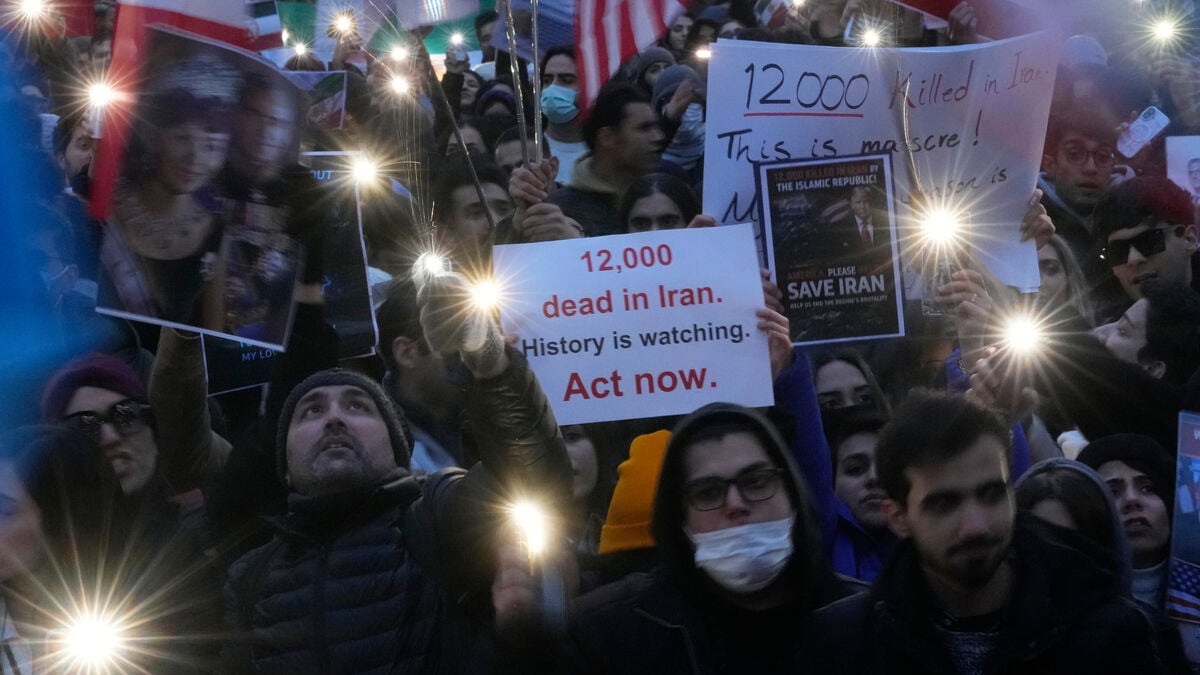
So what can the outside world do now that the Iranian regime has killed thousands - possibly tens of thousands - of civilians?
In theory, a lot - in practice, not much, according to Jann Kleffner, professor of international law at the Stockholm National Defense University.
We have an international community that is very dependent on the UN Security Council, and thus on powerful states that can say yes or no.
Kleffner points to Russia and China, who would veto any coercive measures against Iran.
The system is based on the fact that we need the will and consensus of the states, he says.
Obliged to act
On paper, Iran or responsible individuals could be brought to justice in the International Criminal Court (ICC) or the International Court of Justice (ICJ). The crime itself is clear, according to Jann Kleffner. But since Iran is not a signatory to the Rome Statute, the ICC has no jurisdiction there - and as for the ICJ, Iran has only accepted parts of the court's jurisdiction, which gives limited options.
What remains is for national courts to act, as in the case of Hamid Noury, who was convicted in a Swedish court in 2022 of crimes against international law committed in Iran in 1988. But it is a very complex process, notes Jann Kleffner.
One question raised is whether the UN doctrine of R2P (Responsibility to Protect) is applicable to Iran. The doctrine, which was born in the wake of the Rwandan genocide and the human rights violations of the Kosovo War, means that the international community is obliged to act if a state cannot protect its own population.
“Gross violation of international law”
This includes the possibility of military intervention. But it must be approved by the UN Security Council - and that is where Iran's allies Russia and China are likely to put a stop to it, just as they did when an R2P intervention in Syria was discussed in 2011.
Depending on political will, various political measures are available, such as classifying the Revolutionary Guard as a terrorist organization and imposing more sanctions.
The fact that there are such weak coercive measures is both good and bad, Jann Kleffner believes. The international legal order is built on consensus - a different order would mean that states “lose control completely”, he says.
But it is clearly bad in the sense that we cannot do anything about blatant violations of international law, such as this.
The UN doctrine of Responsibility to Protect, R2P, can be activated when a state fails to protect its population or commits specific crimes against its own people. The doctrine is applicable to four situations or types of crimes: genocide, war crimes, ethnic cleansing and crimes against humanity.
The clearest example of the application of R2P is Libya in 2011, where the UN Security Council gave NATO the go-ahead to intervene militarily after dictator Muammar Gaddafi used air power against the opposition. The controversial operation was initially praised but has since been heavily criticized, as the aftermath was a power vacuum and a protracted civil conflict.
That same year, the UN invoked R2P to deploy peacekeeping and French forces to protect civilians in Côte d'Ivoire. In 2012-2013, the doctrine was used to justify the deployment of West African forces to quell extremist violence in Mali.
R2P has also been invoked for UN operations in Sudan in 2006, as well as for diplomatic operations in Kenya in 2007-2008.