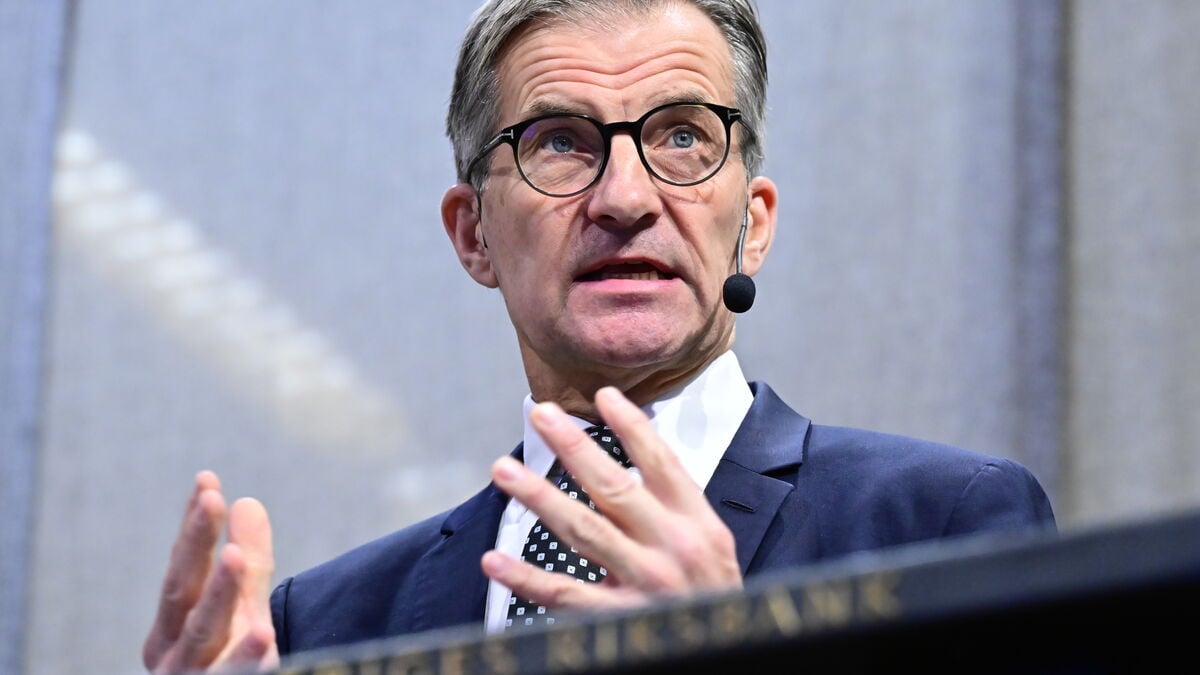
"It looks brighter for the Swedish economy," says Riksbank Governor Erik Thedéen as he concludes the press conference on the interest rate announcement.
"After a period of high inflation and interest rate hikes, we can now see that inflation is back close to 2 percent. Interest rates have come down and the economic recovery has started with some force," he adds.
His main message to all debt-ridden households is that the key interest rate – which mainly affects variable mortgage rates – will remain unchanged in the near future. Although other scenarios cannot be completely ruled out.
Exactly where the interest rate will land next year depends of course on the inflation and economic outlook, says Thedéen.
Difficult to assess fiscal policy
Fiscal policy decisions – such as the government's halving of food VAT and other stimulus measures next year – are difficult to assess, he notes.
The VAT cut is estimated to result in approximately 0.6 percentage points lower inflation in 2026, according to Thedéen. And he foresees a corresponding upward movement in inflation when VAT is raised again at the end of 2027.
Added to this is geopolitical uncertainty and the risk of government fiscal problems in major economies such as France, the UK and the US derailing – which could have effects on the market and global demand.
Experts TT spoke to describe the interest rate announcement as expected.
SEB strategist Amanda Sundström notes that the Riksbank - although it is extremely marginal - is adjusting its forecast for the policy rate at the end of 2027. She interprets this as "a signal" that the Riksbank wants to see a normalization of the policy rate as the economy recovers.
“The risk picture has shifted”
Earlier this year, the Riksbank lowered the interest rate four times, from 2.75 percent at the beginning of 2025.
Mattias Persson, chief economist at Swedbank, sees no need for interest rate adjustments, either upwards or downwards, in the near future. And he believes neither the food VAT reduction nor more generous mortgage rules will change that picture.
No, wages appear to be growing according to forecasts and the Swedish krona is strengthening, he explains.
Amanda Sundström has the same main scenario. But she thinks the risk in the near term is that inflation and inflation expectations may become too low. This could justify a reduction in the policy rate.
We are not there today. But the risk picture has shifted in that direction, she says.
The Riksbank leaves the key interest rate unchanged at 1.75 percent.
In its forecast for the policy rate – the so-called interest rate path – the Riksbank currently indicates that the policy rate will be raised by 0.25 percentage points sometime during the end of 2027, up to 2.00 percent.
The Riksbank's Executive Board then assesses that there is a certain probability that there will be a further increase to 2.25 percent by the end of 2028.
The Riksbank's forecast for CPIF inflation is lowered to 0.9 percent on average in 2026, but remains at 1.7 percent for 2027. This can be compared with the Riksbank's inflation target of 2 percent in CPIF inflation.
The growth forecast is raised to 1.5 percent GDP growth this year, followed by 2.9 percent in 2026 and 2.5 percent in 2027, according to the interest rate announcement. At the same time, the Riksbank is raising its unemployment forecast to 8.8 percent this year, 8.6 percent next year and 8.0 percent in 2027.