When Qatar hosted the men's World Cup four years ago, there was a global outcry over the number of workers killed in stadium construction. In a failed attempt to project empathy, FIFA boss Gianni Infantino embarrassed himself by saying the day before the opening: "Today I feel like a migrant worker."
This year's World Cup is different. The stadiums don't have to be built from scratch and there are no shocking death tolls. But workers' rights are under pressure in all three host countries, according to the global union ITUC.
In its Global Rights Index report, Mexico, like Canada, receives a score of 3 on a five-point scale - with 5 being the worst - for workers' rights. This score indicates recurring rights violations.
The US is worse, scoring a 4: systematic rights violations. In Los Angeles, arena staff have threatened to strike to keep federal immigration police, ICE, out of their workplace.
Union leaders are murdered
But Mexico stands out among the host countries. Union activists are exposed to a higher degree of violence and in parts of the construction industry the notorious drug cartels have made inroads.
It is one of the countries where union leaders are even murdered, says Lennart Reinius, secretary general of the the unions' aid agency Union to Union.
One of the country's most powerful cartels, from the state of Jalisco, is based in Guadalajara - one of three cities in the country where the World Cup is being played.
"They have a strong presence throughout society there and are inventive in making money. They push their way into companies and then it becomes even more sensitive," says Jonas Eriksson.
He is the central ombudsman and responsible for international issues at the Swedish Electricians' Association.
"The workers are very afraid to talk about anything that has to do with their work or the work environment. It's a very difficult country for the workers to actually be and work in," says Jonas Eriksson.
“Poor wages”
As part of an international trade union delegation, Jonas Eriksson inspected construction sites in both Russia and Qatar ahead of the last two World Cups - with mixed results. Even getting into the stadiums is a problem.
"Access has been a constant theme. How many people you can talk to, where you can go... it's been a very difficult issue for us to solve. Mexico hasn't been much different," he says.
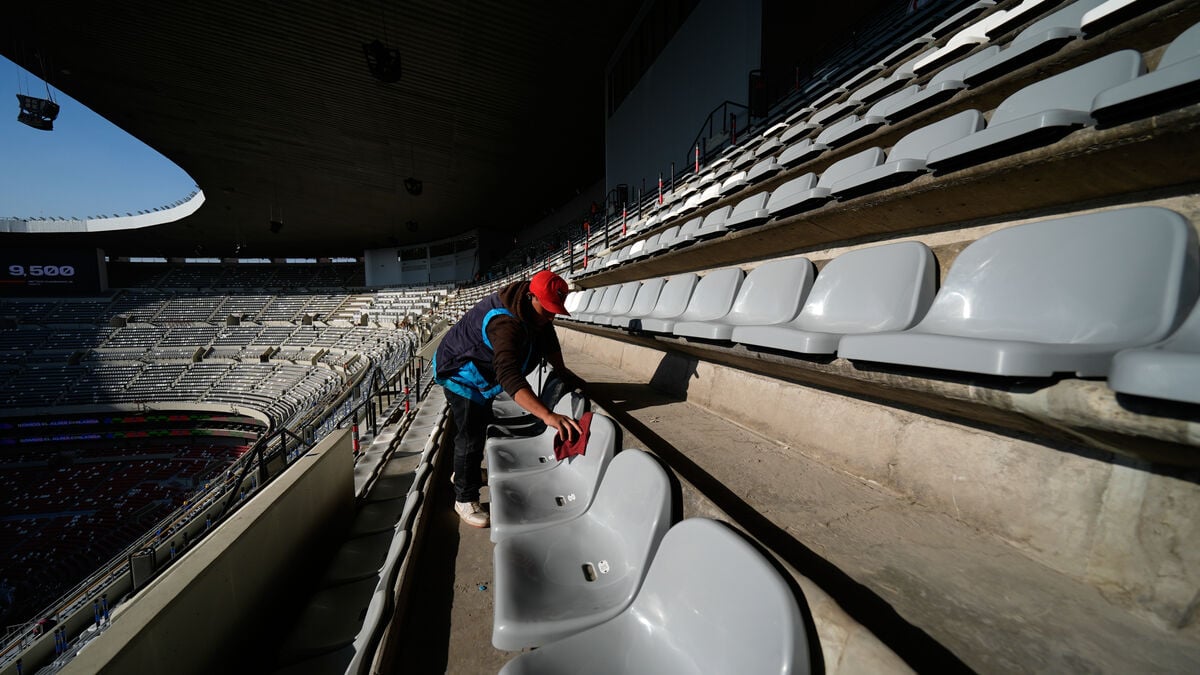
They finally had to do a "small inspection" at the Azteca Stadium - which for the World Cup will be equipped with new boxes, a new roof and new seats, among other things.
The owners went with us. We weren't allowed to talk to any workers directly and the visibility was very limited. It wasn't a great inspection, says Jonas Eriksson.
He describes the lack of safety awareness when working at heights as particularly worrying.
At the World Cup construction sites in Mexico, workers are unionized “to a very small extent,” says Eriksson. Organization is hampered by pressure from both owners and companies, according to the Mexican construction union.
Unlike, for example, the Qatar World Cup, the workforce is domestic, but anyone who raises their voice risks a great deal.
It's internal migration, you could say. They come from poorer parts of Mexico and come there to work. They get very poor wages and conditions based on the fact that they are in a very dependent position towards these companies. If they say no, the companies take someone else, and they don't have a job the next day.
In the US and Canada, the experience is different.
"There we have strong unions that we have been able to work with. But in Mexico we have noticed a fear in these issues," says Eriksson.
Worse than Qatar
Last October, the global federation of construction unions, BWI, signed an agreement with FIFA (the International Federation of Association Football) to guarantee access for inspections. But this only extends to the 2030 World Cup, not the 2034 World Cup in Saudi Arabia.
It risks being even worse than Qatar was, says Eriksson.
He almost gets angry when he remembers the situation in Qatar. The first inspection he was supposed to do was canceled when a 22-year-old worker fell 60 meters straight into the concrete and died.
"I could barely watch the World Cup in Qatar," he says.
The Swedish Football Association voted yes for Saudi Arabia, which ultimately stood alone on the ballot for the 2034 World Cup. Norway abstained as a mark of protest.
Lennart Reinius says he thinks Sweden should impose stricter requirements on the choice of host countries in such events.
But if the new agreement between BWI and FIFA is followed, a door could be opened for change, he believes.
"The positive thing is that when you support the local unions to work on these issues, it will have an effect when the World Cup is over. Then you will have strengthened your visibility and your own ability to act in, for example, Mexico," says Reinius.
But can FIFA be trusted? Jonas Eriksson hopes so.
"They themselves say that they only organize football matches and that they are not responsible for these things. We see that, more or less, as nonsense," he says.
We must be able to ensure, from the first sod to the last ball being kicked into the goal, that the entire arrangement has been guaranteed. That no one has died in the workplace and that there are fair conditions.
The 2026 World Cup will be played in 16 cities: three in Mexico, two in Canada and eleven in the United States. The final will be played in East Rutherford, New Jersey, while the opening match will be played at the Azteca Stadium in Mexico City.
The Azteca Stadium was inaugurated in 1966 and both Pelé (1970) and Diego Maradona (1986) have lifted the World Cup trophy there. The stadium once held over 110,000 spectators, but now has a reduced capacity.
In recent years, the stadium has been renovated ahead of the World Cup, to mixed reviews about the quality of the work.
Location: Coyoacán neighborhood in Mexico City.
Capacity: 87,523
Home to: Mexico national football team, Club América, Cruz Azul.