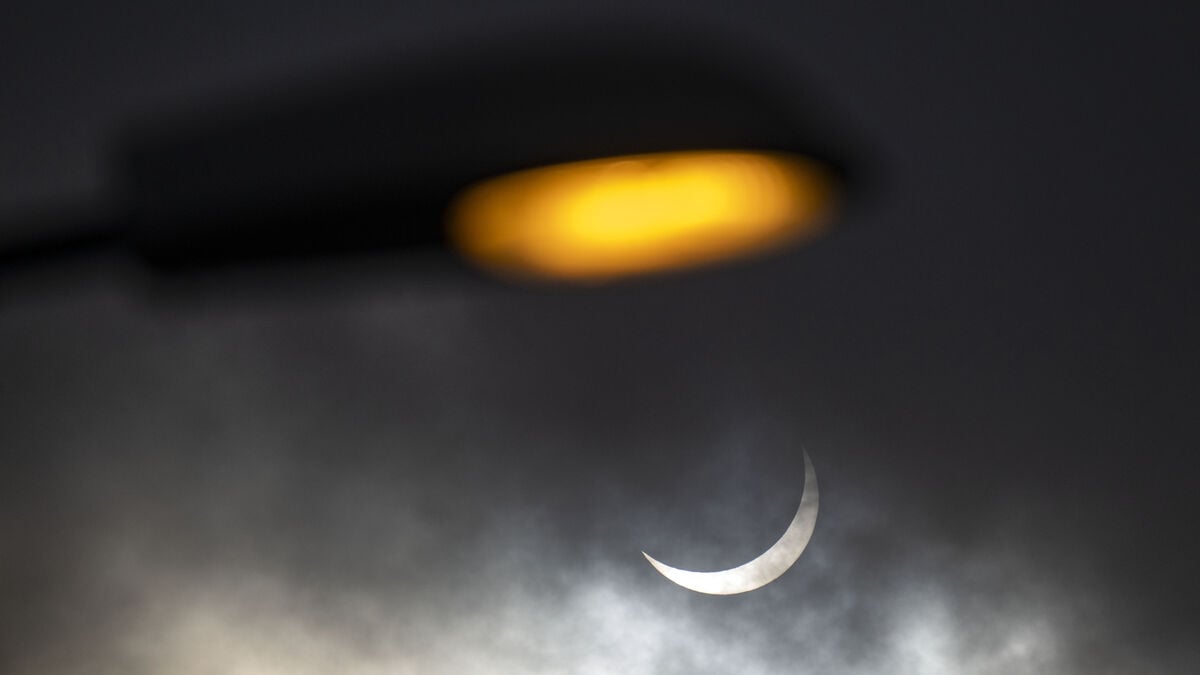
The die-hard skywatchers booked their trips for August 12 long ago. The temptation to see a total solar eclipse in, for example, Spain, where the sun will be completely covered by the moon during the afternoon, has been great.
One of those who will be present is Robert Cumming, astronomer and communicator at Onsala Space Observatory.
It's hard to describe a total solar eclipse, you really have to experience one, he says.
It is perhaps the most spectacular thing the sky has to offer.
But even from Sweden there are good chances for a nice experience.
The nights around August 12 are usually the best time of year to see shooting stars, when the Perseid meteor shower is at its most active. This year, Sweden is also expecting the most extensive solar eclipse since 2015.
At most, about 83 percent of the solar disk will be obscured.
Best in a long time
The solar disk will look like a crescent, a bit like the moon usually does. It's the narrowest solar crescent we'll see in quite a while, says Robert Cumming.
After this year, it will be until 2039 before there is one in this class.
The next total solar eclipse in Sweden? Hardly anyone alive today will experience it, as it won't happen until October 2126.
The partial solar eclipse begins around 7 p.m. and peaks around 8 p.m. in most of Sweden. In the far north, the phenomenon begins and ends up to 20 minutes earlier.
However, a clear view to the west is required, as the sun will be low in the sky when the moon begins to pass in front.
Protect your eyes
It is important, Robert Cumming points out, not to look directly at the sun as it can cause serious eye damage.
Ideally, you should use special solar eclipse glasses or use something to project the sunlight onto another surface.
One of the best options is a disco ball, according to an international study from last year, which Robert Cumming, among others, contributed to.
It turned out that a disco ball works just fine in almost any situation, he says.
Just place it in the sunlight and it will emit small spots of light in the room or on a wall so you can follow the solar eclipse as it happens. And it will be a bit festive too.
A solar eclipse occurs when the moon passes between the sun and the Earth, blocking almost all sunlight from reaching a certain area of the Earth for a few minutes.
During a total solar eclipse, it looks like a disk slides in front of parts of the sun until it covers the entire sun.
However, a total eclipse only occurs along a narrow strip of the Earth's surface. The next total solar eclipse that can be seen from Sweden will not be until October 2126.
During solar eclipses, glasses specially adapted for solar eclipses must be worn to protect the eyes.
Source: Swedish Space Agency.