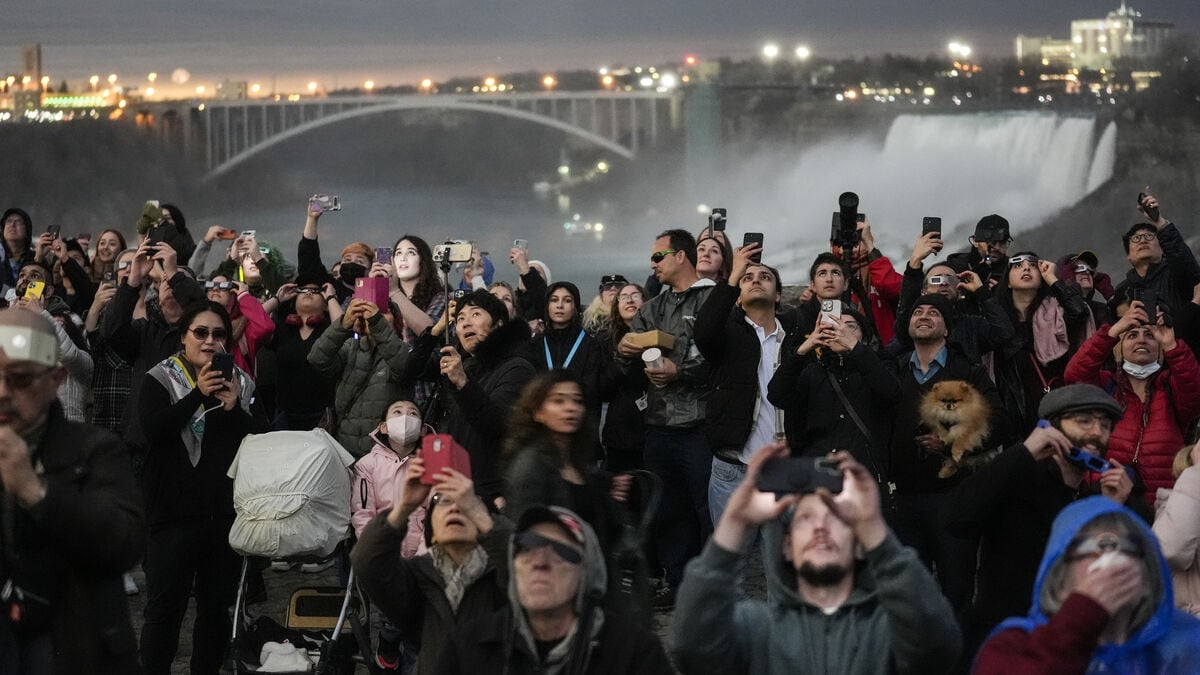
The total solar eclipse that will occur on August 12 will be the highlight of the year for many astronomy enthusiasts.
In Sweden, however, it will be a partial solar eclipse, with up to 85 percent of the sun's diameter covered.
The eclipse occurs in the evening as the sun is setting, so a fairly clear view to the west is important.
It can be extra spectacular if you like. You will be able to see it happening toward the horizon, says Peter Linde, chairman of the Swedish Astronomical Society and associate professor of astronomy at Lund University.
Traveling to Spain
Anyone who wants to get the 100% experience can travel - to Iceland, Greenland or perhaps best of all to Spain, where the solar eclipse is total in a narrow belt all the way from the Basque Country in the northwest to the Balearic Islands in the Mediterranean.
"There are probably many people who travel to Spain to see the totality, including myself. I have only seen one proper solar eclipse, and that was on April 8 the year before last in Mexico. It is an absolutely fantastic natural experience," says Peter Linde.
The year also offers some other great space experiences, says Linde.
Among them is the recurring Perseid meteor shower with up to 100 meteors per hour. The meteor shower reaches its peak on August 12, the same day as the solar eclipse. In other words, it's set for an astronomical evening.
"Then it won't get dark until around ten o'clock, but I think you can definitely stay in the same recliner and watch the shooting stars when it starts to get dark. It's quite special that it happens to coincide," says Peter Linde.
The ISS party trick
There will be no total lunar eclipse, or blood moon, this year. However, there will be some supermoons, i.e. a full moon at the same time as the Moon is closest to Earth in its orbit. Since the sun is still at its most active in its cycle, there is also a good chance of the Northern Lights, even south of Norrland.
Peter Linde also recommends checking out the International Space Station (ISS) this January when it is sunlit and it is dark enough for it to be visible in the evening sky.
I've used it as a party trick among friends. I say, "OK, now we're going out and checking, because in five minutes the space station will be over us," and it always does.
Facts: Astronomical events in 2026
Winter
January 3: Supermoon.
February 26: Jupiter and the moon are quite close together in the sky.
The International Space Station (ISS) is visible in the evening from Sweden at least once a night.
Jupiter is a dominant, bright object. With ordinary binoculars, you can see the four largest moons (the Galilean moons).
Good chances to see the Northern Lights, as the sun is in an active period and the evenings are dark.
Spring
April 22: The Lyrid meteor shower reaches its maximum with about 10 meteors per hour.
Summer
June 17: Venus is near a thin new moon, with Jupiter nearby. Visible in the west just after sunset.
August 11–13: The Perseid meteor shower reaches its maximum with about 100 meteors per hour.
August 12: A total solar eclipse can be seen in Spain, among other places. In Sweden it will be partial and occur in the evening.
Autumn
November 17: The Leonid meteor shower reaches its maximum with about 10–20 meteors per hour.
November 24: Supermoon.
Winter
December 14: The Geminid meteor shower reaches its maximum with about 100 meteors per hour.
December 24: Supermoon.
All observations assume clear weather.
For those who want to keep track of the positions of stars and planets, Peter Linde recommends the free service Stellarium.
Satellites and the ISS can be tracked via the Heavens-Above website and app.
Source: Peter Linde