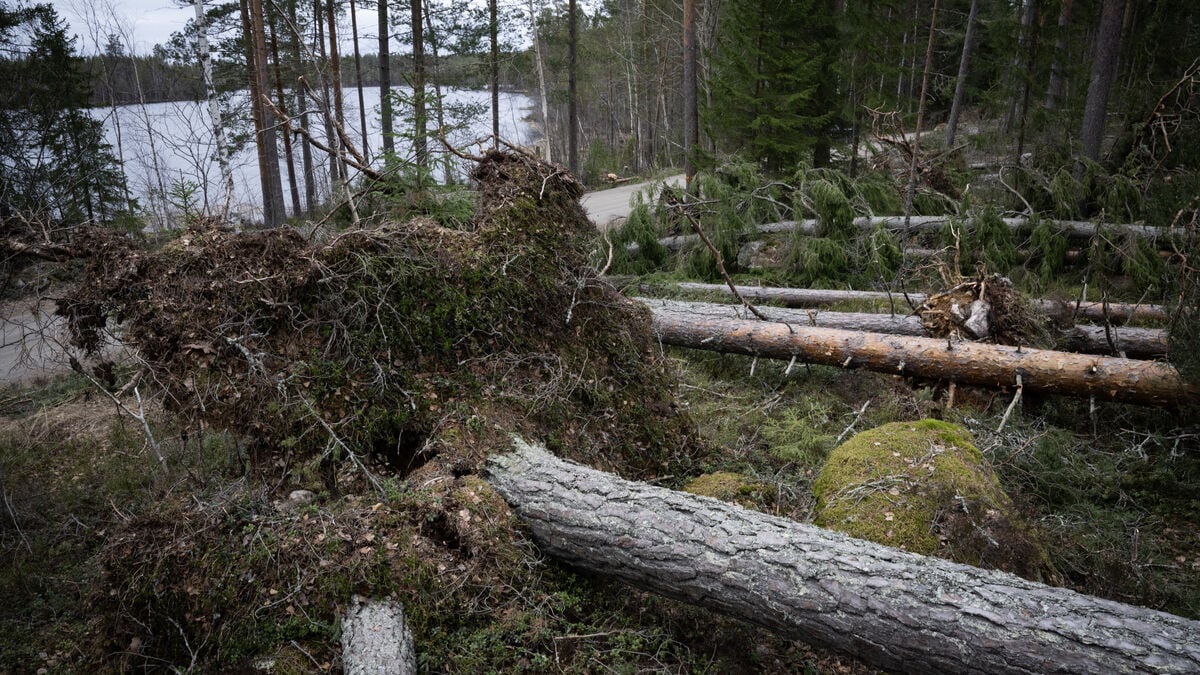
One third of the trees that were blown down during the storms at the end of last year still remain in the forest, according to the Swedish Forest Agency's assessment.
The authority does not yet know why the trees have not been retrieved. One explanation could be that it is difficult-to-access forest that the forestry companies have not had the capacity to prioritise.
It may also be that individual forest owners are simply not aware that their trees have been blown down.
We now hope to be able to fly helicopters during the summer and early autumn to see where we have these areas, says Staffan Norin, Director General of the Swedish Forest Agency.
Spruce bark beetle
The funds for the helicopter flights come from the extra 20 million that the authority received from the government in the spring amendment budget to deal with the consequences of Johannes and Anna.
The spruce bark beetle, a major tree destroyer, is currently swarming through Swedish forests. The money will also be used by the Swedish Forest Agency to increase its monitoring of the feared pest, which sees storm-fallen spruce trees as easy prey. The aim is to reduce the risk of widespread infestations after storms.
Another area that needs improvement is work on digital storm maps. Quickly producing such maps is an important tool for getting an overview of where trees have been blown down, so that forestry companies can immediately deploy resources in the right place.
Using AI
This is currently a time-consuming process that largely involves the Swedish Forest Agency's administrators manually reviewing data from satellites, among other sources. The work will now be streamlined with the help of AI.
With artificial intelligence, we can collect and process data from various sources and more quickly obtain data for the authority's work, but also for forestry's assessment of resources, says Staffan Norin.
Poor forest roads are a bottleneck when large quantities of storm-fallen trees are to be removed from the forest. As part of the work to improve the handling of future storms, the Swedish Forest Agency, together with the research institute Skogforsk, will develop an action plan for how the country's forest roads can be improved.
That work should be completed by the end of the year so we are better prepared for the next storm, says Staffan Norin.
Storms in Sweden that have caused the most damage to forests since 1993, measured in how many cubic meters of forest (m3sk) have fallen:
1. Storm Gudrun, 2005, felled 75 million cubic meters of forest in Götaland, Kronoberg and Jönköping counties.
2. Storms Simone, Hilde, Sven and Ivar during the autumn and winter of 2013 felled a total of 14 million cubic meters of forest. Storm Ivar hit hardest, felling approximately 8 million cubic meters of forest in Norrland.
3. Storm Per in 2007 mainly affected northern Götaland and Svealand and felled 12 million cubic meters of forest.
4. Storm Johannes in mid-2025 felled nearly 11 million cubic meters of forest, primarily in the counties of Dalarna and Gävleborg.
Source: Development of forest damage since 1993 (Swedish Forestry Board)