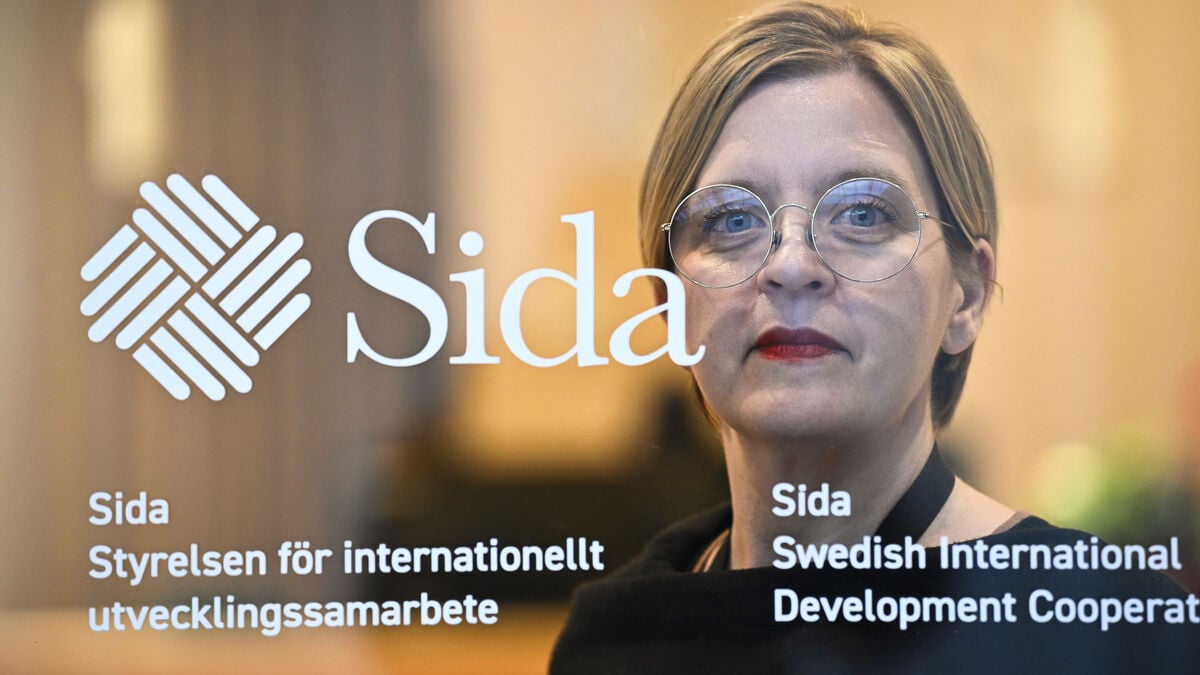
We will find ways to cooperate with states for effective return, says Hanna Hellquist, Director General at Sida, about the provisions in the 2026 appropriation bill.
The regulation letter is a collection of assignments and goals that Sida will work on. One is that Sida will develop methods for development assistance that require countries to cooperate better with Sweden on returns, voluntary remigration and sustainable reintegration.
“Making demands”
Minister of Development Cooperation and Foreign Trade Benjamin Dousa (M) says that conditions for taking back expelled citizens are self-evident. Many European countries have such conditions, he says.
"It is fair that we demand that countries that receive hundreds of millions of taxpayers' money also take back their own citizens who lack the legal right to be in Sweden," Dousa writes in a comment.
If Sida considers providing assistance to a country, it should ideally promote Swedish trade and Sweden's interests in foreign and security policy, in addition to migration.
We should think more from a mutual win-win perspective that is much more explicit than before, says Hanna Hellquist.
Goals remain
At the same time, she points out, the Riksdag's goal for aid remains - to create better living conditions for people living in poverty and oppression.
Benjamin Dousa has made it clear that Sida's appropriation letter entails major changes.
Sida's development aid budget will be reduced by almost a fifth to SEK 19.4 billion (approximately SEK 21.3 billion including the administrative budget) this year. More billions will be managed directly by the government, SEK 19.5 billion this year compared to SEK 16.3 billion last year.
Aid to several countries in Africa and Latin America is being phased out - Ukraine will be prioritized.
Hanna Hellquist does not believe Sida will need to reduce the number of employees, but rather to adapt the organization, for example by changing where in the world it operates.
She points out that Sida's framework for issuing guarantees is increasing by SEK 4 billion. Guarantees are a kind of insurance for lenders who want to enter into aid projects where it is up to the borrower to repay.
That's not to belittle it, because we have a tool with enormous leverage there, says Hanna Hellquist.
Facts: How aid is reduced
According to the government, the biggest change to development aid “ever in Sweden’s history” will be implemented in 2026.
The aid framework is reduced from SEK 56 billion to SEK 53 billion. Greater focus is placed on Ukraine, which is expected to receive aid of at least SEK 10 billion.
The aid agency Sida's allocation will decrease by just over four billion kronor in 2026, when development assistance is reduced.
In 2025, the government announced that aid to Bolivia, Liberia, Mozambique, Tanzania and Zimbabwe would be phased out.
The previous goal of one percent of GNI (gross national income) going to aid has been abandoned by the Tidö government and the SD.
In 2022, the aid framework amounted to 0.89% of GNI
In 2023, the limit was 0.87%, in SEK 56 billion.
In 2024 it was 0.84%, SEK 56 billion
In 2025 it was, provisionally, 0.81%, SEK 56 billion
In 2026, it is provisionally assumed to be 0.74% of GNI, SEK 53 billion.
Source: Ministry of Foreign Affairs