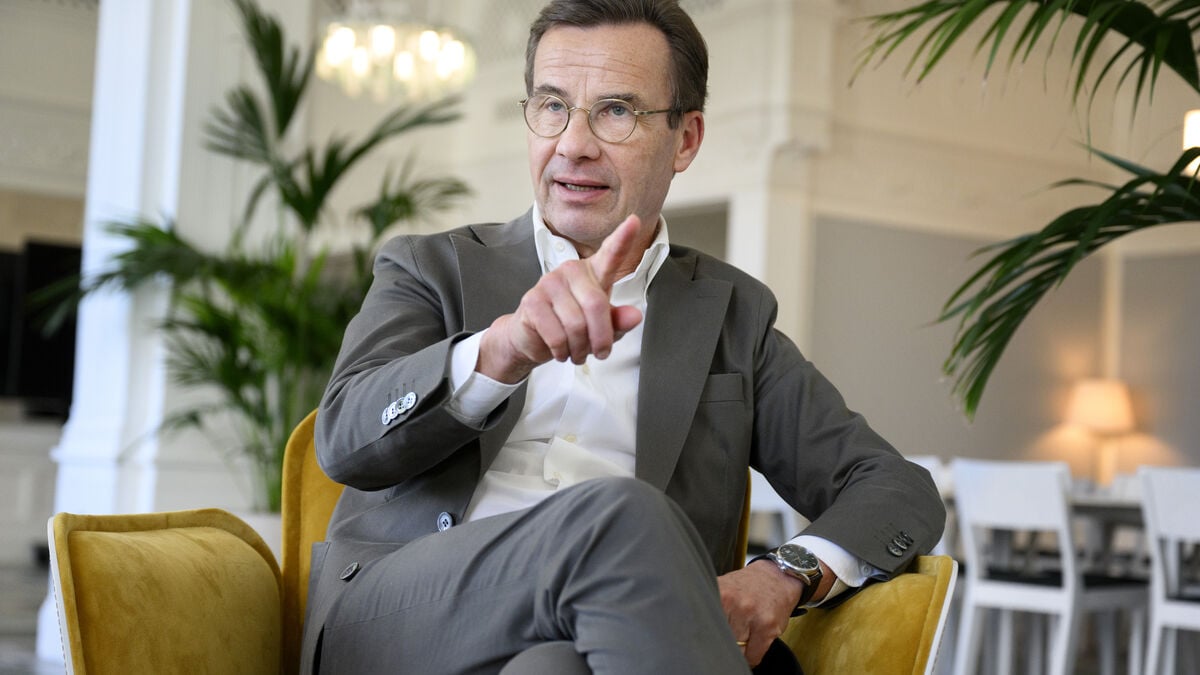
Tidö was explicitly a project for the previous term of office, says Kristersson, now prime minister of the caretaker government, in an interview with TT on Sunday.
We do not have a majority in the Swedish parliament to continue the blue-yellow government formation, he says, referring to a government arrangement in which Kristersson and Liberal Party leader Simona Mohamsson promised SD ministerial posts before the election.
Even though the Tidö side was defeated by a few seats by the four red-green parties, Kristersson still feels like a winner in some sense - the Moderates moved forward and took back the seat from SD as the second-largest party in the Riksdag. And the other two government parties also advanced, and he now sees a majority for bourgeois economic policy in the Riksdag, if the Centre Party is included.
"There is, I think, a fairly substantial non-socialist majority that might be useful for something," he says about what he wants to try if Magdalena Andersson fails.
In that case, it would require the Centre Party to drop its strong opposition to cooperation with the SD and for the SD to consider standing outside a government. But the question is whether that is even conceivable. Deadlocks and red lines do not only exist on the red-green side.
No strange agreements
He does not believe in any new variants of the December agreements (2014) or January agreements.
I think the Swedish people's interest in new strange agreements and agreements is minimal.
But, as he wrote in his resignation application to the Speaker, all parties must be constructive if Sweden is to have a government.
If all the red lines remain, there will be no government at all.
But as constructive as he would promise to let Magdalena Andersson and her budget go, to help her lift lockdowns, he is not. And he does not expect her to do so if, with a deficit in mandates in the Riksdag, he were to let him go to get a government in place.
Only in times of war
And a coalition government, with S and M at the forefront, is only possible in the event of war or the threat of war.
I also said that to Magdalena Andersson the other day when she asked to speak to me - and I really mean it.
In other situations, a coalition government is a poor alternative, according to Kristersson. This is shown by the coalition between the Christian Democratic Union (CDU) and the Social Democratic Union (SPD) in Germany.
It's hard to say that the German government is a good example of getting a lot done.
He does not believe in forming a government as long as the 134 days after the 2018 election. Sweden cannot afford that. Nor does he believe that four attempts at becoming prime minister will fail and special elections will be called.
I base this on the fact that we have not had by-elections in modern times.