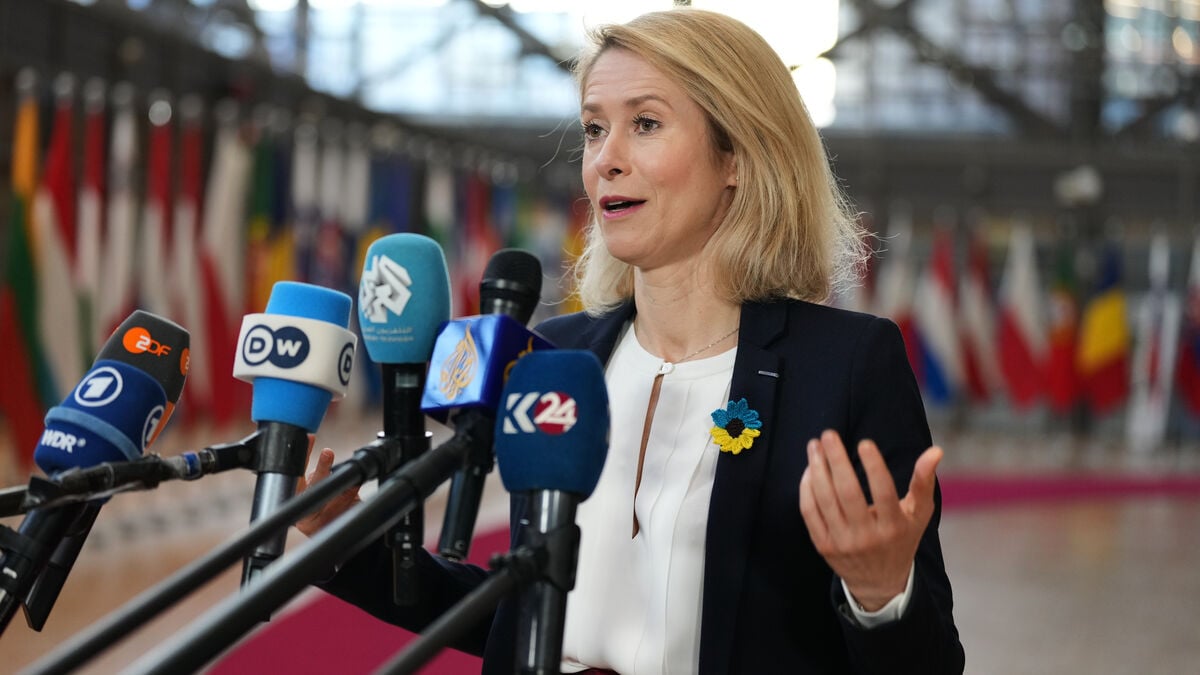
"I truly regret that we could not agree today, in light of the fact that tomorrow is a sad anniversary," Kallas said after the foreign ministers' meeting in Brussels, referring to the fourth anniversary of Russia's full-scale invasion.
That is not in line with the cooperation we should have.
Earlier in the day, Foreign Minister Maria Malmer Stenergard (M) described Hungary's threat to Ukraine support as "a disgrace to Europe" and said that Hungary and Slovakia are engaging in "obstruction."
It is frustrating and embarrassing for these countries.
Release oil?
Plans for the foreign ministers' meeting were put on hold by Hungary and Slovakia's announcement that they were blocking the sanctions decision.
Hungarian Foreign Minister Péter Szijjártó claimed that Kyiv is “pursuing an anti-Hungarian policy” and is risking Hungary’s energy security by not releasing supplies of Russian oil through the Druzhba pipeline.
When Ukraine starts oil deliveries, we can think again. The ball is in their court.
The 4,000-kilometer pipeline runs through Ukraine to Russia-friendly Slovakia and Hungary – the only EU countries exempt from the bloc’s ban on Russian oil imports. Ukraine says the pipeline was damaged in a Russian attack on January 27.
Both Hungary and Slovakia claim that Ukraine is deliberately delaying the repairs, writes Politico.
Kallas is of the opposite opinion. She points out that Russia has destroyed 80 percent of Ukraine's energy facilities.
I can't blame Ukraine for repairing infrastructure that the population needs in minus-25-degree weather for heating and electricity - that they prioritize their suffering population over a pipeline that takes cheap oil to other countries.
Unclear about billion-dollar loan
Hungarian Prime Minister Viktor Orbán has gone a step further, threatening to veto the EU's €90 billion loan to Ukraine over the oil pipeline. The heads of state and government decided on the giant loan in December, but Orbán can still block it as a legal text on the loan must be formally approved by a unanimous council.
"We agreed on this in the Council. If it doesn't work, we can always go back to the frozen (Russian) assets," Kallas said, referring to a previously rejected idea of using frozen Russian funds as collateral for a loan to Ukraine.
Orbán's threat comes despite the fact that Hungary, along with Slovakia and the Czech Republic, has been granted an exemption in the loan model, which means that they are not burdened by the loan to Ukraine.
Facts: EU's 20th sanctions package against Russia
In addition to a total ban on all shipping services related to Russian crude oil (including shipping and insurance), Commission President Ursula von der Leyen's proposal for the 20th sanctions package also includes the blacklisting of an additional 43 vessels from the Russian shadow fleet (making a total of 640 listed).
Maintenance of Russian so-called LNG ships, which are used for gas export, is prohibited.
Furthermore, 20 regional Russian banks are being sanctioned and measures are being taken to prevent certain trading in cryptocurrencies.
An import ban on Russian metals, minerals and rare earth metals is being introduced. And EU countries are prohibited from exporting, among other things, rubber, tractors and cybersecurity services to Russia.
Source: European Commission