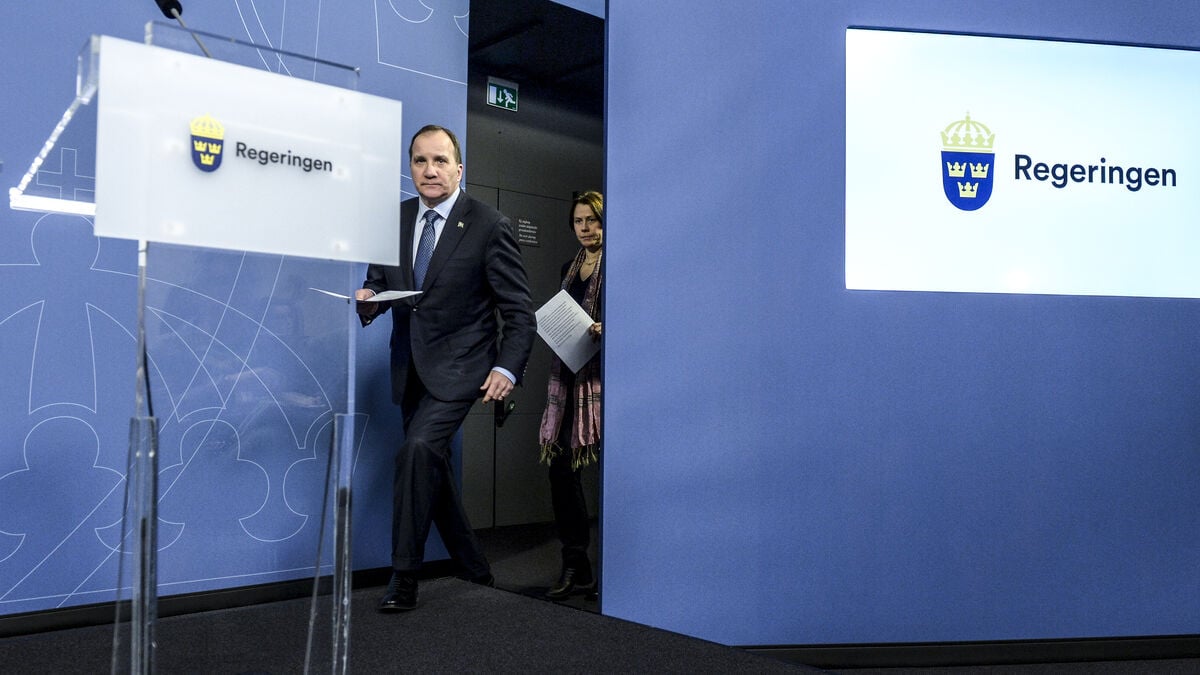
At a serious press conference at the end of November 2015, then-Prime Minister Stefan Löfven (S) and Deputy Prime Minister Åsa Romson (MP) announced that Sweden's asylum rules would be adapted to the EU's minimum level.
The swing was sharp. As recently as September of that year, Stefan Löfven had said in a speech that "My Europe does not build walls." The images of the three-year-old Syrian boy Alan Kurdi, who was found drowned on a Greek beach, had sparked strong reactions around the world that same year.
But during the autumn, the flow of refugees to Europe and Sweden increased significantly. The Swedish Migration Board spoke of an "unprecedented situation".
In November, there were 10,000 asylum seekers a week and municipalities around the country prepared sleeping places in dormitories, tents and hotels.
"Changed quickly"
By the time Sweden tightened its rules, many Western European countries, led by Denmark and the Netherlands, had already begun restricting refugee reception since the late 1990s.
But Sweden resisted and was completely unaffected. All countries changed except Sweden; we carried on in the same tradition as we had always done, says Henrik Emilsson, migration researcher at Malmö University.
It was in the 1960s that migration first became a political issue in Sweden, according to Andrea Spehar, associate professor of political science and director of the Center for Global Migration at the University of Gothenburg.
At that time, labor immigration was being discussed. In the late 1950s and early 1960s, Sweden needed a large workforce to build up the welfare state and the economy.
But in the late 1960s, the trade unions, and partly the Social Democrats, began to politicize the issue, says Spehar.
When the need for foreign labor changed, the arguments were that those who were born in Sweden should instead be prioritized in the labor market.
Not least women, who had not been in the labor market to the same extent before. They also began to discuss various cultural aspects and adaptations, says Andrea Spehar.
The debate led to the rules being tightened. For decades to come, Sweden would have some of the strictest rules for labor immigration in Europe.
This was the case until 2008, when the then conservative alliance, in an agreement with the Green Party, relaxed the rules. An aging population and economic growth in Sweden were cited as reasons for opening up.
International solidarity
However, refugee policy continued to be relatively generous even when labor immigration was tightened.
If you look at the two major refugee crises that have received a lot of attention in Europe, especially the one from the former Yugoslavia and the crisis linked to the war in Syria, you see that Sweden and Germany have in both cases received the most in relation to population size, says Andrea Spehar.
According to her, the fact that Sweden has had a generous refugee policy is partly due to the fact that since the time of Olof Palme there has been an international focus on solidarity toward vulnerable groups.
But it's also about the party-political system, where we have a consensus democracy. Different ideologies must be reconciled.
According to Spehar, the Social Democrats and the Moderates have wanted a somewhat stricter refugee policy since the 1990s.
But they have not been successful with their proposals because parties such as the People's Party (now the Liberals), the Green Party and the Left Party have blocked them, she says.
When it comes to integration policy, Sweden has also stood out internationally.
In international contexts, Sweden has appeared to be very liberal.
There we see a shift toward Sweden not wanting to deviate from other countries; instead, they want to create a negative brand.
In international research, it is called "negative nation branding" when countries try to appear as inhospitable as possible. Andrea Spehar believes Sweden has succeeded in doing so.
There is definitely a reduction in immigration, which has been the main goal of the Tidö Agreement. But at the same time, it is not only the government's merit, it is also about EU policy and the fact that border surveillance has increased enormously since 2016.
SD's influence
After Löfven and Romson's press conference in 2015, politics stood in the balance for a few years, according to Henrik Emilsson.
Among other things, humanitarian reasons were reintroduced into refugee policy, he says.
But when the Tidö parties took over, a profound change in the area began.
"They're trying to change everything. It's not a reform here and there, but a whole battery of changes," says Emilsson.
Refugee reception has been tightened, as has labor immigration; the demands on those who come here have increased, and there are also ambitions to get people to return.
Henrik Emilsson believes that if public opinion previously dragged politics along when it comes to the migration issue, there is now a tendency for the opposite to happen.
Politicians didn't listen to voters for a long time. Now they're even getting ahead of the voters and wanting a more restrictive immigration policy.
According to Andrea Spehar, migration policy is influenced by how different parties politicize the issue - the Sweden Democrats have had the greatest influence on politics over the past decade. But it is also influenced by public opinion.
We have seen this now with the teenage expulsions, that a strong public opinion can make a government back down.