The weather in the Italian Alps was a sigh of relief for Olympic organizers. Heavy snowfall just days before the fires were to be lit silenced the doomsayers, who had feared rain, slush and icy slopes.
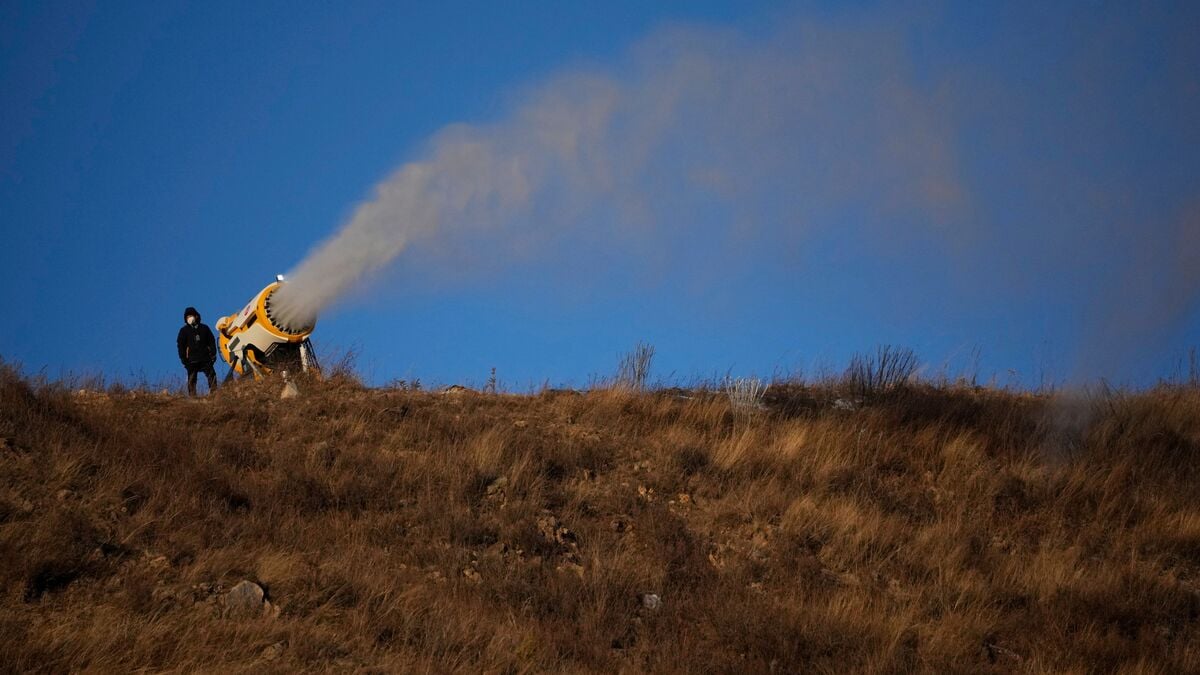
The Alps are warming up faster than the rest of the world. And the snow cannons have been running intensively ahead of this year's Winter Olympics. Ahead of the games, organizers announced that they had produced 1.6 million cubic meters of artificial snow, which is estimated to account for 85 percent of the surfaces for this year's competitions.
"You don't want a white ribbon with green on either side," says Daniel Scott, a professor at the University of Waterloo in Canada, who specializes in the question of what happens to the Olympics in a world with less and less winter.
Less snow
The last time Cortina hosted the Winter Olympics, in 1956, the average February temperature during the decade was -6.3 degrees Celsius. That was almost four degrees colder than today's climate. Of the 21 resorts that have hosted the Winter Olympics, the average temperature has risen by 3 degrees, which has hit snowpack hard.
In Beijing, where the Olympics were held in 2022, almost all the snow has disappeared since the 1950s. In Vancouver (2010) and Pyeongchang (2018), more than 80 percent of the February snow is gone.
In addition to being energy- and water-intensive, some researchers and athletes have pointed out that artificial snow makes the surface harder and faster, which increases the risk of injury. But the heat is an even bigger issue.
"We saw that the risk of injury in Sochi increased six times for snow sports compared to Vancouver. And it wasn't because the athletes were worse off," says Scott.
The courses themselves were challenging.
"But it was very hot and wet. It was like skiing in a slushie."
Previous Olympics at risk?
Last year, Scott mapped 93 ski resorts. Even before 2010, six of them were deemed climatologically unsafe to host. But by 2050, the number had risen by another 35. Just over half - 52 - are deemed safe enough to host an Olympics in February. And for the Paralympics, which will be held in March, only 22 are safe.
Vancouver and Sochi are two uncertain examples, according to Scott. Solutions could include moving the competitions higher up in the mountains, which would mean longer travel from the host cities, as well as even more artificial snow. Another could be to shift the schedule.
"If you bring the Olympics and Paralympics forward by three weeks, it makes a big difference, especially for the Paralympics. The number of reliable locations for the Paralympics almost doubled with that shift."
1964: Lack of snow in Tyrol forced organizers in Innsbruck to call in 2,000 soldiers to transport 25,000 tons of snow from the Brenner Pass.
1980: Artificial snow was used for the first time at a Winter Olympics.
2010: Snow shortage forced organizers to produce 7,960 cubic meters of snow. Helicopters were deployed, as well as 200 truckloads of snow from three hours away.
2014: 80 percent of the snow in Sochi was artificial.
2018: 98 percent of the snow in Pyeongchang was artificial.
2022: Some locations had all artificial snow.
2026: 85 percent of the snow is artificial (1.6 million cubic meters).
Sources: The Guardian, Quartz, The Washington Post, Britannica
TT has used climate data from the EU's Copernicus observation program (ERA5, Reanalysis) to examine how the February weather (when the Winter Olympics are held) has changed from the average of the 1950s to today (2014-2025).
Temperatures have increased in all cities, by an average of 3 degrees. Beijing and Oslo were five degrees warmer.
Snowfall has decreased in all cities except Sapporo, Japan. On average, half of the snow has disappeared, but in Beijing, Vancouver and Pyeongchang, almost all of the snow has disappeared.