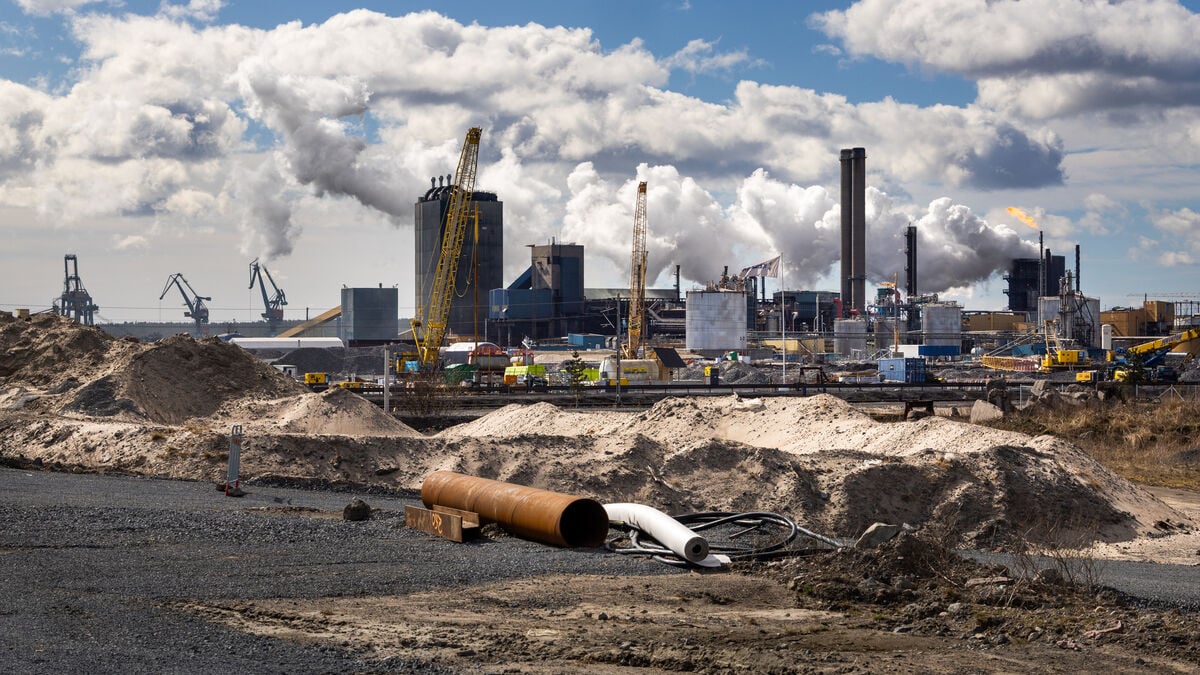
A few lonely foundations rise like bare tree trunks on a giant gravel patch on Svartön. Here, SSAB will build a 1.5-kilometer-long steel mill.
At regular intervals, the coking plant in the background – filled with coal from Australia and the USA – coughs up a large cloud of steam, as it has done since 1975.
It will be a visible reminder of why the new construction is being carried out. The coke oven and blast furnace will be replaced with electricity, which will significantly cut carbon dioxide emissions.
"We came to the conclusion that continuing to invest in old technology from the 60s and 70s was not the right way to go. We could never get that effect in terms of environmental benefit and climate smartness," says Technical Manager Carl Orrling at SSAB, and continues.
Then we decided to build a completely new steel mill and close down the old business.
“Reduced risk appetite”
Svartön in Luleå is central to the green transition in the north. When municipal councillor Carina Sammeli (S) gives speeches, she almost always shows an aerial view of the area.
Investments of almost 80 billion kronor are planned there, to be implemented over the next five years, she says.
Here the railway meets the sea and mining giant LKAB is partnering with SSAB and upstart Stegra, which is building a transshipment and storage facility.
LKAB is aiming for an industrial park for rare earth metals on the island, and the port of Luleå will be able to accommodate large ships with Sweden's largest dredging project. On the other side of the bridge, there are plans for a battery anode factory and an electrofuel plant. But plans for a large fertilizer factory were scrapped last fall.
In recent years, not least with Northvolt's bankruptcy and the rumors surrounding Stegra, the willingness to take risks to invest here has decreased. It was a bit more like Klondike five years ago, says Sammeli.
Danger was felt - alarm raised
Lately, the green vision has been overshadowed. At the beginning of the year, employees at the SSAB site began to suffer from nausea, nosebleeds and headaches. On April 3, all construction work was stopped. At least 24 people have been affected, five of whom have received medical treatment. David Renström usually does construction work in the area. But for now, administrative tasks are the order of the day in the barracks.
It was a bit worrying at first. But I think SSAB handled it well, he says.
David Renström himself raised the alarm when he smelled an almond scent in the area. This could be a sign of potentially deadly hydrogen cyanide.
It took five minutes, then they were there and tested. My impression is that they take it seriously.
No one knows why the workers fell ill. But suspicions are directed downwards. A century of heavy industry on Svartön has left its mark.
"There are major investments being planned now, but it's not the first time that huge investments have been made here. You could say that the investments have been going on in waves since the 1880s," says industrial historian Roine Viklund at Luleå University of Technology.
According to the county administrative board, there is garbage, slag, dredged material, bricks and barrels with unknown contents and, in places, cyanide.
It was not uncommon for companies in the past to bury, or dump into the water, things they didn't want to see, says Viklund.
What is stirred up when excavator buckets go into the ground is hard to say.
"We don't really know anything. There are now a lot of tests going on to clarify what has made them sick," says Renström.
"More aware"
Next door to SSAB's new steel mill is the port of Luleå. Safety coordinator Robert Ridefors shows a gravel patch where a faint smell of petroleum lingers.
This is where two detectors gave a reading for hydrogen cyanide on April 21, causing the port to temporarily close. Ridefors was one of those who, with open windows, drove through the port area with calibrated detectors to investigate the alarm. The instruments react even to very low levels.
"It's not like the moment the gas detector goes off I become seriously ill," he explains.
He feels that everyone is more on their toes after the illness alert at SSAB.
Absolutely, people are more aware and attentive to smells and equipment that set off alarms.
“There is frustration”
So what is hiding in the ground? SSAB says the top layer is blast furnace slag - a glass-like material from iron production, followed by moraine and sand from dredging in the 1970s. Of the total area of the new operations, 10 percent has been classified as contaminated land. As they have worked their way down, new layers have been analyzed. In total, more than 1,700 soil samples have been taken, as well as 160,000 gas tests - without being able to determine the cause.
"It is clear that there is frustration that we cannot connect a cause to these disease symptoms. I can also imagine that for those individuals who are not feeling well, it is a very difficult situation not to get an answer," says Carl Orrling.
Regardless of whether SSAB finds the cause or not, work will eventually resume, but with strengthened procedures if people in the area develop symptoms. However, the Seko union has imposed a safety stop, and Byggnad's safety representative David Renström expresses some skepticism.
I cannot in good conscience start any work if there is no clarity on why we are getting sick out here and guidelines on how to protect ourselves.
At the harbor, Robert Ridefors sees a bright future for Svartön, despite the alarm and the proximity to the SSAB building.
"I'm not worried in the least. What lies ahead of us is, after all, incredibly exciting," he says.
Facts: Black Island
+ SSAB. The steel giant's operations in Luleå account for 3.4 percent of Sweden's total carbon dioxide emissions (11.4 percent of industry's emissions). With a new electric steel mill, the lion's share of emissions will disappear. To be inaugurated in 2028.
+ LKAB. The mining giant wants to build a processing center for critical metals. A demonstration plant is due to be completed this year.
+ Stegra. Building a transport and storage facility to service the steel mill in Boden.
+ Hybrid. A pilot plant for test production of sponge iron is in use, as is underground storage of hydrogen.
+ Luleå Port. Will begin dredging in 2027 to be able to accommodate deep-draft ships all year round.
+ Talga. A factory for anode materials for batteries is to be built on nearby Hertsön.
+ Uniper/ABB. Have plans for an electrolysis plant to produce hydrogen gas on Hertsön.
Svartön is an island in Luleå. Until the end of the 19th century, there were not many permanent residents here. In 1882, construction began on a pier for work on the Malmbanan railway, and the first ore train arrived from Malmberget in Gällivare in 1888. During the first half of the 20th century, some heavy industry was built here and the first sod was laid at Norrbottens Järnverk (NJA) in 1941. During the 1950s, the ironworks were the most modern in Europe.
The booming shipbuilding industry required a lot of steel, and it was decided to build Stålverk 80. To gain land, the space between three small islands was filled with dredged material, making Svartön larger.
But the oil crisis led to a shipbuilding crisis, which in turn led to a steel crisis and the plans were scrapped.
In 1978, SSAB was formed, to which NJA was transferred and modernized.
Source: Roine Viklund, Luleå University of Technology.