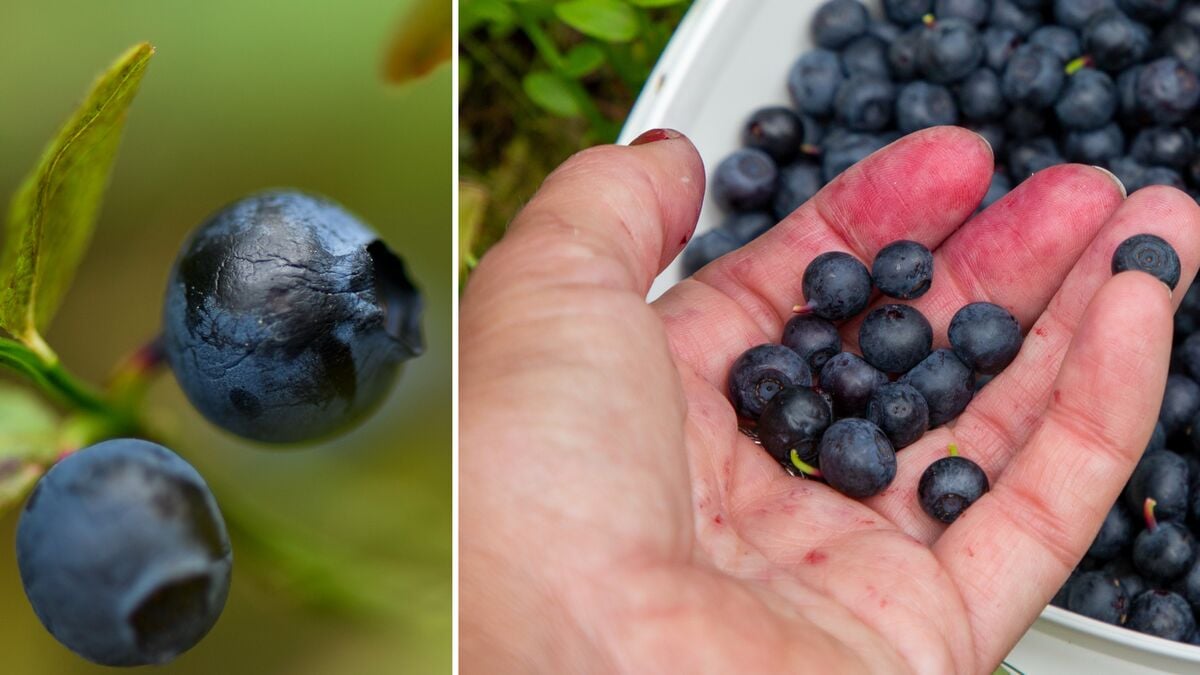
A warm spring and summer heat waves have caused the blueberry season to start earlier than normal. In southern Sweden, the berries have already been ripe for a while and are now also visible further north, according to Ola Langvall, a forestry researcher at the Swedish University of Agricultural Sciences (SLU).
It's getting to be time to go out and pick, he says.
Favourable weather the summer before gives more buds and good prospects for a good blueberry year. But the flowering parts of the plant also have to survive grazing wildlife during the winter - and frosty nights during the flowering period in May and June.
But this year I haven't received any reports of such problems, so the conditions are right for there to be plenty of berries.
Here are the most berries
Due to the dry weather, the blueberries are still quite small, but if it rains they can swell and become larger. They will also become more numerous and sweeter over time.
It takes two to three weeks for most berries to ripen. In central Sweden you can wait another week or so, and in northern Sweden until the end of July or the beginning of August.
Most berries can be found in an older coniferous forest with pine or spruce, where the soil is not too dry, according to Ola Langvall.
Sparse, old forest is good, as the light comes down. But I actually find most berries in young forest, a five- to ten-year-old clearing that has started to come back. It is also light there, which produces lots of flowers and berries.
Good for the intestinal flora
Blueberries are often described as a super berry for health. According to Mai-Lis Hellénius, professor at the Karolinska Institute, the berries are low in calories, rich in vitamins such as vitamin C, and full of fiber in the skin.
"Blueberries are good for the intestinal flora, have an anti-inflammatory effect and positively affect the immune system, thus reducing the risk of infections. They are also packed with antioxidants, which give them their blue color and protect our cells from damage," she says, adding:
All of this can help reduce the risk of common public health diseases, such as cardiovascular disease, type 2 diabetes, various forms of cancer and memory disorders.
In general, Mai-Lis Hellénius wants to encourage using blueberries for more than just jam and pie.
Have a handful a day on your yogurt or porridge, throw them in a salad or mash them into a dressing. But don't forget that there are other berries too.
Blueberries (Vaccinium myrtillus) are a species of the heather family, growing 15–40 centimeters tall. Botanically, blueberries are dwarf trees with a main trunk and branches that form a crown of leaves.
The blueberry plant is common and spread throughout the country. Around 17 percent of Sweden's surface is covered by blueberry bushes.
Blueberries tolerate shade well and grow well on acidic soil in forest and heathland terrain, where the plant lives in symbiosis with mycorrhizal fungi.
Flowering occurs in May–June. The fruit, which is a berry, is black and usually covered with a light blue waxy coating.
Blueberries contain high levels of vitamin C, vitamin K and manganese, as well as high levels of antioxidants.
Forest blueberries are different from American blueberries, which are slightly larger, paler and contain fewer antioxidants. “The blueberries you pick in Swedish forests are a little healthier. But the American ones can be eaten as snacks, they are much better than candy,” says Mai-Lis Hellénius.
Source: National Encyclopedia