Over 400,000 middle and high school students have cast their votes in the 2026 school election, with schools in 90 percent of the country's municipalities participating. Never before have so many voted in a school election, and the turnout of 82 percent is a record high.
It's a large proportion and it also means that this gives an incredibly good picture of how young people actually view politics, says Magnus Jägerskog, Director General of the Swedish Agency for Youth and Civil Society Affairs (MUCF), which has organized the school elections since 2002.
Two trends
The school election was held over two weeks until September 8 and the results show two distinct trends.
There is a very clear leftward shift where both the Social Democrats, the Left Party and the Green Party are increasing. Another trend is that the Moderates are further consolidating their role as by far the largest party among young people, says Jägerskog.
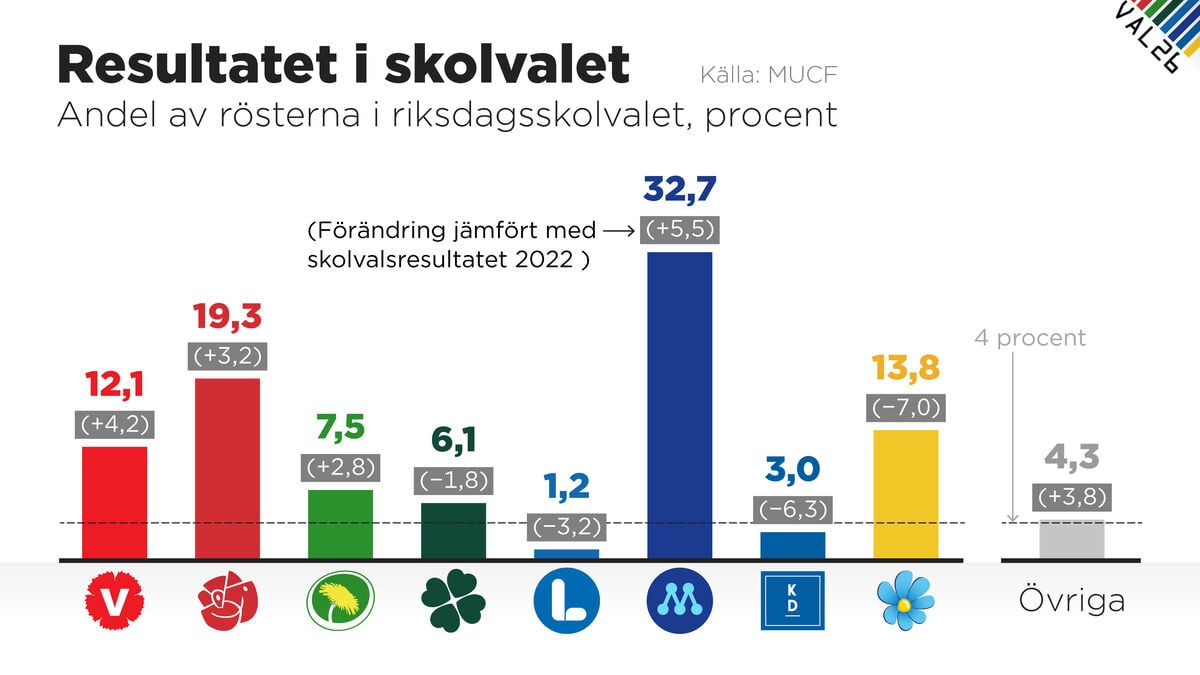
M receives 32.7 percent of the vote, up from 27.1 percent in the 2022 school elections.
S rises 3.2 percentage points to 19.3 percent, V increases 4.2 percentage points to 12.1 percent and MP rises 2.8 percentage points to 7.5 percent.
The Liberals and the Christian Democrats will simultaneously lose a lot from 2022 and both will fall below the threshold. L will receive 1.2 percent (–3.2) and KD will receive 3.0 percent (–6.3). However, the Sweden Democrats will lose the most, down 7.0 percentage points to 13.8 percent.
Reduced block differences
The Center Party is also declining, to 6.1 percent (–1.8).
The Moderates and the Sweden Democrats together are still barely 2 percentage points larger than the Social Democrats, the Left, the Green Party and the Center. And that is the big difference, in the 2022 parliamentary election the right wing was 25 percentage points larger, says Magnus Jägerskog.
Including KD and L, which are below the threshold, increases the gap to around 6 percentage points.
It is also notable that support in the school elections for "other parties" is increasing sharply, up 3.8 percentage points to a total of 4.3 percent. Behind these figures lies primarily the Örebro Party at 2.6 percent, and Alternative for Sweden, which receives 1.2 percent.
Even though the school elections have no impact on the general elections, Magnus Jägerskog emphasizes that it is a major and important democratic initiative among young people. This is especially true when democracy is in decline globally, at the same time as voter turnout among young people fell in the last parliamentary election, he says.
It is important to mobilize and hold conversations about democracy, and for young people to practice casting their votes.