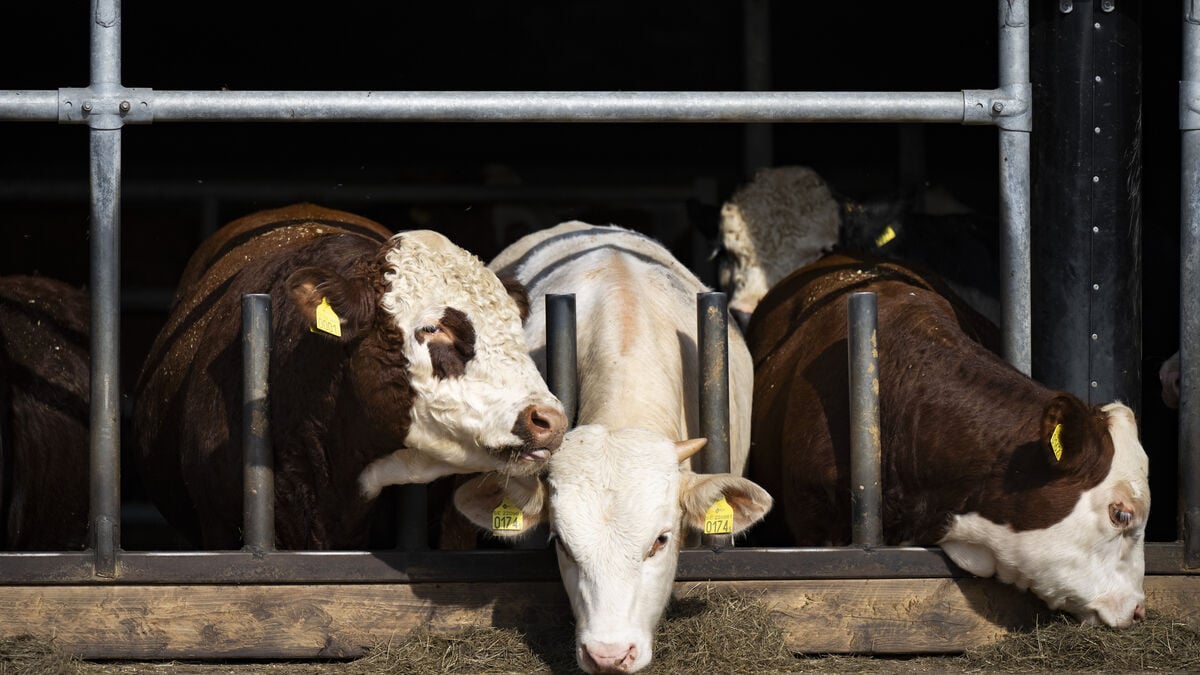
There has long been a shortage of Swedish beef. Production has decreased due to a shortage of both cows and beef producers.
Competition for cows at slaughterhouses has increased, which has led to longer transport distances to collect the animals.
Josefine Jerlström, a researcher at SLU, studies how slaughterhouses can operate to improve animal welfare while also becoming more profitable in a hard-pressed industry.
"Long transports are not good for the animals. We therefore have transport regulations to comply with, which state that they may not be moved for more than eight hours," she says.
Waste from injured cows
Transport has been shown to lead to increased injuries, although the majority of animals that sustain chronic injuries were injured on the farm. An analysis of traumatic injuries, based on over 300,000 cows slaughtered in 2020–2022, shows that just over nine percent of them suffered from chronic injuries sustained on the farm, while one percent accounted for acute injuries, which occur during transport or at the slaughterhouse.
Injuries lead to food waste. Damaged meat accounted for 34 percent (49 tons) of the discarded beef during the period.
"If a cow injures itself, you have to cut away the meat and throw it away," Jerlström explains.
Consequences from summer 2018
The reason for the shortage of cattle goes back to the drought in the summer of 2018. Jerlström says the effects are still visible today: there was a shortage of feed and prices skyrocketed. Profitability decreased for farmers, which led to many being forced to close their operations.
Another aspect is the long rearing period: it takes one and a half to two years before calves born can be slaughtered.
Even though the industry is under pressure, Jerlström sees signs that things are starting to turn around.
"There are glimmers of hope," she says, adding that slaughtering has decreased and that farmers seem to want to keep cows to have more calves.
According to Jerlström, the key to achieving better animal welfare and profitability is having committed management, the right equipment, and creating the conditions for the staff.
"Preventing animals from injuring themselves, both on the farm, during transport and in the slaughterhouse, is one way to reduce waste."
The price of beef has risen significantly in recent years and continues to rise. In 2020, the producer price for beef was 42 kronor per kilo, according to the Swedish Board of Agriculture.
Currently, the producer price for beef is estimated at 94 kronor per kilo.
This is how the producer price of beef (young bull) has risen over time:
2020: 42–46 SEK/kg
2021: SEK 48–50/kg
2022: SEK 54–56/kg
2023: Just over 62 SEK/kg
2024: SEK 63–65/kg
2025: Close to 80 SEK/kg
2026 (in June): 94 SEK/kg
Source: Swedish Board of Agriculture