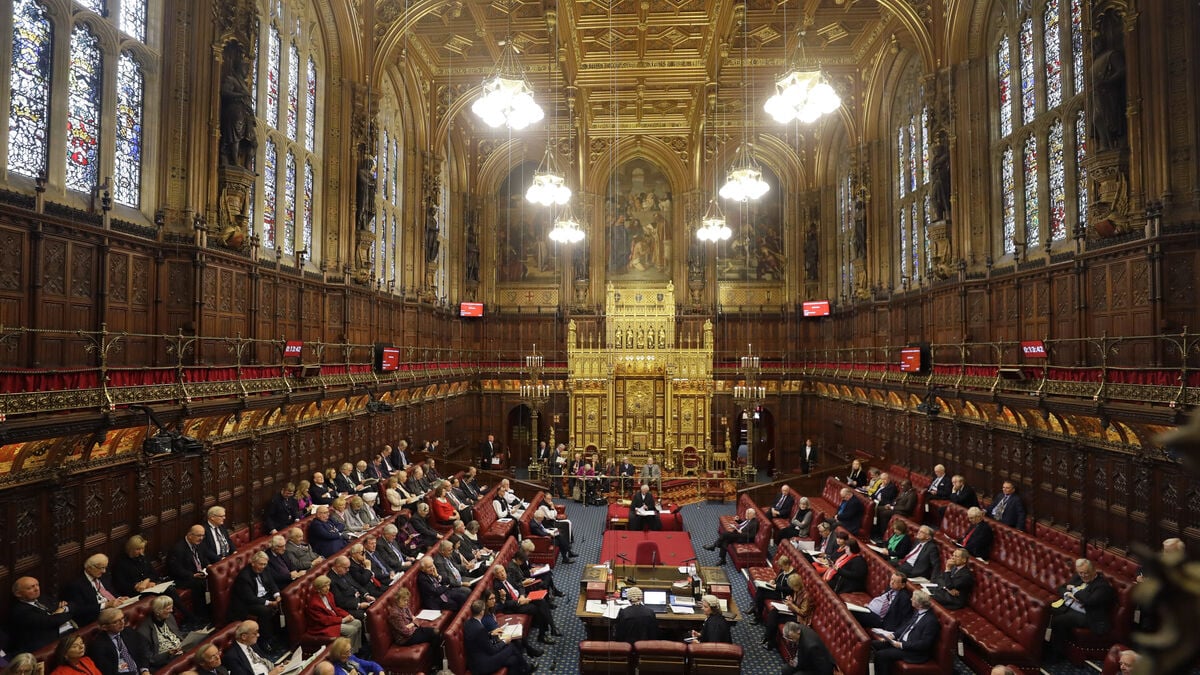
It was the Lords themselves who recently hammered out the law that means the last hereditary seats will disappear. This means that dukes, earls and viscounts will not be allowed to pass their seats on to the next generation.
Inherited seats in parliament have long been criticized as being outdated, but it was Prime Minister Tony Blair who, with a landslide victory in the 1997 election, was able to begin to tear down the old traditions. The resulting law saw the House of Lords shrink from over 1,300 seats around the turn of the millennium to just under 700 at that time.
Delayed until now
But nobles are not easily moved. To get the bill through, Blair’s Labour agreed to a compromise that a number – currently 92 – of hereditary seats would remain until the reforms were completed. And that has been the case until now, despite many agreeing with the current Prime Minister, Keir Starmer, who said in 2022:
I would be surprised if anyone could present even a half-decent argument for inherited nobility.
But there are those who have persistently tried, including Charles Courtenay, better known as the Earl of Devon. He now holds the peerage that has been in the family since the time of Empress Matilda in the 12th century.
Battle of Waterloo
Courtenay believes that the hereditary lords receive undeservedly harsh criticism compared with, for example, other members, who are also unelected.
During an interesting debate about hereditary seats, someone said, "How did they actually get here, the hereditary lords?," he told The Guardian.
And I happened to be sitting next to the Duke of Wellington. It's pretty clear how he got in - there's a picture of him on the wall there, during the Battle of Waterloo.
He refers to the fact that the then Duke of Wellington led the victorious campaign against Napoleon in 1815, and believes that this merit is no worse than the vague reasons why members are appointed nowadays.
How did the others get in here? We don't really know.
300 years in the future
Courtenay argues that with titles, jobs and in many cases possessions that have been passed down for dozens of generations, it becomes easier to think long-term.
I think we have longer time horizons than the rest of the House of Lords. We can look at things 100, 200, 300 years ahead.
He takes the environment as an example.
One problem is that everyone looks at it in terms of returns and political cycles. It's all about five, ten years. But what about future generations? How do we get that into our politics?
“Titles from bygone centuries”
The Earl, whose title roughly corresponds to a Swedish count, is rebuffed by Nicklaus Thomas-Symonds, the Labour Minister with the traditional title of Paymaster General (roughly Grand Treasurer).
"Our parliament should be a place where talent is recognized and merit is counted," he says, according to the AP news agency.
It should never be a gathering place for the old gang of boys, or a place where titles from bygone centuries trump the will of the people.
Women were only admitted to the House of Lords in the 1950s and 1960s. Today they make up about a third of the members. However, none of the hereditary peers are women. The number of members from ethnic minorities is also extremely small.
The Earl of Devon agrees that the group is out of date, but believes that the fault is that the government has not changed the laws governing who is allowed in.
We are only white guys because we are not allowed to be white girls.
Traditions live on
Regardless of gender and ethnicity, time is now up for his almost 900-year-old job. Or is it? The new law has a temporary loophole. All hereditary seats in the House of Lords will be removed when the current parliamentary session ends in May. But sources tell British media that the resistance of the hereditary lords has been appeased with a promise that a smaller number of them will be appointed for life before then.
This means they get "regular" House of Lords seats instead. These are not inherited. But conservative Britons can take comfort in the fact that the centuries-old traditions are still alive, at least with this generation.
The House of Lords is one half of the British Parliament.
The roots go back to the 11th century when the King of England convened the Magnum Concilium ("Great Council").
A few centuries later, parliament was divided into an upper house for the wealthy nobility, and a lower house for representatives of the provinces and cities. The upper house was long the most powerful, but now almost all political power lies with the lower house.
The building in London where they meet, the Palace of Westminster, is almost 1,000 years old. However, it has burned down and been extensively rebuilt and expanded over the centuries.
The number of members of the upper house varies, but is very large by international standards. The only larger parliament in the world is the National People's Congress in China.