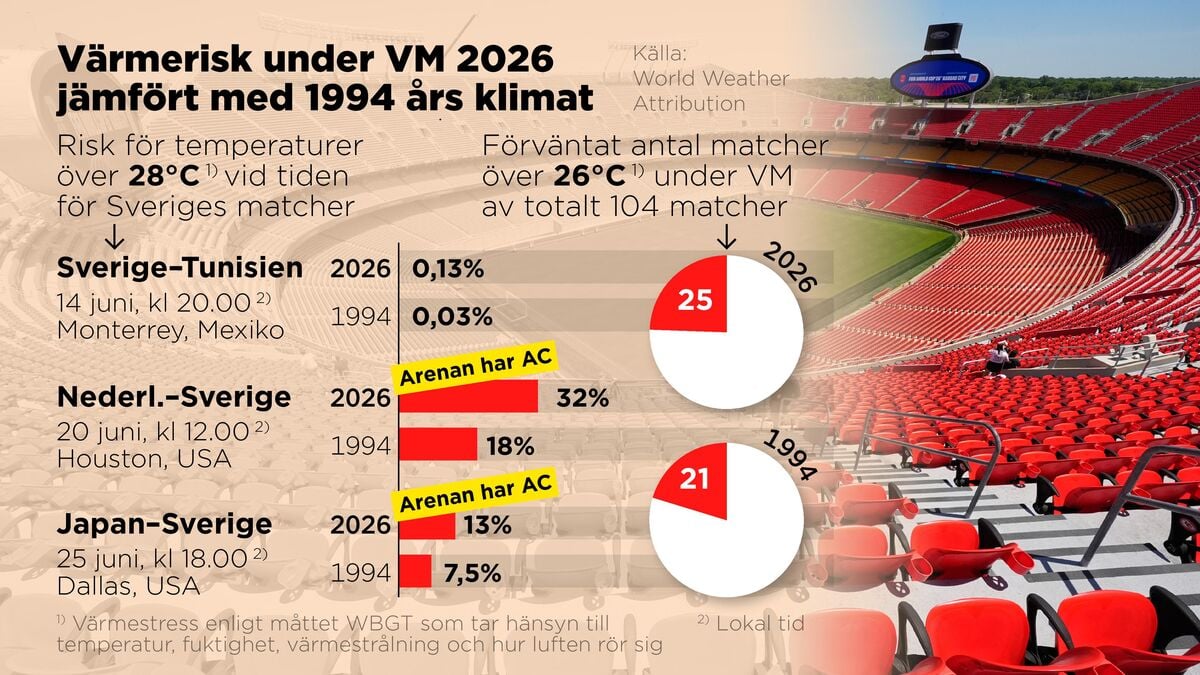
It has been 32 years since the last World Cup was held in North America. A lot has changed in the climate during that period.
More than half of global warming has occurred since then, increasing the risk of dangerously hot matches, said Friederike Otto, professor of climate change at Imperial College London, at a press conference.
She leads the research network World Weather Attribution (WWA), which specializes in assessing how climate change affects extreme weather.
Large increase in risk
Ahead of the World Cup, WWA has reviewed all 104 matches and looked at how conditions have changed since 1994. They have based their analysis on a time-weighted heat index (WBGT), which in this case primarily uses temperature and humidity.
In practice, the measurement indicates how difficult it is for the body to shed excess heat, says anesthesiologist Chris Mullington, who also researches how the body copes with heat stress, at the press conference.
Football players generate a lot of metabolic heat during sprints, acceleration and high-intensity play. As WBGT increases, the body's cooling ability becomes less efficient.
The risk is greatest in Houston, Dallas and Atlanta, where the stadiums are air-conditioned. However, nine games are expected to be played in stadiums without air conditioning in such dangerous conditions that the players' union is recommending that they be postponed.
If the matches at this year's World Cup had taken place at the same locations and dates in 1994, there would have been six matches.
Risk to the audience
The audience, with a wide range of ages and medical conditions, is also affected.
They may also be exposed for a much longer period than the match itself as they will be walking to the stadium, queuing in the sun, visiting fan zones, sitting in exposed areas and travelling home on crowded transport. So when WBGT levels are exceeded, it is important for the whole event planning, not just the pitch itself, says Mullington.
The global temperature increase since 1994 is 0.7 degrees Celsius so far. If emissions continue as predicted, that increase will more than double.
Without adaptation measures, such as cooling infrastructure, shaded areas for spectators, measures for irrigation and air conditioning, summer in the Northern Hemisphere will become even more dangerous for spectators and players, says researcher Joyce Kimutai at the press conference.
Facts: Risk of dangerous heat during the World Cup
The players' union Fifpro has been pushing for stricter guidelines for heat stress based on the WBGT (Wet Bulb Globe Temperature) measurement. WBGT measures not only temperature, but also humidity, heat radiation and how air moves (for example, through wind).
When WBGT is above 26 degrees, cooling breaks should be introduced during matches, preferably 30 minutes into the half, Fifpro believes. When WBGT is above 28 degrees, matches should be postponed until conditions are safe, the union believes.
Heat stress can cause even well-prepared elite athletes to suffer from heatstroke (increased heart rate, confusion, unconsciousness – in the worst case, circulatory collapse with fatal outcome). More common problems are irritability, lack of concentration and judgment, reduced performance, dizziness, nausea, cramps and dehydration.
FIFA has mandatory breaks only when near or above 32 degrees WBGT.
Sources: WWA, Fifpro, Swedish Work Environment Authority