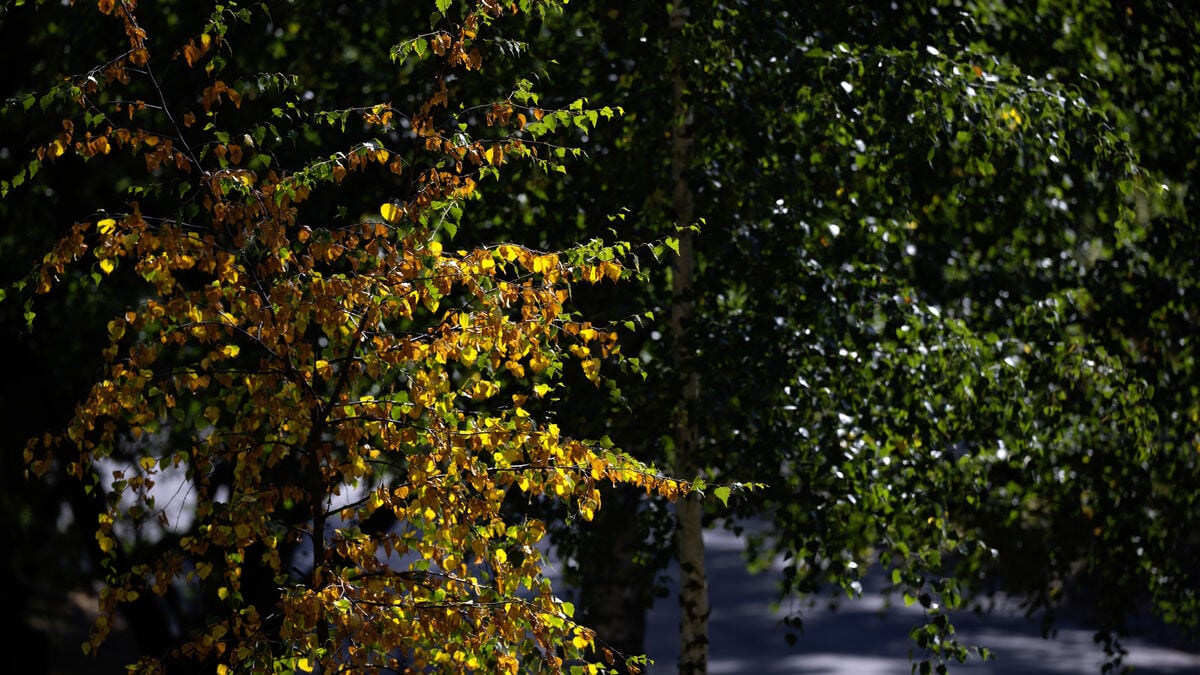
Henrik Sjöman, scientific curator at the Gothenburg Botanical Garden and researcher at SLU Alnarp, says he saw yellowed trees in Österlen a couple of days ago.
Trees lose water through their leaves, and if the soil is too dry, they must quickly shed them. Otherwise, the trees risk ending up in an even worse situation.
"When the tree decides to die, it absorbs the green chlorophyll, which is very nutritious. Then other colouring substances appear that have always been in the leaves, but are not visible because of the green chlorophyll," says Sjöman.
More difficult for birches than oaks
Different trees cope with drought differently and some species are quicker at changing colour.
The birch is one of the first species to act, while an oak retains its leaves and green colour a little longer.
Forest researcher Ola Langvall at SLU shares the view that the drought in southern Sweden is the main cause of the phenomenon, but says that it could also be due to other factors.
For some of the trees, it could be fungus-infected leaves, he says.
Another theory is that leaves seem to have a fixed lifespan, so the early leaf fall this year is causing the leaves to turn yellow earlier. We see a clear tendency for that in our observations of birch, which we have been doing for 20 years now.
Large local differences
Sjöman says that the impact of the drought on vegetation became clear during the extreme summer of 2018.
Then we saw defoliated forest types and that the birches shed their leaves and were completely bare at the end of July.
If the trees had not been short of resources, October or the end of September would be the normal time for the trees to change colour, depending on where in Sweden they are located. It is very local where you see how the trees have been affected by drought.
You can take a short drive from western Skåne, where it is relatively green, and then you come to the eastern side and see that the trees are much yellower because it has been drier and warmer there, says Sjöman.
Yellow colours: The yellow pigment carotene (also found in carrots) is always present in the leaves throughout the summer, but it is hidden by the strong green chlorophyll. When the tree pulls in the chlorophyll to shed the leaf, the yellow colour “steps” forward.
Red colours: The red pigment is not present in the leaves from the beginning in the same way, but is formed through a chemical reaction controlled by temperature. It occurs when there are hot days combined with sharp temperature drops and cold nights (when the difference between day and night is between 10 and 15 degrees).
Source: Henrik Sjöman, scientific curator at the Gothenburg Botanical Garden and researcher at SLU Alnarp.