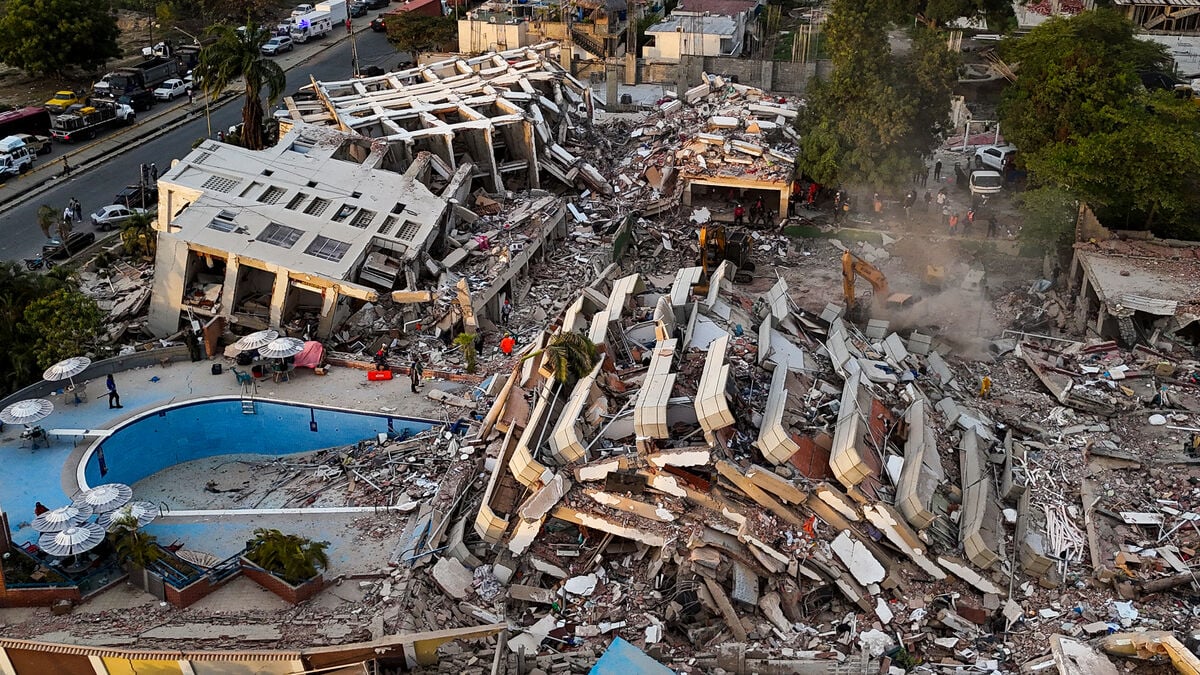
Since June 7, when a magnitude 7.8 earthquake struck Mindanao in the Philippines, five more earthquakes with a magnitude of over 7 have occurred. The twin quakes in Venezuela on June 24 were the most catastrophic, followed by 7.3 quakes off Mexico on July 17, 7.4 in Colombia and 7.7 off Flores in Indonesia.
Usually, about 15 earthquakes of that strength occur per year, but in 2010 there were 24 and in 2017 almost six months went by without a single one.
There is a somewhat random variation in how often they occur, says Björn Lund, a seismologist at Uppsala University.
What stands out about this year's earthquakes is that an unusually large number of them occurred in populated areas, leading to great devastation.
Clear variations
Earthquakes occur when tectonic plates, which are in constant but slow motion, get stuck and tangled together. The stresses build up to a point where they eventually rupture, leading to rapid movement - an earthquake.
Some seismologists have wondered whether the quakes come in clusters, but with the exception of aftershocks, those theories have not been proven.
Björn Lund takes the gigantic earthquakes of over 9 as an example, of which there were some during the 1950s and 1960s, followed by a lull until the Monday earthquake in 2004.
There have been clear variations. We are trying to understand how and when these really big earthquakes can happen, where such large parts of the plate boundaries move at once. But the understanding of these processes is in its infancy.
Can shake loose
The fact that there are tremors in Latin America and Southeast Asia relatively close in time is a coincidence, according to Lund.
An earthquake in Venezuela does not affect the plate over in Indonesia. It is far too far away for the actual movement of the plate to matter.
If the distances are shorter, the seismic waves from one earthquake can trigger another earthquake.
These are the kinds of things you see, for example, in the double earthquake in Venezuela, where one thing shakes the other loose, he says.
But when, for example, a month has passed between the earthquakes in Venezuela and Colombia, it is more uncertain. It may be that the earthquake in Colombia was building up, and that the waves from the Venezuela earthquake caused it to occur earlier.
It's more difficult to calculate.
Facts: Several strong earthquakes this year
February 22, off Kota Belud, Malaysia, 7.1.
March 24, off Tonga, 7.5.
March 30, off Vanuatu, 7.3.
April 1, off Bitung, Indonesia, 7.4.
April 20, east of Miyako, Japan, 7.4.
June 7, south of Mindanao, Philippines, 7.8.
June 24, double earthquake in Venezuela, 7.2 and 7.5.
July 17, off the southern coast of Mexico, 7.3.
August 10, Colombia, 7.4.
August 14, off Flores, Indonesia, 7.7.
Source: USGS