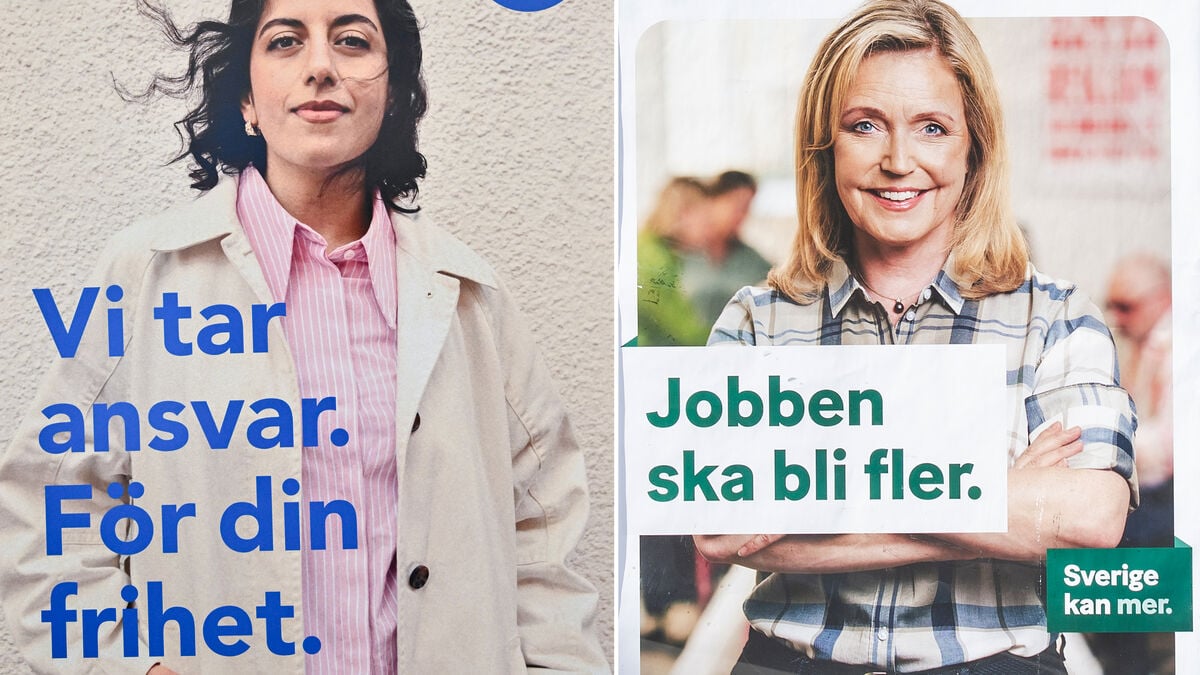
Four to five weeks before the election, the parties are allowed to start putting up this year's election posters - a ritual that is over a hundred years old and is very much alive.
It is a strong tradition that is important for the parties to rally around. In many places in big cities, there is even a bit of a fight for the spots, says Nicklas Håkansson, associate professor of media and communication studies at JMG in Gothenburg.
Much other advertising is relatively easy to defend against, but election posters in public spaces are more difficult to avoid, he adds.
Early election posters were often cartoonish, sometimes with longer texts from party platforms. Today's advertising is more streamlined and "intended for quick consumption," according to Håkansson.
It's quick messages, a short slogan, an image that counts. It's also more obvious that we see the party leader on the posters. It's person-centered in a different way than 50 years ago.
Difficult to measure effect
Political attacks or hateful images of opponents are, however, unusual, says Nickas Håkansson, adding that a good poster from the parties' point of view makes people follow the rest of the campaign.
It is probably not safe to assume that election posters are there to make people change their minds, it is difficult to trace such effects to specific campaigns. There is much evidence that they have more of a reminder function, "the election is coming soon - here we are".
“More important than ever”
The country's three largest parties show no signs that the importance of posters has diminished. The Moderates will put up around 20,000 this year, at least as many as in the last election.
"With a record number of undecided voters this year, election signs are more important than ever. For us, the election is about whether effort will pay off and crime will be punished – and that's what our signs say," says election manager Martin Borgs.
For the vast majority of people, the election campaign begins when the election signs go up. It's a bit like the premiere of a crayfish, he adds.
“Keeping the election pulse up”
The Social Democrats are also investing as much as before – with the message "Time to take Sweden seriously" – and point to the importance of the posters when fewer and fewer people follow traditional news media.
In this way, they can contribute to a high voter turnout. They also become internally mobilizing, keeping the election pulse up, says party secretary Tobias Baudin.
The Sweden Democrats, with the message "We make Sweden Sweden again," also see the posters as an important part of the campaign.
"Compared to previous elections, we are investing more than ever in different types of campaigns, where election posters are only a small but important part of our election campaign," writes SD's press department.
On Sunday, September 13, 2026, there will be elections for the Riksdag, regional and municipal councils.
The rules for election posters differ around the country. Along public roads outside urban areas, the county administrative boards have decided on permits and conditions. In some counties, posters may be put up from five weeks before the election (August 9), while others allow posters from four weeks before the election (August 16).
In public places, permission from the Police Authority is usually required, and municipalities may have their own rules for where posters may be put up.
For example, election posters may not be placed along motorways, expressways, single-lane roads or on bridges over such roads. They may also not be placed on curves, roundabouts or in other places where they may obscure visibility.
The posters must be taken down by September 20th and the parties are responsible for ensuring that they do not cause littering.
Source: County Administrative Board