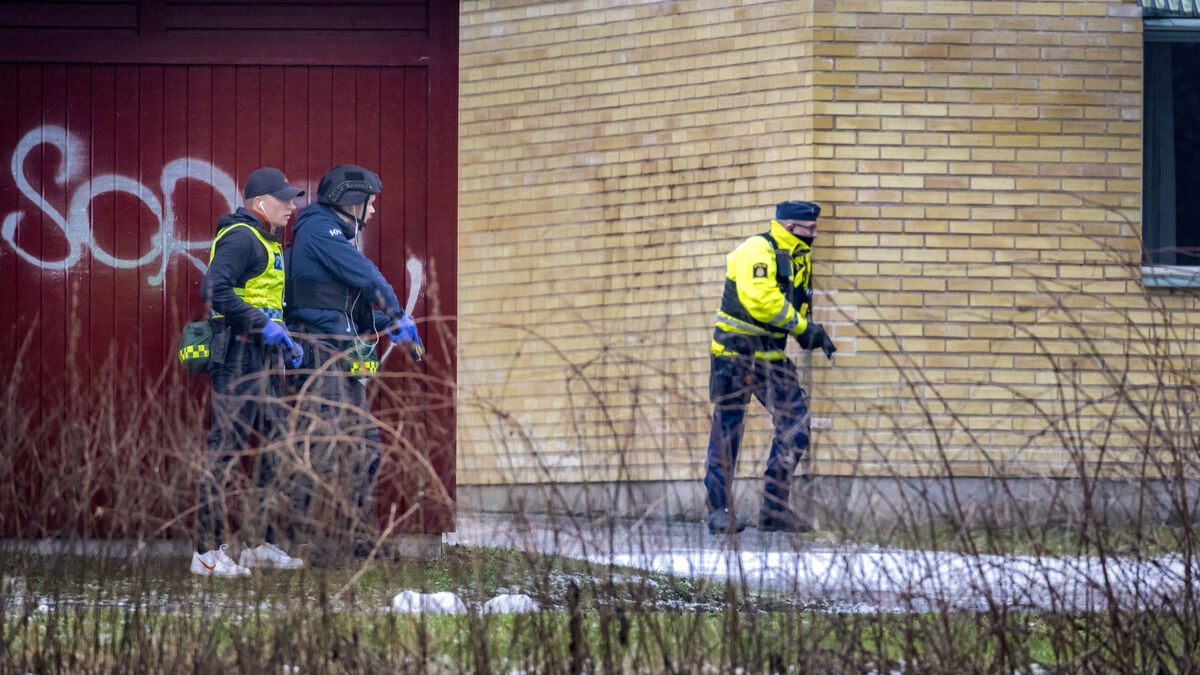
Ten people were killed and six people were injured when 35-year-old Rickard Andersson opened fire inside Campus Risbergska on February 4 this year. After a confrontation with the police, he took his own life.
The school shooting, which was the first in Sweden and the worst mass murder in modern times, caused great concern around the country.
Information regarding concerns for individuals increased rapidly at first, in direct connection with the attack, and then it continued for a number of weeks, says Andreas Salsborn, coordinator at the police for the so-called Redex collaboration with the Security Service.
Intelligence cooperation targets violent extremism, including potentially lone perpetrators who also plan violent acts in school environments.
Bad stomach feeling
Redex works, among other things, to support local police areas with analyses and assessments of incoming alarms and tips, and contributes with suggestions for operational measures.
"It's very much about supporting local police areas in their preventive and deterrent work. Our focus is that intelligence should lead to operational measures to the greatest extent possible," says Andreas Salsborn.
Even though it has been almost ten months since the attack in Risbergska, the level of anxiety in the country remains at a historically high level, which is reflected in the number of reports reaching the police. This can be anything from a person writing things online or saying something in a classroom, to a counselor having a bad feeling, according to Salsborn.
There are no clear statistics on how many alarms or tips result in criminal investigations, but it is far from all. Most often, you can work with other efforts than a police investigation to reduce the risk of violent acts.
But the fact that we have so many young people expressing themselves in this way is extremely serious, says Andreas Salsborn, who emphasizes that in principle in all cases these are people who are feeling very bad.
These are people who have lost hope and trust in the outside world and in those around them.
Bullying clear motive image
It is not uncommon for bullying to be involved, which is evident both in research and in the cases that Redex receives information about.
The experience of bullying is extremely common when looking at the subject image. So successful work against bullying has very positive effects on that issue, and of course on a variety of other issues as well.
However, not everything reaches the police. If it is not considered an emergency case, you can contact the support team at the Center for Violent Extremism (CVE), which is tasked with supporting preventive work against school attacks.
One of the most important preventive measures that we highlight is to have the conversation with the student and to do it early, says Marcus Hjelm, advisor at CVE.
CVE has developed a method support for how to act when concerns arise about a student. It contains examples of how to talk to guardians, collaborate with colleagues, but also direct questions to ask the student.
Methodological support can be used to build trust and a relationship, to create a good conversational climate so that people can approach it in this way: "But why are you showing pictures of executed people? Why are you writing that you should do this or that?".
Try to understand
As long as the student talks, it's fine, says Hjelm.
Then the student will say things that you find both scary and disgusting, but then you are prepared for it and try to understand what this is about?
In several cases where we have intervened early and managed to understand the problem, we have been able to act on it in a good way, according to Marcus Hjelm.
And when you haven't stepped in, it's gotten worse. There's a clear line there, he says.
The difficult thing about a person like the perpetrator at Campus Risbergska is that he had left the school environment and had few contacts with society at large. The risk of such a person going under the radar is of course greater, according to Hjelm.
–Being 35 years old and not being part of another context, then you are more invisible. It highlights the need to have an open mind on these issues, and to also consider adult education, he says.
Swedish and international research on violent extremism and school attacks has identified several individual factors that are believed to increase the risk of a person being radicalized into a violent environment or committing a school attack:
Young men in their teens and 20s are overrepresented in violent environments and school attacks
Previous exposure to or perpetration of violence/abuse
Strong interest in weapons and glorification of violence as a means to achieve political or personal goals
Mental illness and neuropsychiatric disabilities can be vulnerabilities, but must be seen in the interaction with other risk factors
Unemployment or failure to complete school/higher education
Perceived or actual political/social exclusion
Past crises and trauma
Destructive family relationships, such as physical/mental abuse, financial vulnerability
Friends/acquaintances who are active in violence-prone environments
Lack of social relationships
Perceived friendship with former perpetrators, such as the two teenagers who carried out the school massacre at Columbine High School in Colorado, USA, in 1999
Source: Center for Countering Violent Extremism (CVE)