Last year, 152 applications for exploration permits were submitted to the decision-making body Bergsstaten, a slight decrease compared to 2024 (159). At the same time, there are currently just over 800 exploration permits.
Although that number has increased significantly over the past decade, the government, led by Minister of Industry and Trade Ebba Busch (KD), has sought to change the environmental assessment system in order to achieve a faster permit process.
Nonsense from little clowns
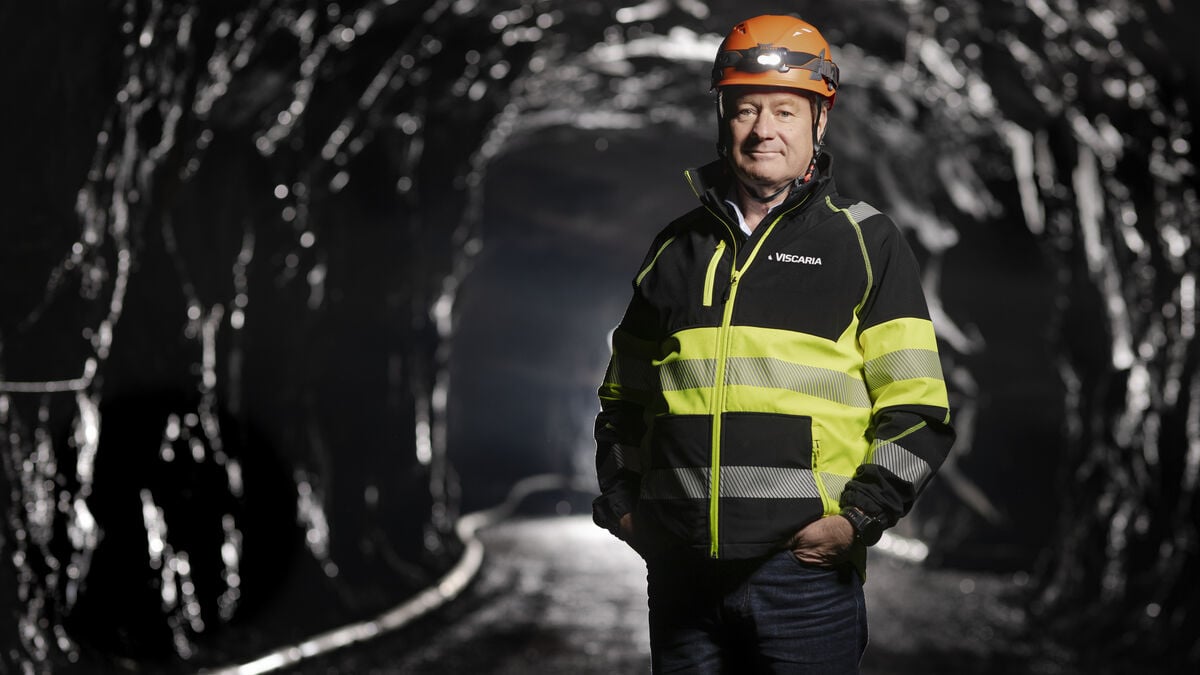
However, Viscaria CEO Jörgen Olsson is taking a hard line against voices that want a simplified process for economic reasons.
"I think a lot of it is nonsense from little clowns who think it should be easy to open a mine. The ones who complain are those who can't afford to apply for a permit or run this kind of business. Then I say they should open a hot dog stand instead," he tells TT.
In Viscaria's case, the company applied for a permit in the spring of 2022. Three years later, in April 2025, it received the green light and, according to Jörgen Olsson, the permit application alone cost 120 million SEK.
"You get a mining permit to mine and ravage the land for 25 years. It is an environmentally hazardous activity; you destroy open nature and release metals and water. It will cost a lot of money because it is irresponsible to say that it will be much easier," he believes.
The Viscaria mine is located next door to LKAB's iron mine in Kiruna and has been closed since 1997 when the then owner, Finnish Outokumpu, closed down operations due to, among other things, low copper prices.
Now, almost 30 years later, the reality is completely different. A couple of weeks ago, the price of copper passed $13,000 per ton for the first time as copper is in demand for everything from AI infrastructure to green transitions such as electric cars and wind turbines.
The hope is that 2029 will be the first year that the Viscaria mine is in full production. Jörgen Olsson hardly sees any reduced demand for copper in the future, quite the opposite.
"I've actually believed in this copper price since 2020. We have a much smaller supply today than demand; a global deficit."
Decreasing copper levels
Jörgen Olsson also highlights another aspect. In the world's more than 700 mines, copper grades are falling at the same time as a globally growing middle class is driving up the price of copper.
Doesn't it feel shameful that the mine is not in operation now when demand is so great?
"It is what it is. I am not particularly concerned about the future price of copper. As long as we do not get into a third world war, then the price of copper will plummet."
"Everything you've touched today, your clothes, your bed, sheets, your floor, indirectly contains copper because it is made with modern infrastructure and machinery. There is not a machine in the world that does not have copper in it."
Last fall, the company signed a letter of intent with German copper recycler Aurubis, which will cover approximately half of the mine's production. Jörgen Olsson links previous challenges regarding loan financing from the Swedish side to the crisis in Northvolt, which at the time had Viscaria in the barrel.
"When Northvolt went downhill, there was extremely high risk aversion among Stockholm's financial institutions; it froze solid," he says.
A total of six billion kronor is needed. After a new share issue last autumn, the company intends to obtain the final loan package of approximately four billion kronor by the summer.
"I am old and experienced; nothing is guaranteed, but I am not worried. I respect the challenge," says Jörgen Olsson.
The Viscaria mine west of Kiruna was first put into operation in 1983 by LKAB, which initially mined the copper ore. In 1985, the operation was taken over by the Finnish company Outokumpu, which chose to close the mine in the late 1990s due to, among other things, falling copper prices.
The mining company Viscaria now intends to reopen it and received approval from the Land and Environmental Court at Umeå District Court in May 2024.
So far, SEK 500 million has been invested in a water treatment plant.
The mine deposit is divided into four zones and extends four kilometers horizontally. Vertically, ore bodies have been mapped down to a depth of 800 meters.
The assessment is that many former mine shafts can be repaired and reused.