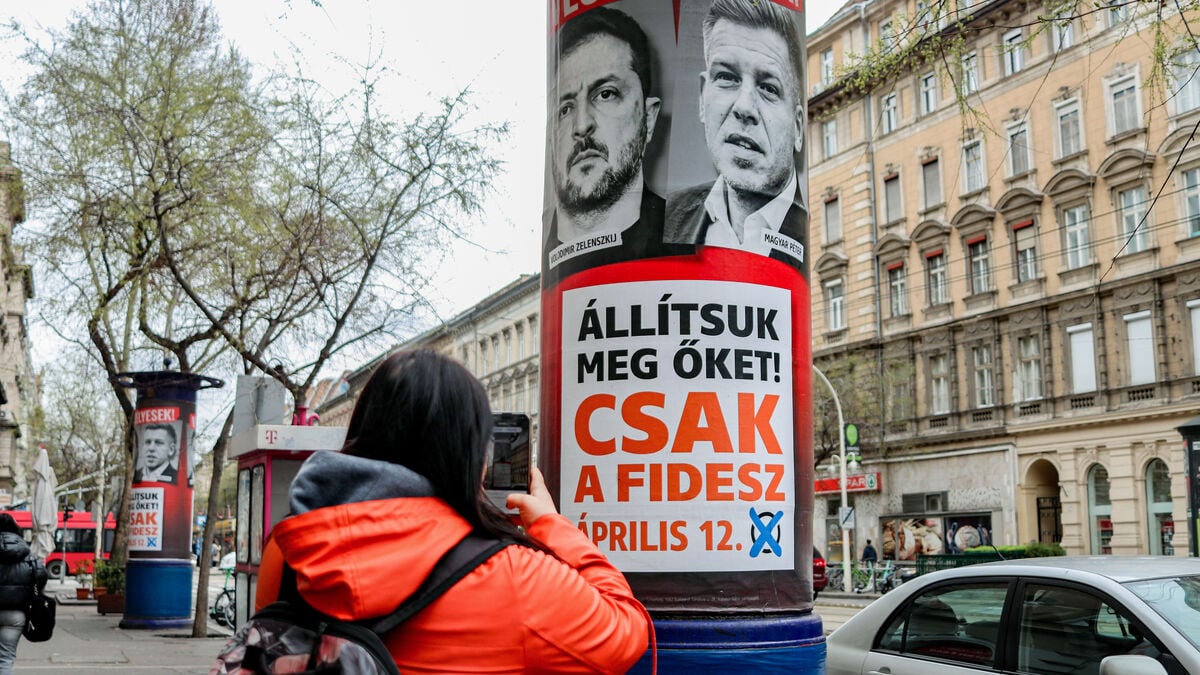
Budapest is cold and gray. Nataliya Savchenko buttons up her padded raincoat and pauses in front of an election poster. A stern Volodymyr Zelenskyy in black and white stares out across the street, side by side with Hungarian opposition leader Péter Magyar. “Dangerous! Stop them!” it says, followed by a call to vote for the ruling Fidesz party in the April 12 election.
"I try not to care," says Nataliya Savchenko.
In Budapest, Ukraine's leader appears on more posters than Hungary's. Ukraine has become a pawn in Orbán's election campaign, with Zelenskyy as the enemy who will take Hungarian money and send Hungarians to die on the battlefields in the east.
“Needs everything”
A half-hour walk away, Pastor Márta Bolba drinks lukewarm peach tea at the Dévai Fogadó support center, a gathering place for Ukrainian refugees. Women with bright voices flutter between the rooms of the converted shoe factory. Behind one door, an elderly couple is receiving counseling, behind another, an English lesson is being held. A woman sorts donations that have been scrubbed clean: rubber boots for little feet, summer dresses in cheerful colors.
They need everything, says Márta Bolba.
Dévai Fogadó receives no support from the state. It is part of Orbán's agenda, she claims: to starve out the non-profit organizations that highlight the suffering caused by the state. When asked how the Ukrainian refugees are received by the state, Márta Bolba responds by referring to the election posters on the street outside.
Fidesz builds its power on hatred and xenophobia. The Ukrainians who come here experience their people being dehumanized and humiliated.
The children decided
Nataliya Savchenko arrived in March 2022, barely a week after the full-scale Russian invasion. It was her second escape since 2014, when her hometown of Sloviansk in Donetsk was taken by armed forces with close ties to Russia and she made her way to Poltava. There were no children to consider then. Six years later, her three-year-old daughters made the decision.
One of the girls was so afraid of loud noises, she says.
So life was squeezed into a backpack. The twins each had to choose a toy to bring. One chose the “worst ever,” according to Nataliya Savchenko: a battered stuffed animal that, with a child’s logic, had to be saved from the war.
The first time in Hungary, near Gyöngyös, eighty kilometers east of the capital, was difficult. Many villagers were influenced by government propaganda, she says.
It's a huge difference living in Budapest compared to the countryside. There, they have a certain image of foreigners... They weren't nice at all.
No government support
She tells the story of the worst incident: when one of her daughters was denied treatment after a fall on the playground.
She was little then, maybe four, and at the hospital they refused to even look at her. We went to another city and had an X-ray. Her shoulder was broken.
Today the situation is different. Life in Budapest is good and the people are helpful. Nataliya Savchenko works two jobs and the twins speak Hungarian so well that they have to act as interpreters for their mother at the grocery store and at the doctor's.
She makes a clear distinction between the Hungarian people and the government. When asked what support she has received from the state, the answer comes quickly.
Nothing. I have received help from organizations, but not from the state.
After the outbreak of war in Ukraine in 2022, hundreds of thousands of Ukrainians came to Hungary, but few stayed.
Many left after August 2024, when Viktor Orbán’s government cut off the right to subsidized housing for refugees from “safe” areas in Ukraine. Overnight, thousands were left homeless and forced to move on or back to Ukraine. However, according to the EU and the UN, no Ukrainian regions can be considered safe.
At the end of 2025, just over 65,000 refugees from Ukraine were living in Hungary, according to the UN refugee agency UNHCR. The vast majority of them have so-called temporary protection status, according to a survey published by UNHCR in February 2026.
The survey shows that many Ukrainians in Hungary live in difficult economic conditions, with 38 percent stating that their income is not enough to cover basic needs.
Two out of five households report receiving financial support from the Hungarian state. The average support is the equivalent of just over 800 kronor per month.
Source: UNHCR, Hungary: Socio-Economic Insights Survey 2025