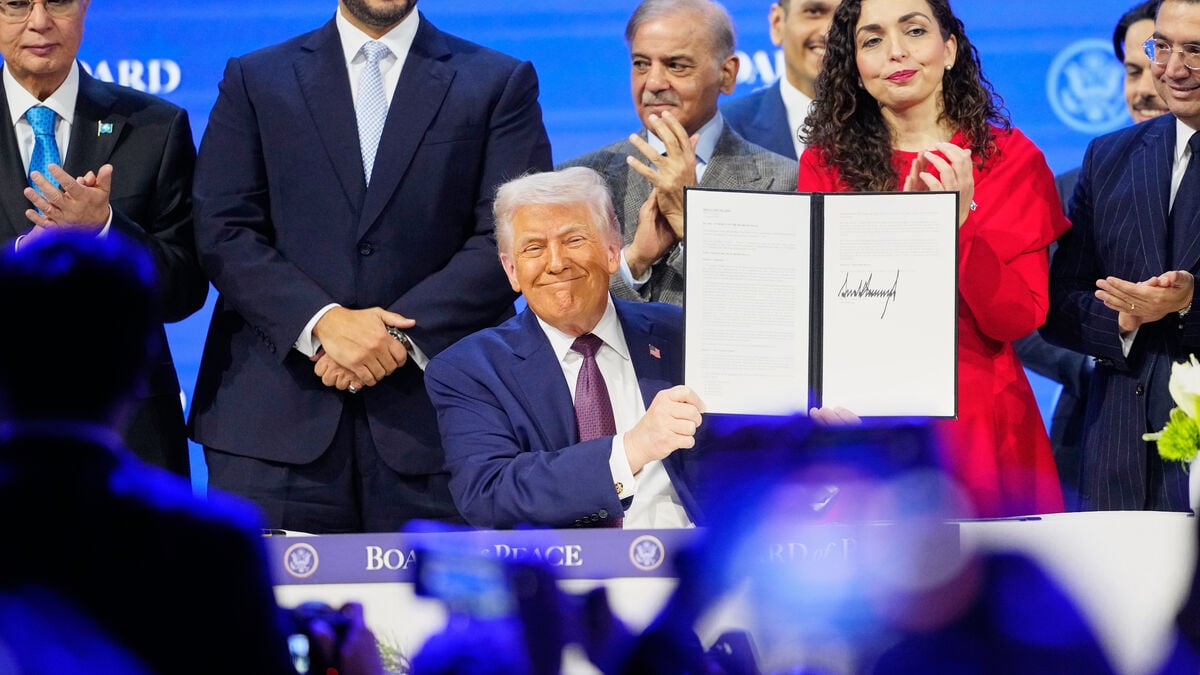
What is the idea of the peace council?
The Peace Council was created to monitor the ceasefire between Israel and Hamas and oversee the reconstruction of war-torn Gaza. In November last year, the council received the support of the UN Security Council in a resolution, giving it an international mandate and legitimacy.
But the charters that the US has circulated in recent days do not mention Gaza. Instead, they speak of a broader mission aimed at promoting stability and securing lasting peace "in areas affected by or threatened by conflict."
An underlying assembly, called the Gaza Executive Council, is instead responsible for the future governance of Gaza.
Who is involved?
The Peace Council is chaired by US President Donald Trump, who has lifelong membership and veto power over all decisions.
The list of invitees is long and includes some 60 countries. At a ceremony in Davos on Thursday, representatives of some 20 countries signed the council's letter of intent. Among them were Hungary, Turkey, Indonesia, Azerbaijan, Saudi Arabia, Qatar and Kosovo.
According to Trump, Russian leader Vladimir Putin and Israeli Prime Minister Benjamin Netanyahu - both wanted for war crimes by the International Criminal Court - have also agreed. The major powers China and India are said to be hesitant.
Several have more or less definitively refused: Sweden, Norway, the UK, Germany, Italy, Slovenia and France. France's refusal prompted Trump to threaten 200 percent tariffs on French wines and champagne.
How much does it cost?
Membership is free and valid for three years, but can be extended by Trump.
However, those who want a permanent seat on the council must pay a sum of one billion dollars, equivalent to just over nine billion Swedish kronor, in the first year.
It is unclear how much control Trump will have over that money.
New UN?
The Peace Council is clearly designed as a challenger to the UN, critics say. Trump has long accused the UN of being ineffective, wasting money and having an overly liberal, “woke” agenda.
The statutes emphasize “the need for a more flexible and effective international peacebuilding body” and the importance of “departing from methods and institutions that have too often failed.”
"Many are quite concerned that this is the US government's attempt to replace the power and legitimacy of the Security Council," UN analyst Maya Ungar at the International Crisis Group told ABC News.
Especially since it gives Donald Trump basically unilateral veto power over all decisions made by the Council.
In connection with Thursday's signing ceremony, Trump claimed that the council should cooperate with the UN.
Donald Trump, President of the United States (Chairman)
Marco Rubio, US Secretary of State
Steve Witkoff, US Middle East envoy
Jared Kushner, Donald Trump's son-in-law
Tony Blair, former British Prime Minister
Marc Rowan, CEO of the venture capital firm Apollo Global
Ajay Banga, President of the World Bank Group
Robert Gabriel Jr., US Deputy National Security Advisor
Source: White House