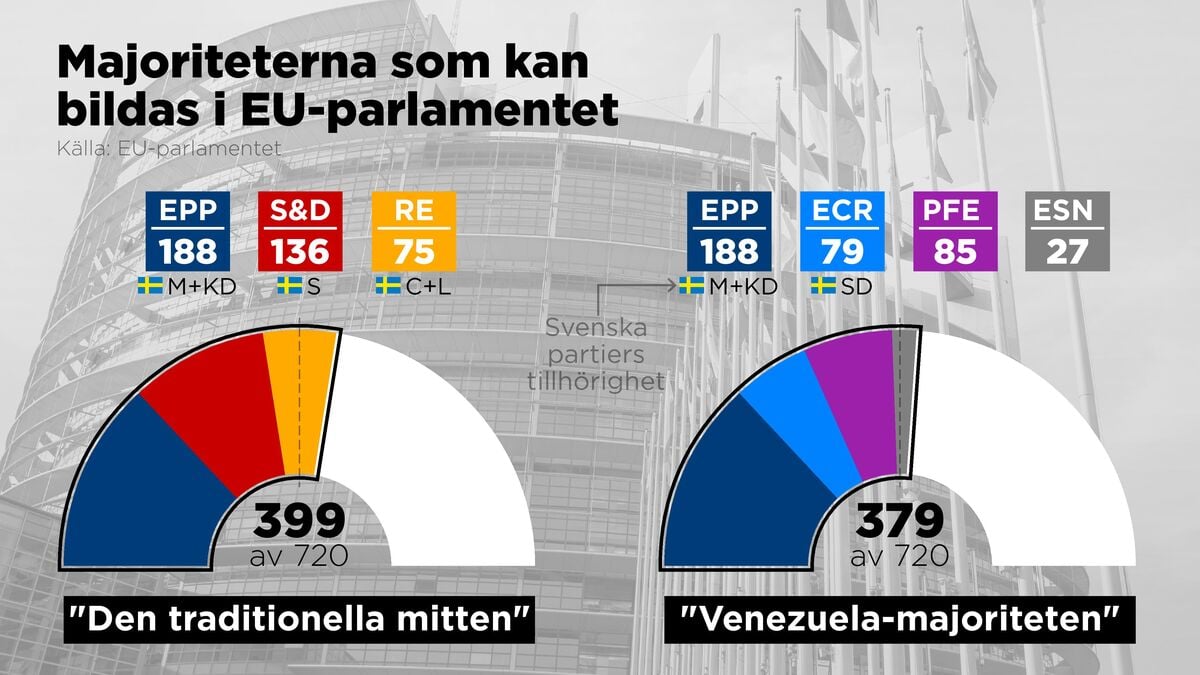
It was on the issue of support for the opposition in Venezuela that the European Parliament's traditional right-wing group, the EPP, chose to align itself with the far right for the first time last autumn, rather than with liberals and social democrats.
This has meant that what in Sweden is called Tidö cooperation in the EU context is now called a "Venezuela majority".
At that time, it was a non-binding resolution. Recently, however, the Venezuela method has been used more and more often to push through real legislative proposals in a more conservative direction, not least in the environmental field.
The groups on the far right are breathing the morning air. Here you can find both the ECR, which includes the Swedish Sweden Democrats, but also the even more nationalist and anti-immigration party groups PFE (Patrioterna) and ESN. The latter two have previously been considered far too radical in their criticism of the EU and benevolent in their attitude towards Russia to be allowed to participate in the negotiations.
"From what I hear so far, the Patriots, ECR and ESN - but also the EPP - are very much on the same page on a large number of issues," says Marieke Ehlers from Geert Wilders' Dutch PVV to the news site Politico Europe.
“Sitting with Nazis”
Among the Greens, things are not as happy. There is strong criticism of both newly introduced exemptions and postponements of climate laws, and of the EPP allowing itself to be supported by parties such as the Hungarian Fidesz and the German AFD. Or for that matter the Czech SPD, the Bulgarian Vazrazhdane and others who stand even further out on the fringes.
They are sitting in front of an open curtain with Nazis. This is going on. I don't know how many years it will take before people say "oh, what happened?", says Alice Bah Kuhnke (MP) at a Swedish press conference.
Social Democrats and liberals are also critical. Last week, they left a meeting of a newly established review group with a bang, accusing the right and far right of wanting to use it together for a "witch hunt" against environmental organizations.
Strong position
However, the EPP swears it is free and believes that everything only depends on the strong position of the party group, where it is clearly the largest and at the same time also a wave master.
This is what is called democracy. The number of members matters. How the voters have voted matters, says Tomas Tobé (M), who is one of the EPP's vice-chairs.
According to him, there is only organized cooperation with the SD party group ECR – not with the groups further to the right. At the same time, the EPP does not mind if other party groups vote for their proposals.
Sometimes I ask myself what the Social Democratic group would do if they had a majority for their own proposals. Would they refrain from pursuing their own policies and go to us and say "we are prepared to back down . . . just because we want to make up with you"? I doubt it, says Tobé.
Division over Ukraine
Unlike the Tidösambarbetet in Sweden, the liberals are not part of the Venezuela majority. This makes the Venezuela camp more "un-Swedish" with support from 8 of the 21 Swedish members, compared to at least 13 behind the agreements in the middle.
Karin Karlsbro (L) warns that EPP cooperation on the right risks making it more difficult to get a majority behind, for example, support for Ukraine and new free trade agreements.
"The EPP is playing with fire. You should know which branch you are sitting on," says Karlsbro.
However, when it comes to Ukraine, there is a clear split on the right. PFE and ESN are significantly more pro-Moscow, with a strong rejection of military support for Kiev and EU membership for Ukraine.
This causes the SD group ECR to draw a red line on topics like Russia and Ukraine.
It is not on the map that we cooperate with them (PFE and ESN) on those issues at all, says Charlie Weimers (SD).
The parties in the European Parliament sit together in party groups, which need to consist of at least 25 members and have representation from at least seven different countries. The following groups currently exist:
EPP (188 members) – including German CDU, French LR and Swedish M and KD.
S&D (136) – including German SPD, Spanish PSOE and Swedish S.
PFE (85) – including Hungarian Fidesz and French National Rally. No Swedes.
ECR (79) – including Italy's Brothers, Polish PIS and Swedish SD.
RE (75) – with, among others, Dutch VVD and D66 and Swedish L and C.
The Greens/EFA (53) – including the German Die Grünen and Swedish MP.
The Left (46) – including French LFI and Swedish V.
ESN (27) – including German AFD and Czech SPD. No Swedes.
The other members, currently 30, are non-attached.