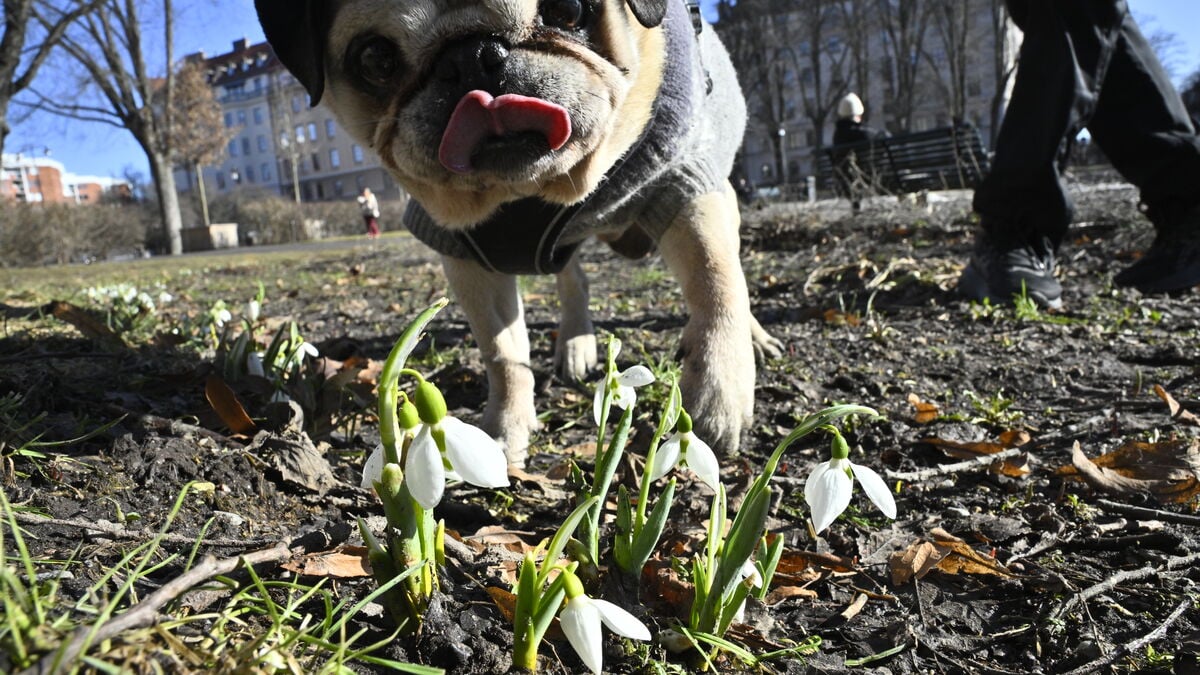
Meteorological spring has arrived in Umeå, with the average temperature staying above freezing for seven days in a row.
It was a fairly cold winter caused by a stubborn high-pressure block, but it gave way in time for the spring we usually get, says Magnus Joelsson, climatologist at SMHI.
But what is normal is changing. Winter's grip has been released significantly earlier in the 2020s than it did in the second half of the 20th century. In Svealand and Götaland, spring now comes just over two weeks earlier, according to an analysis of SMHI's climate data reviewed by TT.
"It's simply because we have a warming climate. Temperatures are higher now than they were previously at the same time of year," says Joelsson.
The differences are clear. During the last century, spring was welcomed in cities like Västerås, Örebro, Norrköping and Visby in mid-March. In the 2020s, it now arrives on average at the end of February.
Can grow corn
On Öland, farmer Göran Wilén notices the changes. It's a time shift.
You sow a little earlier in the spring and then you also harvest a little earlier in the fall.
Nowadays, he often has time to plant a catch crop to capture nitrogen before the autumn sowing.
The biggest difference Wilén notices is that corn has become a common crop among his neighbors.
"In the mid-1990s, only a few enthusiasts started growing corn with varying results. Today, it is a very large crop," he says.
A little later up north
One station that stands out is Kiruna, where spring has even arrived later in the 2020s. This is because spring occurs in May there, when temperature changes are smaller than in February and March. The city is warmer from February to April, but not warm enough to be considered spring.
It's a bit funny and has to do with how you define the seasons, says Joelsson.
And even though meteorologically it may be spring early in the year, it may not feel like it, as the sun is still absent.
Seasonal definitions are starting to drift apart a bit. We can still have summer in October even if we don't experience it as summer. It may be that spring is not experienced as light.
Fact: Spring is arriving much earlier
Average 2020s (including 2026 where spring started) compared to 1950-2000 in brackets.
Meteorological spring means consecutive days with an average temperature above 0°C, no earlier than February 15 (SMHI's definition).
Visby: 18 Feb (13 Mar), 23 days earlier
Örebro: 22 Feb (16 Mar), 22 days earlier
Jokkmokk: 30 Mar (20 Apr), 21 days earlier
Västerås: 26 Feb (18 Mar), 20 days earlier
Norrköping: 23 Feb (15 Mar), 20 days earlier
Kalmar: 19 Feb (11 Mar), 20 days earlier
Stockholm: 26 Feb (16 Mar), 18 days earlier
Växjö: 22 Feb (12 Mar), 18 days earlier
Umeå: 24 Mar (10 Apr), 17 days earlier
Linköping: 26 Feb (15 Mar), 17 days earlier
Jönköping: 27 Feb (15 Mar), 16 days earlier
Öland (Ottenby): 18 Feb (6 Mar), 16 days earlier
Halmstad: 17 Feb (5 Mar), 16 days earlier
Piteå: 26 Mar (10 Apr), 15 days earlier
Uppsala: 3 Mar (18 Mar), 15 days earlier
Karlstad: 3 Mar (17 Mar), 14 days earlier
Gothenburg: 17 Feb (3 Mar), 14 days earlier
Luleå: Apr 4 (Apr 17), 13 days earlier
Härnösand: 13 Mar (26 Mar), 13 days earlier
Gävle: 7 Mar (20 Mar), 13 days earlier
Lund: 17 Feb (2 Mar), 13 days earlier
Östersund: 23 Mar (4 Apr), 12 days earlier
Gällivare: Apr 18 (Apr 27), 9 days earlier
Mora: 16 Mar (25 Mar), 9 days earlier
Falun: 15 Mar (23 Mar), 8 days earlier
Kiruna: May 2 (May 1), 1 day later
Source: SMHI, 26 measuring stations. Processing: TT.
TT has reviewed climate data from 26 of SMHI's weather stations from Kiruna in the north to Lund in the south, to investigate when spring will arrive in the 2020s.
It has been compared with a reference period, the years 1950–2000.
Spring means that the daily average is above 0.0 degrees for seven consecutive days. The start date of spring is counted as the first day of the seven-day period. The earliest this can happen is February 15.