I'm more uncertain about Wall Street, but I still believe in a small increase in dollar terms. If I were to guess at the S&P500 index today, it would be up 5-10 percent, says Lars Söderfjell.
Highly valued stocks
The Trump administration's tariffs, currency turmoil and concerns about financial bubbles have dominated the market this year. But those who have dared to invest their savings in stocks have generally received good returns.
It has been a strong year for the stock market. It is mainly the rise in profits for companies in the US that has lifted. Then the valuations have also risen. In the US, the index is trading at more than 22 times next year's profit. That is high, says Maria Landeborn, senior strategist at Danske Bank.
The Stockholm Stock Exchange, with the OMXS index up about 8 percent, has had difficulty keeping up with the gains. On Wall Street, the broad S&P500 index is up 15 percent, which comes on top of two years of gains of 24 and 23 percent respectively.
A sharp rise in the value of the krona against the dollar – and also against the euro – explains a lot of the difference.
We have had currency headwinds, says Söderfjell.
In addition, shares on the Stockholm Stock Exchange – mainly interest-rate-sensitive financial shares and cyclically sensitive industrial shares – have not had the same strong profit development in the AI race as the tech giants on Wall Street.
Söderfjell warns of bubble valuations in certain individual stocks in the US.
Electric car maker Tesla and software company Palantir are trading at nearly 200 times next year's earnings. If you take them out and look at the rest of the S&P500 index, well, Wall Street is valued roughly in line with the historical average, he says.
Potential inflation problems
If Tesla and Palantir were to plummet 50 percent, it would reduce Wall Street's combined P/E ratio – that is, the price divided by the earnings forecasts for the coming year – by 11 percent, according to Söderfjell. But it would only lower the S&P500 index by 1.2 percent.
The clearest cloud of worry in 2026 is the risk that we have an AI bubble that bursts, warns Landeborn.
Then it's not just the technology companies that are taking a beating, she says.
An unexpectedly weak economy is another risk she sees. But she also warns of potential inflation problems in the US, as a result of tax cuts and stimulus, which could prompt the US Federal Reserve (Fed) to tighten its monetary policy by raising interest rates.
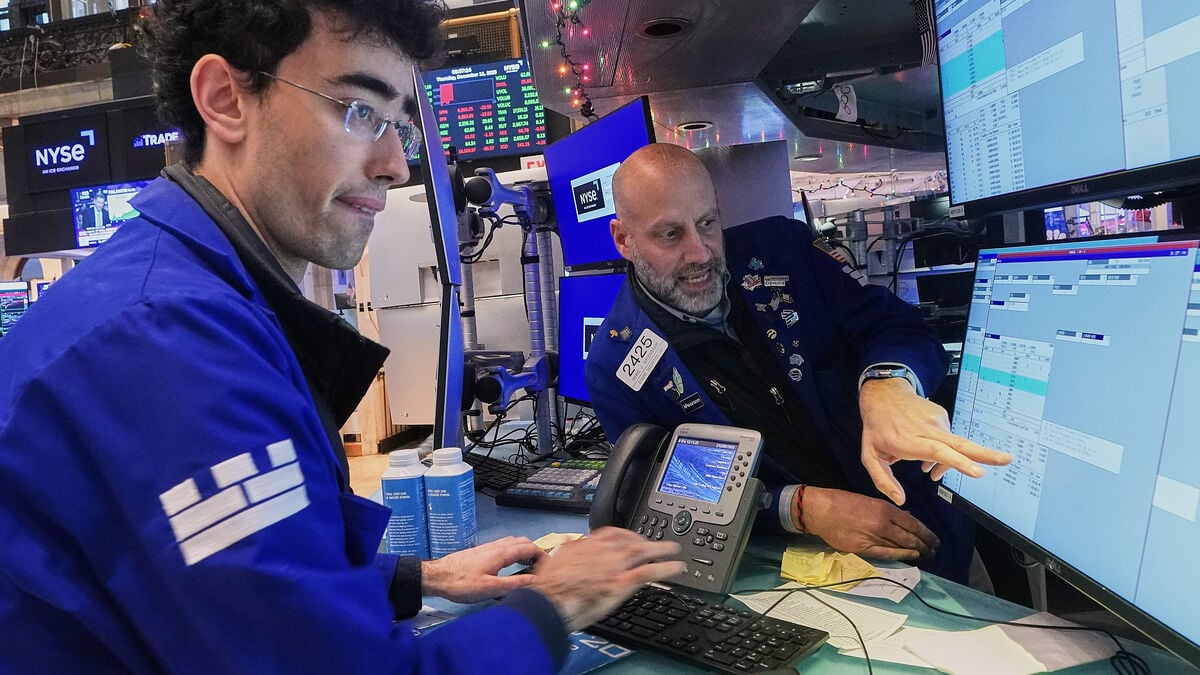
The stock markets in the US – on Wall Street – set the tone for the stock market mood around the world, both in ups and downs. And professionals there expect continued gains next year.
According to a survey conducted by the Financial Times, the average forecast among Wall Street's nine largest banks is around 10 percent plus for the S&P500 index in 2026. That would be slightly lower than the historical average over the past ten years of plus 14 percent.
Continued gains for AI stocks, the effects of tax cuts in the US and expectations of interest rate cuts from the US Federal Reserve (Fed) are included in the calculations for the 2026 price increase.
The stock market year 2025 has surprised many since the tariff shock in April. The S&P500 index has since hit new records and looks set to end the year up around 15 percent. This follows a 23 percent plus in 2024 and a 24 percent plus in 2023 for the S&P500 index.
Wall Street bank strategists believe, on average, that European stock markets – as measured by the Stoxx Europe 600 index – will rise 6.4 percent in 2026, according to the survey.
Source: Financial Times