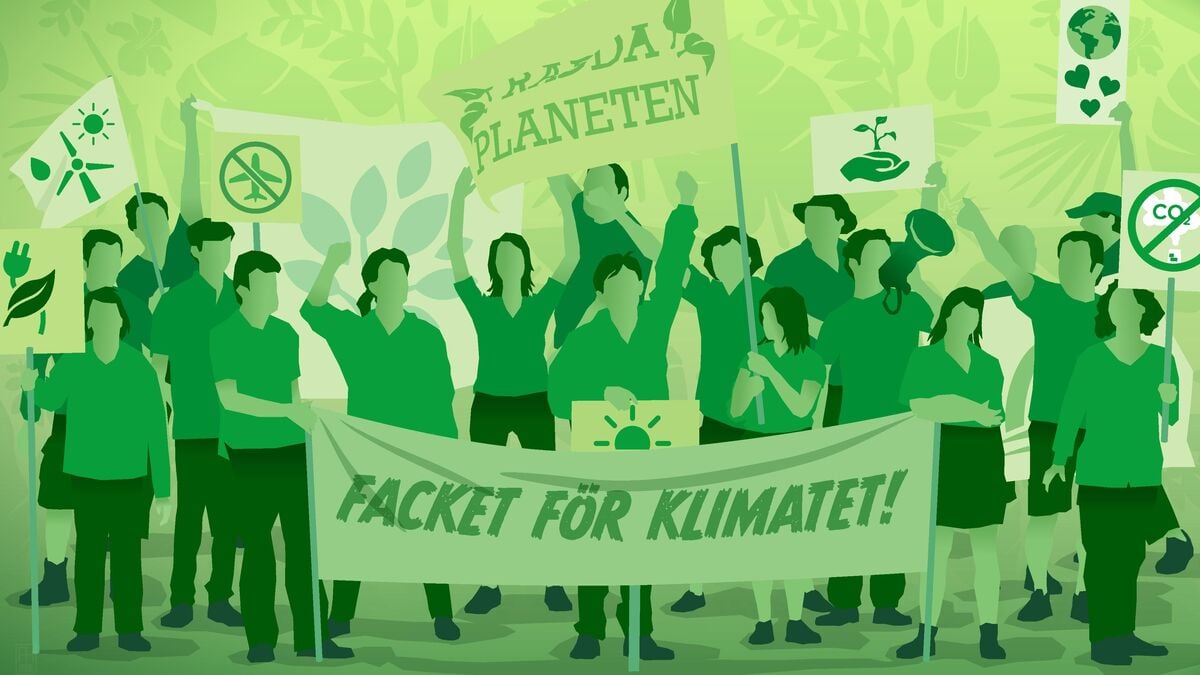
Alongside wage negotiations and safety rounds, unions around the country are starting to get involved in environmental and climate issues at work.
TCO leader Therese Svanström notes there is power in the 12 unions, which together have 1.3 million members.
There is such a huge green drive among employees who want to get involved and contribute, she says, and continues:
We even have several unions that have developed new union roles to push forward in discussions with the employer.
Trying to influence
Fredrik Kennedy is one of them. He works in the IT department at the Swedish Medical Products Agency, a workplace with about 1,000 employees in Uppsala. He has been a local climate representative for the ST union for a year.
"I had been looking for a way to get involved in a more organized way," he says.
Vision – which brings together civil servants and managers in municipalities, among other things – has several climate representatives at city administrations in Gothenburg who come together in a climate council. The representatives are pushing, among other things, to make it easier for employees to cycle or use public transport, and to set climate requirements in procurements.
There are many small parts where we try to be involved and influence and raise awareness of these issues, says Jessi Svahn, who works in the social administration.
Can do a lot
Economist Tobias Lundquist has written a report for Arena Idee about how unions can work on political influence, agreements and local sustainability issues.
You can do a lot. An important thing is to get it on the agenda, to have it on the agenda at meetings like APT and to look for solutions together with the employer. The best thing is to make changes in production, where I believe you can have the greatest climate effect.
Kennedy at the Medical Products Agency has tried to push for procurement issues and travel policy.
"Because the role is new, there is not much established knowledge within the union about how to do it, which is also one of the challenges," he says.
He has tried to get people to choose trains over planes, but it is difficult when the government requires "mode-neutral" business trips.
Aviation is one of the absolute largest emissions for which the authority is responsible.
Tobias Lundquist, who is acting chief economist at Unionen, believes that unions will take a clearer role on climate issues, although he does not expect the issue to top the agenda.
It will never be as important as the collective agreement as a whole, he says.
TCO is behind a report that is based, among other things, on an online survey from Novus with 3,200 employed people who were randomly selected.
59 percent work at a workplace that actively works to reduce its impact on the climate and environment. 49 percent want their workplace to work on the issues more actively, and 32 percent believe that climate impact could be greatly reduced with more measures.
42 percent feel that they can, to a large extent, make suggestions or participate in climate work.
The responses were collected from April 14–28 and the response rate was 62 percent.