The landing of the Orion space capsule in the Pacific Ocean concluded a historically long human journey: nearly 407,000 kilometers from Earth. The expedition provided important information for future missions aimed at establishing permanent bases on the Moon. Bases that could enable crewed trips to Mars.
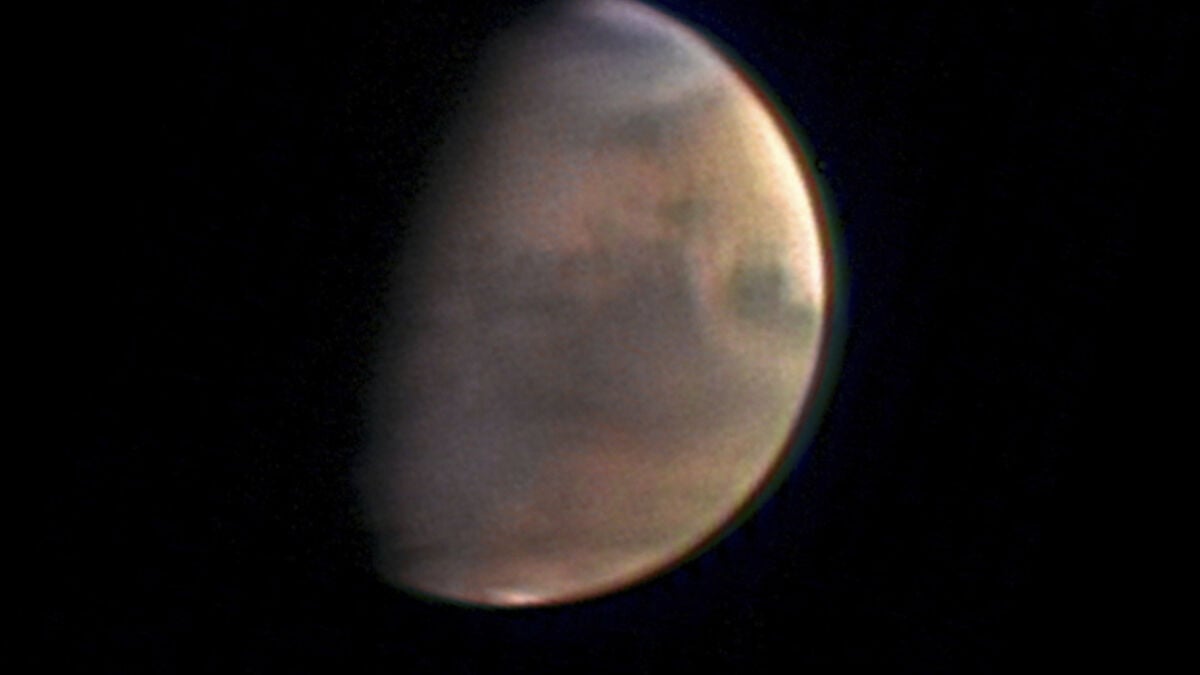
But the distance to Mars is at least 145 times greater than to the Moon.
It will be a very long journey - a round trip of at least a couple of years. During that journey, the crew will be in a radiation environment very different from that on Earth. So one of the big challenges is precisely radiation protection and safety for those on board, says Johan Gustafsson, researcher in medical radiation physics at Lund University.
Disease risks
It is about galactic cosmic radiation, that is, high-energy, near-light-speed particle radiation. On Earth we are protected by the magnetosphere and the atmosphere. The ISS is also partly within Earth's protective field. But the total radiation doses that astronauts on Mars could be exposed to mean increased risks of cancer, Alzheimer's and other diseases.
Should astronauts be caught in an intense solar storm, the radiation could cause immediate damage. Therefore, reinforced protective shelters in spacecraft are being designed.
Ideally, you should have hydrogen-rich materials such as water. It would be possible to store the water needed during the journey in the walls and in this way provide protection. I have also seen sketches of water-filled sleeping bags that the crew could crawl into.
Ethical dilemma
The question is what medical risks the space authorities are prepared to expose the astronauts to and how much the trip may cost.
The major limitation is that we have insufficient knowledge about how the radiation environment in space affects humans. It is very difficult to make reliable risk calculations based on data we have from radiation on Earth, or animal or cell experiments, says Johan Gustafsson.
The proposed manned bases on the Moon may bring greater clarity to the issue.
The journey to the Moon is considerably shorter and once on the Moon you can basically shelter yourself if you need to. But our knowledge about how the human body is affected by a long period of time in space could certainly increase, says Johan Gustafsson.
Facts: Risks for Mars travelers
Galactic cosmic radiation is not the only health risk for Mars travelers.
Long periods of weightlessness mean that astronauts lose bone tissue. They also lose muscle mass if they do not eat properly and exercise enough.
The immune system changes, which can lead to various illnesses.
The isolated and confined environment of the spacecraft can be mentally taxing. The fact that the crew works together despite this is crucial to the success of the expedition. For the same reason, the risks of both fatigue and sleep deprivation must be minimized.
Astronauts are also at risk of boredom, homesickness and depression. Researchers are investigating how, for example, studying, using virtual reality and growing plants can counteract this, as well as how much privacy a crew member needs.
Source: NASA