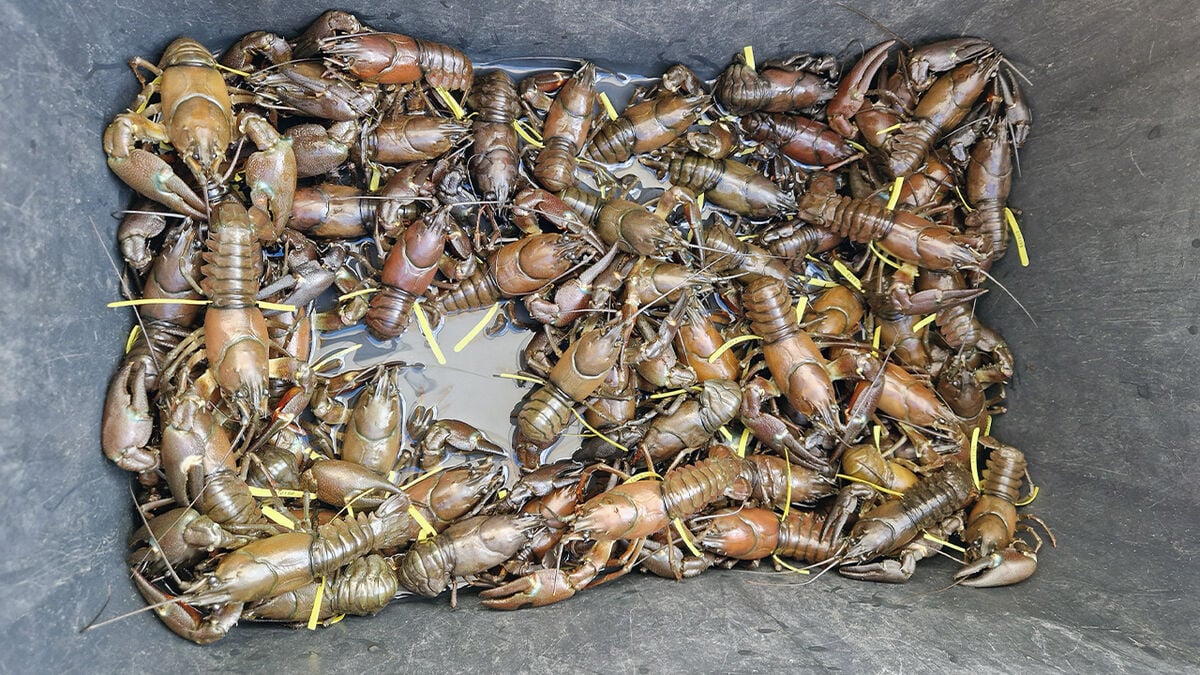
The project is run by the Swedish University of Agricultural Sciences (SLU), which, with the help of professional fishermen around Hjälmaren, tagged and released the crayfish this summer. The tagging project is one of the largest of its kind in Europe.
It takes a week to tag 2,500 crayfish, notes Patrik Bohman, an environmental analyst at SLU.
What the researchers want to know is why such a large proportion of the stock consists of small crayfish - less than ten centimetres long. The phenomenon is noticeable in both Hjälmaren and Vättern.
We have a very small percentage that become large and commercially viable. Even in areas that are not fished, they grow very poorly. And that's a bit strange, we think, says Patrik Bohman.
One theory is that competition for food has increased.
"There are a lot of crayfish in the water, so it could be due to increased competition. But we don't know that yet. Those are the kinds of things we should look at," says Patrik Bohman.
During the course of the project, the crayfish will be caught several times, measured and weighed, and then released again. The first time will be in September.
In the project, SLU collaborates with American universities on molecular tests.
Then we look at different amino acids and see what the health status is, what the crayfish have eaten and the like. We do this both in Hjälmaren and in Vättern, says Patrik Bohman.
Preliminary results may be available as early as next year.
Ideally, we would like to continue this project for three years. Maybe we can expand it to Lake Vättern as well, because we actually have bigger problems there, says Patrik Bohman.