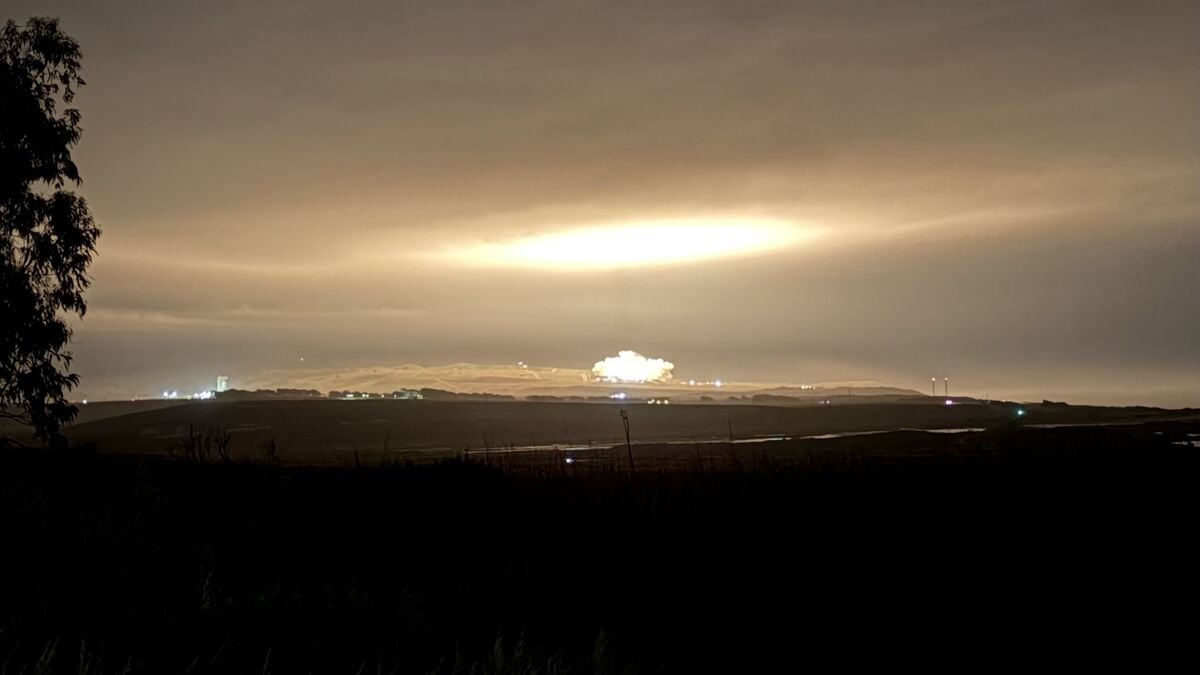
The launch took place on Sunday from Vandenberg Air Force Base in California and was carried out by the space company SpaceX.
For the Swedish Armed Forces' chief of space Anders Sundeman, it is a big day.
"We will have the opportunity to control and prioritize an intelligence sensor that is always up and has the ability to scout at long distances. This is a major capability boost," he says.
Today, the Swedish Armed Forces receive satellite images from allies or commercial satellites. Within two years, Sweden will have about ten of its own military satellites in orbit around the Earth.
It's a highly accelerated schedule, driven by a serious need, says Sundeman.
New weapons
Firstly, Sweden has become a member of NATO, which has increased the Swedish Armed Forces' potential area of operation to NATO's external borders.
Secondly, Sweden is getting new weapons with increasingly longer ranges.
Then we also need to have target information and intelligence information at longer distances, says Sundeman.
It is both about mapping potential military targets inside Russia and about detecting threats early, such as Russian troop movements.
It takes the satellite an hour and a half to orbit the Earth. A dozen or so satellites are not enough to keep full coverage of what is happening in Russia, the Baltic Sea region and the Arctic. However, Sundeman points out that the Swedish satellites should be added to those that other NATO countries have.
Like a washing machine
Sunday's launch took about ten minutes, but it will take about a month before the satellite, which is the size of a washing machine, gets into the correct orbit.
During the first year, the manufacturer Planet Labs will help the Swedish Armed Forces manage the satellite. The satellite can be steered to some extent, for example to avoid collisions with other satellites or space debris.
In the long term, the satellites will be controlled from a Space Operation Center at the Air Force Headquarters in Uppsala. The satellite images, however, will be channeled to various parts of the Armed Forces.
The center may be moved from Uppsala depending on the conflict situation.
The Swedish satellites will not have any offensive capability to protect themselves against attack or to disrupt enemy satellites.
Countries are starting to acquire offensive capabilities for use in the space domain. It is an area that is becoming more and more relevant, says Sundeman.
Facts: The Swedish Armed Forces' satellites
As early as 2024, a Swedish military test satellite was sent into space.
Around ten operational military satellites are to be launched in the coming years.
The Swedish Armed Forces have signed contracts with the manufacturers, American Planet Labs and Finnish ICEYE. Planet Labs satellites are equipped with cameras and ICEYE with radar.
In the long term, the satellites will be controlled from a central location at the air force headquarters with about ten employees.
Sweden is planning to be able to launch satellites from Esrange in Kiruna itself. Today, it lacks the ability to launch satellites from the European continent.
Between 12,000 and 15,000 military and commercial satellites are estimated to be in space today.
Source: Swedish Armed Forces Space Chief Anders Sundeman