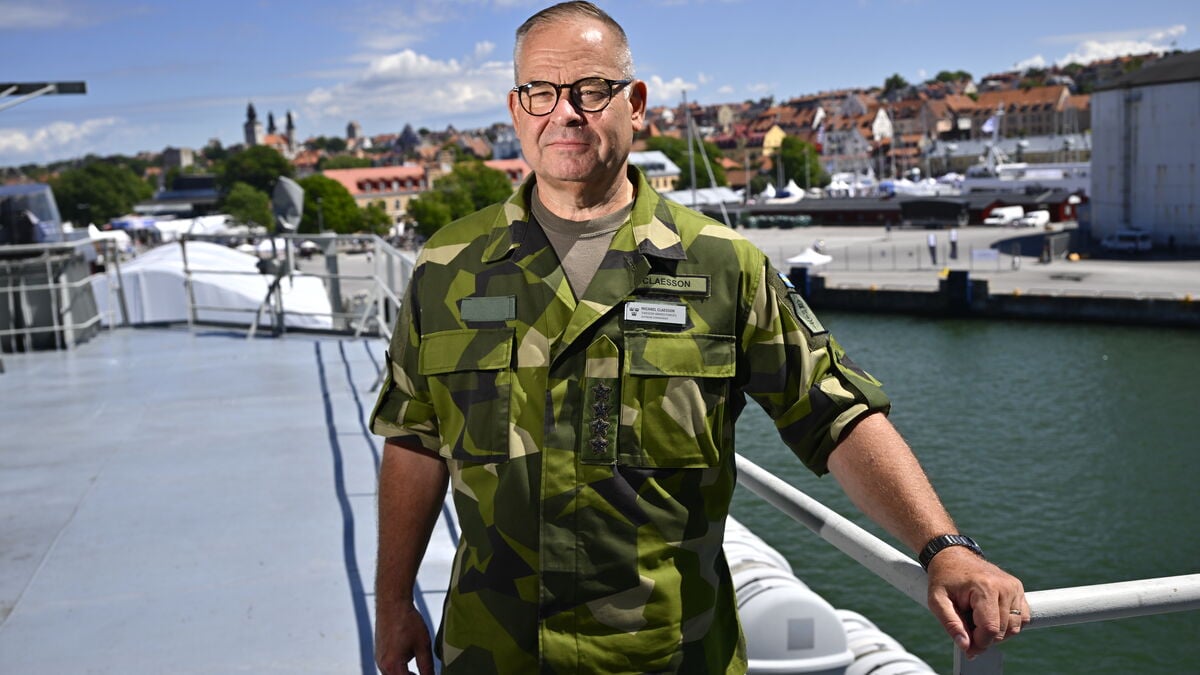
ÖB notes that Sweden is already seen as a model ally, with both military and economic strength.
So it's clear that we see a major role for Sweden, he says.
We can probably expect, just like other allies, but in relation to economic strength and population, to receive additional objectives.
Just under a month ago, the United States distributed a document to allies with plans for a reduction in American military capabilities that are currently at NATO's disposal.
Difficult to replace
According to ÖB, the American reallocation is in many ways "not that insanely dramatic"
But there are individual capabilities that are very important.
According to media reports, the US wants to reduce the number of F16 and F15 fighter jets from around 150 to around 100, reduce aerial refuelling planes, relocate an aircraft carrier and retain fewer long-range surveillance drones.
Claesson does not want to go into the contents of the classified document.
I can only say that there are capabilities in this list that could in various ways be more or less difficult to replace quickly.
Clear messages
ÖB instead points to what is important in current American contributions, such as aircraft carriers, air defense against ballistic missiles, command and control capabilities, and satellites.
At the NATO summit in Ankara on July 7-8, he hopes for such clear information about the US's plans that other NATO countries can begin planning for how military resources that are being removed can be replaced.
If the United States withdraws large naval resources, it could primarily have consequences for the defense of northern Europe with the Atlantic and the Baltic Sea.
It is clear that it is in the direction of danger when it comes to qualified naval resources, says Claesson.
Takes time
He hopes for an orderly process that follows NATO's regular planning. Every four years, NATO countries receive updated requirements from NATO regarding the military resources they should be able to provide. Sweden received its so-called capability goals last year.
The countries then have several years to meet the requirements, depending on what is involved.
"You can't ask to establish an aircraft carrier group, for example, in two years," says Claesson.
He does not rule out that, in addition to new national capability goals, some calibration of NATO's defense plans may also be needed.
The most important thing at the summit, according to ÖB, is that NATO shows unity and determination.
If there is reason on the Russian side to question cohesion, then there is a possible risk that it will be interpreted as weakness, a weakness that means that Russia increases its own risk appetite, he says.