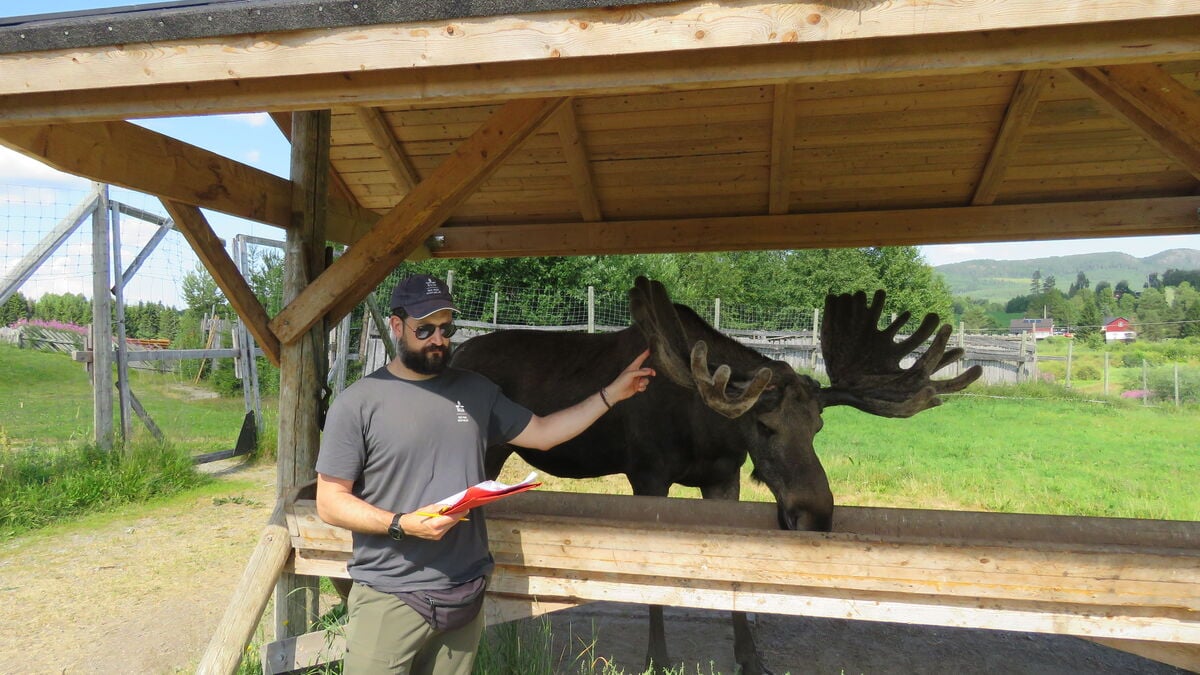
A large, fast and powerful animal like the moose does not lend itself to being studied just any way. But researchers at the Swedish University of Agricultural Sciences (SLU) took advantage of a moose park in Västerbotten, where they observed seven moose over ten weeks.
The aim was to try to capture the characteristics of the different individuals by noting how they moved, ate, rested and related to the other moose - and to the people who visited the park. The moose's behaviour was graded on different scales. It soon became clear to the researchers that the animals really did have personalities. Some were bold, others more docile. Some seemed to take it easy when people came to visit, others were wary.
Let yourself be patted
We saw that when people offered branches - that is, good food - the moose had to make a decision: should I stay close to the other moose, or should I go my own way? We discovered that the most dominant animals were also the ones that had the least problem approaching people. They accepted being petted. But the dominant animals were also less social towards the other moose, says Bruno Esattore, a researcher focused on animal behaviour and cervids.
The fact that the moose differed was not that surprising in itself; the benefit of the study was rather that the method worked, he continues. And the research team hopes that the knowledge can be put to practical use.
Sweden is unique with its many moose parks and we believe that park managers can benefit from the method. Visits can be adapted based on the animals' different personalities, both to ensure the animals' well-being and the safety of visitors, says Bruno Esattore.
Fearless people create problems
The research is now continuing among moose in their natural element, out in the forest and on the ground. There, the animals are followed with GPS and the data provides a picture of their movement patterns and the dangers they are exposed to. With knowledge of how moose behaviour differs, it would be possible, for example, to pinpoint which ones are most at risk of being hit, or which ones cause damage to forests or agricultural crops, explains Bruno Esattore.
Studies of other species have shown that it is usually the animals that are more fearless - those that take greater risks - that cause problems. If you have problems in a specific area, you can try to identify which individuals are moving there and target measures specifically at them to reduce the problems, says Bruno Esattore.
The moose park study has been published in Applied Animal Behaviour Science.
Facts: The moose
The European moose (Alces alces) can grow up to 2.2 meters tall at the withers.
Weight: 200–700 kilograms, bulls weigh more than cows.
In Sweden, moose are found throughout almost the entire country, except in southern Skåne and on Gotland.
Moose feed primarily on buds, shoots and leaves of shrubs and trees. In winter, pine shoots and twigs dominate, and in some areas damage can be done to young forests. The bark of deciduous trees is also part of the diet.
In the summer, moose also graze on herbs, berry bushes, willow bushes and other deciduous trees. They also eat water lily leaves and nate. In late summer, they sometimes venture into oat fields, where they can eat large quantities.
Source: SLU's Species Data Bank