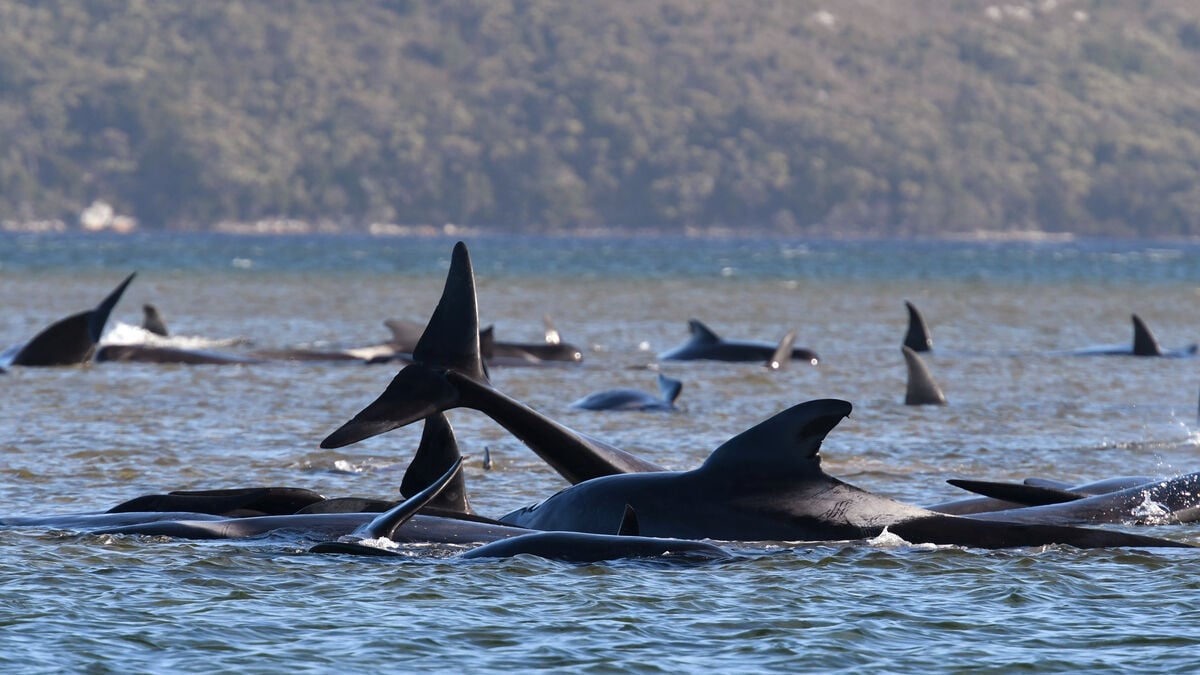
The Strait of Gibraltar between Spain and Morocco connects the Atlantic Ocean with the Mediterranean Sea. Here, along one of the world's busiest shipping lanes, lives a small, critically endangered population of long-finned pilot whales.
Despite their name, pilot whales are technically large dolphins, and like other dolphin species, they live in pods that use high-frequency sounds to communicate. These clicks and squeaks travel shorter distances than, for example, the more melodic songs of humpback whales.
Now researchers have shown that pilot whales are forced to adapt their communication in response to noise from shipping. The study, led by Milou Hegeman and Frants Jensen at the University of Aarhus in Denmark and reported by Der Spiegel, among others, shows that the dolphins raise their “voices” to try to drown out the constant background noise.
Not all sounds
To investigate the animals' communication and behavior, the researchers attached recording devices - like small tracking transmitters - with suction cups between the dorsal fin and blowhole.
Between 2012 and 2015, a total of 23 long-finned pilot whales were tracked for up to 24 hours each. The devices were then collected and the sound recordings could be analyzed by the researchers.
The increase in decibels recorded was particularly pronounced for higher-frequency, shorter-term clicks. But whales can't always raise the volume of their calls to be heard over noise pollution - some sounds can't be made louder, according to the study, published in the Journal of Experimental Biology.
Increase stress levels
In light of the researchers' findings, it is believed that the long-finned pilot whales in the Strait of Gibraltar, which number around 250, are now finding it increasingly difficult to communicate and locate each other.
“For the critically endangered pilot whale population in the Strait of Gibraltar, these partial compensatory mechanisms are likely insufficient to maintain effective communication,” the study authors write.
Previous studies have pointed in the same direction - that human noise has a negative impact on marine animals. In 2012, a study showed that ship noise increases stress levels in right whales, and in 2024, researchers found that tortoises around the Galápagos increased their vigilance with increasing ship noise.
Pilot whales (Globicephalinae) are a subfamily of the dolphin family. There are five genera in the subfamily.
In the genus Globicephala (pilot whales), there are two distinct species: long-finned and short-finned pilot whales.
The long-finned pilot whale is a powerful dolphin with a low, rounded dorsal fin. Males can grow to over 7 meters long and weigh up to 4.5 tons; females can reach around 6 meters and weigh around 2.5 tons.
They are very social and usually live in large pods of sometimes several hundred individuals.
The long-finned pilot whale is not threatened per se, but the small population living in the Strait of Gibraltar is considered threatened due to its exposed location in one of the world's busiest shipping areas.
Humans are the pilot whale's greatest threat, and in the Strait of Gibraltar they face ship collisions, noise pollution, fishing and environmental toxins, among other threats.