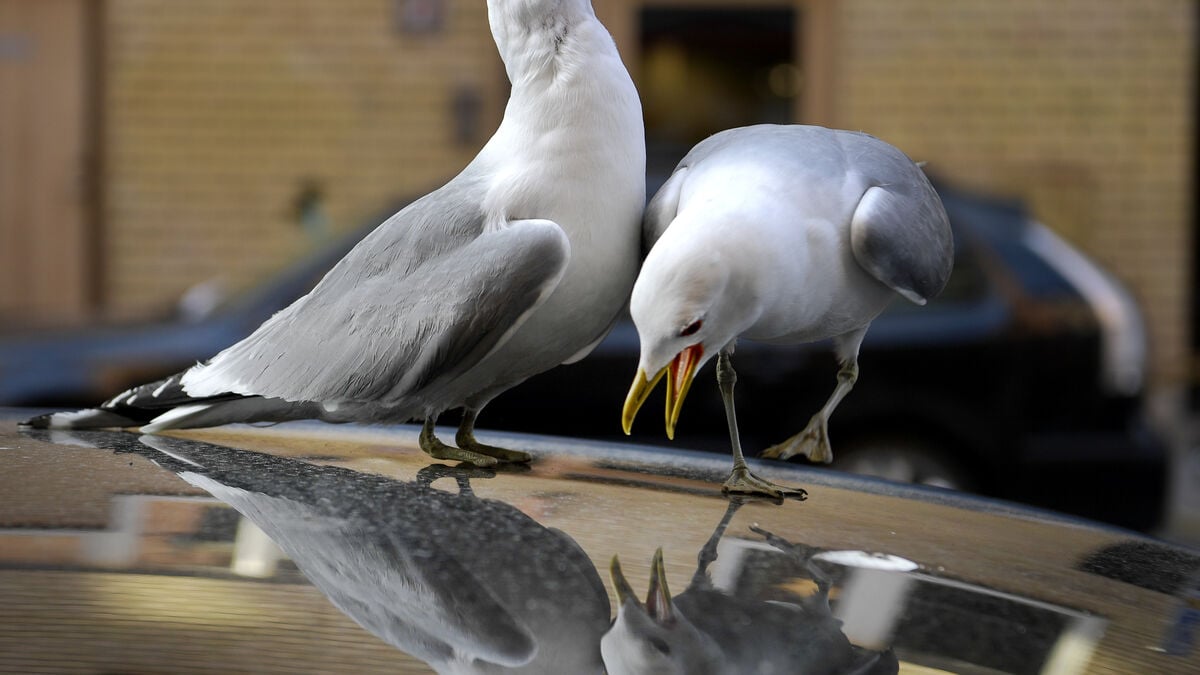
Complaints about seagulls to the city of Stockholm alone have increased by 29 percent this year compared with last year. In Malmö, a housing association has found a way around the hunting law and is conducting protective hunting against seagulls to get rid of the sound of seagulls.
"Gulls are very vocal and have shrill cries. They call to each other when they perceive danger and to maintain contact between the male and female in a pair and between parents and chicks," says Per Alström, professor of ecology and genetics at Uppsala University.
Caustic feces
During breeding season, gulls can become very protective of their young and attack people.
They normally dive a couple of metres above people's heads to scare them, says Per Alström.
Then they poop here and there, which can be considered disturbing. They are also hungry and have specialized in eating leftovers from us humans. Sometimes they can be very close-minded.
Every year, Anticimex handles over 100 seagull-related cases in the country, estimates Thomas Persson Vinnersten, biologist and pest expert at Anticimex. Often it is because they have caused fouling.
Their feces are quite corrosive. Many people get their solar panels on their roofs dirty, which can make them less effective. They also build nests, where the material can end up in the wrong place, such as in gutters that can get blocked and lead to flooding, says Thomas Persson Vinnersten.
Seeking safety and water
Much of the conflict between humans and seagulls arises because both thrive in the same environment, says Thomas Persson Vinnersten.
It is natural for seagulls to live out on skerries in the archipelago or on small islands in lakes. But many of them have moved into cities because they seek safety from birds of prey, proximity to water, food and enjoy the tall, flat-roofed houses that we live in.
But despite the fact that many people feel that there are hordes of gulls that get in the way, the five most common Swedish gull species, black-backed gull, common gull, herring gull, black-backed gull and great horned gull, have actually declined. The black-backed gull and great horned gull in particular have declined in number, by 50 and 60 percent respectively over the past 30 years.
The seagulls also fulfill an important function, according to Per Alström.
They are omnivores and therefore act as cleaners in the ecosystems where they occur. It would also feel very empty without seagulls. They generally liven up the atmosphere.
Gulls migrate south after the summer and return to Sweden in the spring. Many of the gulls live primarily in colonies. The breeding season lasts from the end of April.
Gulls and terns both belong to the family of gulls. Gulls are usually smaller than terns.
The most common gulls in Sweden include the herring gull, black-backed gull, herring gull, herring gull and black-backed gull.
Characteristics, adult birds:
The seagull has a white body and head, light gray upperparts, black tips, yellow legs and a yellow-green beak.
The black-headed gull has a light grey back and white underside. In summer, it has a chocolate brown head. Its legs and beak are bright red.
The sea hornbill has a white body and head, a dark gray/black back, a yellow beak with a red spot and pink legs.
The grey heron has grey upper wings, white undersides and a white head, a yellow beak with a red spot and pink legs.
The herring gull has a white body, dark gray upperside, bright yellow legs and a yellow beak.
Source: Anticimex, Bird Map.
If gulls have their chicks nearby, they can become aggressive and attack. But they rarely hit a human. Often they dive a few meters above their heads, enough to scare them.
To protect yourself, you can look up and make eye contact, then they won't dare to come too close. You can also hold a stick or umbrella over your head, they always dive towards the highest point.
Source: Per Alström, professor of ecology and genetics at Uppsala University.