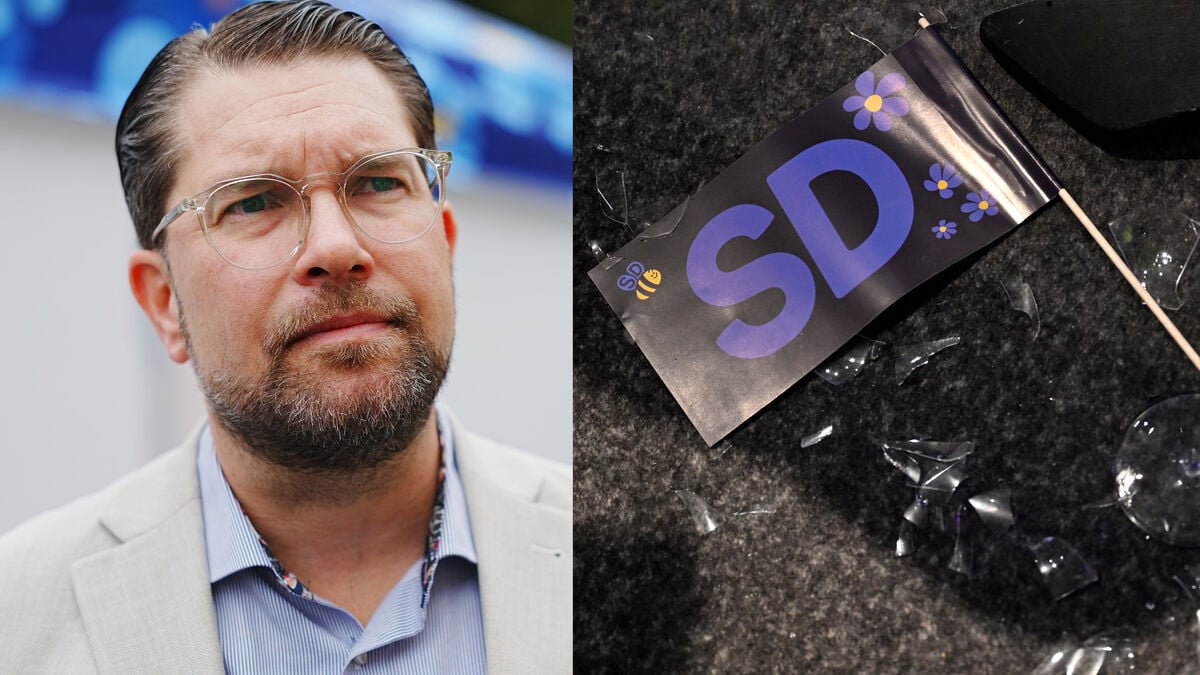
In opinion poll after opinion poll, SD was second largest after S. Election night was a cold shower. The party is down 3 percentage points and losing voters in virtually all municipalities.
"The special thing here is that the three government parties are moving forward while the Sweden Democrats are losing. I think few would have expected that," says Andreas Johansson Heinö, political scientist and publisher at Timbro.
It is a signal from the voters. More people have appreciated the appearance and policies of the three bourgeois government parties on issues that have been important.
Worse than the polls
Party leader Jimmie Åkesson explained the result on election night by saying that SD had fought for the Tidö team and that more voters were now voting for Tidö - not a single party - and had turned to L in the election.
Johansson Heinö sees Åkesson's analysis as an attempt to frame the results in a positive way.
Voters know what they are doing, whether they vote for SD or not.
Support also appears to be declining among young people. In the school elections, where M became the largest party, SD lost the most of all - seven percentage points.
There is still some kind of right-wing wave among young people, but M has managed to outcompete SD to some extent, says Johansson Heinö.
Not cracked on the outer edge?
Hällefors in Örebro is the municipality where SD is losing the most. A reasonable explanation could be that the upstart Örebro Party, led by Marcus Allard, has squeezed SD votes. Even though far-right parties such as the Örebro Party, Alternative for Sweden and the Civic Coalition are small, those votes can make a difference when the election results are as close as they were this year.
While the Left Party, for example, seems to have succeeded in cracking down on the Nyans party, which was perceived as a threat in many constituencies, SD may not have really succeeded in curbing it on its side.
Those who think that SD should have been more radical will certainly say that there would have been no room for these alternatives if SD had been more radical.
In the same way, others point out that it is precisely the radical things, such as SD leader Richard Jomshoff's statements about treason and Muslims, that are causing voters to flee.
I think a lot of voters think they've gone too far there, says Johansson Heinö.
A loss of three percent is not a collapse, however. SD is and remains a large party that has grown rapidly and gone from being seen as a political pariah by many to government office. This also means more volatile voters.
The bigger you are, the harder it is to keep only core voters. In this way, a loss is a completely normal development.
It's just that the Sweden Democrats haven't been through this before.
Facts: The Sweden Democrats' loss
Here are the municipalities where SD is losing the most in the parliamentary elections (percentage points):
Hällefors (Örebro County): –7.3
Eastern Göinge (Skåne County): –6.6
Bjuv (Skåne County): –6.5
Ockelbo (Gävleborg County): –6.4
Torsås (Kalmar County): –6.3
SD is declining in 285 municipalities, increasing in four and remaining unchanged in one municipality.
In the school elections, SD fell the most of all parties and ended up at 13.8 percent, a loss of 7.0 percentage points.
In the parliamentary elections, the party loses 3.0 percentage points and receives 17.5 percent according to the preliminary results.
The compilation is based on data from the Election Authority at 11:40 a.m. Monday, September 14. At that time, 6,277 of 6,626 districts were counted.