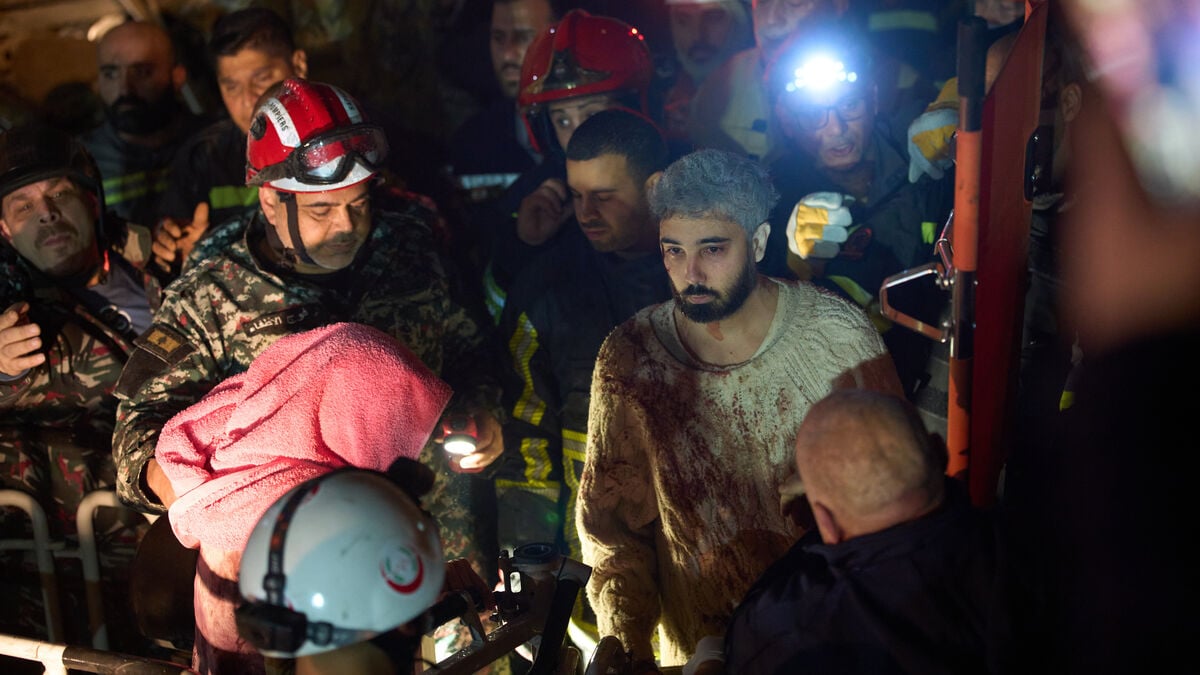
Lebanese media are calling it “Black Wednesday.” In about ten minutes, around 160 bombs were dropped on 100 targets in the country.
Then the airstrikes continued well into Wednesday evening and night in both the densely populated Beirut area and the southern parts of the country.
More than 300 people have been killed and at least 1,150 injured, Lebanon's health ministry said on Thursday evening. Lebanese hospitals are appealing for urgent blood donations from the public and rescue operations are continuing among the rubble on Thursday.
According to the Israeli military, Hezbollah leader Naim Qassem's nephew, who had also been the leader's secretary, was killed in one of the attacks.
Dismay
Prime Minister Nawaf Salam has declared a national day of mourning on Thursday, when government offices will be closed, flags will fly at half-mast and television and radio broadcasts will be adjusted "to this painful national tragedy," according to the Lebanese news agency NNA.
The attacks are met with condemnation from several quarters.
Israel's actions in Lebanon pose a "serious threat" to the ceasefire between Iran and the United States, UN Secretary-General António Guterres said, according to his spokesperson.
Leaders in countries including France, Germany, the United Kingdom and China have expressed concern about the attacks and several countries want to see the ceasefire also apply to Lebanon.
EU foreign policy chief Kaja Kallas wrote on X that Israel's right to self-defense does not justify the massive destruction caused. She also urges that the ceasefire should also apply to Lebanon.
Despite the condemnations, Israeli Prime Minister Benjamin Netanyahu said, according to AFP, that Israel would continue to strike Hezbollah “wherever necessary.” The Israeli military warned the population in Beirut’s southern suburbs of upcoming airstrikes.
Iran threatens
The Lebanese government has decided to seize weapons from non-state actors in Beirut. Similar decisions have previously been made for southern Lebanon and targeted Hezbollah. However, the Lebanese state has had problems implementing the arms monopoly in practice.
Iran claims that a ceasefire in Lebanon is one of the main conditions of the agreement with the US and threatens “strong responses” if it is violated. Hezbollah has already resumed rocket fire into Israel.
Even Pakistan, the mediating country, has stated that Lebanon should be included in the agreement.
However, Israel and the US claim that attacks on Hezbollah targets in Lebanon can continue.
Facts: Seven invasions in 50 years
Over the past 50 years, Israel has entered Lebanon with ground forces on seven occasions.
Israel's opponent in Lebanon, the Shiite Muslim movement Hezbollah, is a militia and political party. It was founded partly with Iranian help after Israel's occupation of southern Lebanon in the 1980s. It acts as a proxy for Iran in conflicts in the Middle East and has been partly labeled a terrorist organization by the EU and the US.
The long-running conflict flared up again in connection with the Gaza War. A ceasefire was reached in 2024 that required both Hezbollah and Israel to withdraw from a buffer zone in southern Lebanon. The parties have accused each other of violating it.
In the spring of 2026, fighting broke out again when Hezbollah fired rockets at Israel in response to Israel's war with Iran. Israeli ground forces have advanced further into Lebanon, hundreds of thousands have been displaced, and there are warnings of a lasting occupation.