"It's cold, your gloves are getting soggy. You're freezing; you have to warm yourself in the kitchen when you get back to work later," says Annica Österberg.
She describes the feeling of being forced to visit the water station at Gutavallen outside Visby's city wall more or less every day. She works at a hotel with a restaurant, a job that requires several cans of clean water every day.
Benny Jönsson, another frequent visitor, helped his elderly neighbor and his son who has hip problems. He himself bought the drinking water he needs, but is clear about his opinion:
"It's hell!"
One of several cases
On December 3, Region Gotland issued a boil-water advisory after finding high levels of certain organisms. A few weeks later, analyses showed what appeared to be parasite shells in the water, which led the region to tighten the advisory. It was not until January 30, 58 days later, that the region declared the danger over.
Visby was hit by boil-water advisories as recently as 2023, after the bacterium Clostridium perfringens was discovered. In the summers, water shortages are a recurring problem. But Gotland is far from alone. In August, unusually high temperatures in Lake Mälaren made purification more difficult and Stockholmers were urged to save water. In southeastern Sweden, low groundwater levels are now the rule rather than the exception.
Six out of ten Swedish water producers say they are already noticing changes in the possibilities for extracting water. A third say that the quality has also deteriorated, according to a survey from SGU .
Margareta Lundin Unger is chair of the Water Supply Group, which brings together authorities and organizations to plan for a changing climate. She points out that much is already being done, but that more will be needed as the climate changes.
"It's getting drier, wetter and warmer. And all three factors affect water resources," she says.
Among other things, she believes that we will need to be more frugal with our water and that it will become more expensive for users. We will probably have to get used to more alerts about water problems.
"It will probably happen more often," she says.
Turned off the taps
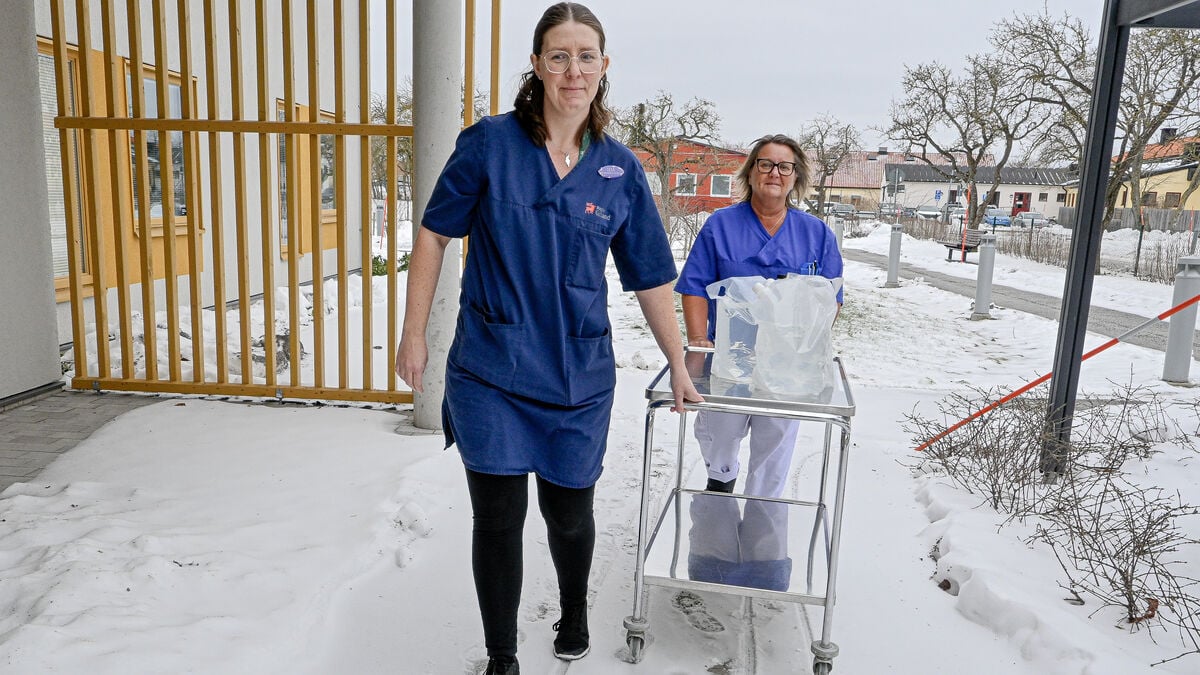
At the short-term unit in Visby, staff were forced to go out in the cold to get water from the tank that had been placed there. The water is used to cook porridge, rinse fruit and vegetables, make coffee and for drinking.
"We had to turn off the water in some sinks in the rooms because the residents don't know or remember that they are not allowed to drink the water. It also made it quite difficult when you had to help wash someone," says Ida Wiflings, assistant nurse.
The announcement that the boil-water advisory had been lifted was met with cheers and applause.
"There was cheering among the staff. Hands were raised in the air: 'Yes, finally,'" she says.
We expect clean drinking water to come out of the tap. It is only when it disappears that we reflect on how dependent we are on this vital resource.
"Of course we take it for granted. But we had a certain feeling two years ago, when there were bacteria in the water, that it is quite fragile."
At the lunch restaurant Maltfabriken near the harbor, Christer Dennerdal sighed over the situation. Every day he boiled up to 300 liters of water in large pots, carrying them to the refrigerator until the next day.
"It's like standing around making soup all day; it feels like it."
The Horror: Östersund
Region Gotland said the drinking water in the Visby area was probably always safe to drink. But one could not be completely sure.
Parasites are tricky: they cannot be cultured like bacteria, nor can their DNA be analyzed unless there is a large quantity. Although traces were few, the region is painfully aware that it doesn't take many for people to get sick.
"We don't want a new Östersund," says Susanne Bjergegaard Pettersson, expert at the Water and Sanitation Department at Region Gotland.
She is referring to the horror example from 2010, when 27,000 people were affected by stomach illness caused by the parasite cryptosporidium. A recent thesis shows that the cost to society ended up at 1.7 billion kronor and many who fell ill still had stomach problems ten years later.
"Gotland is Gotland, and in that case we have to take care of ourselves. We don't want to see half the population pushed into the hospital," she says.
Drought - and rain
When it rains heavily on Gotland, runoff can carry pollutants from farmland into water reservoirs. And when summers are dry, there is little water instead.
"We have had a couple of tough summers with water shortages, where we've just barely managed but have put a lot of pressure on our water sources and our plants. It is a combination of a changing climate and the fact that the plants we have today are from the 1970s and older, and need to be modernized and renewed."
On Gotland, planning is underway for a new water source with a waterworks, new dams to collect rainwater, diverting water from Bästeträsk on the northern part of the island, or perhaps using Baltic Sea water with a desalination plant. But the plans are at least a few years away.
"We are hard hit by the climate change that has reached Sweden," says Susanne Bjergegaard Pettersson, and continues:
"We may have to dress the shot first, but it will affect other places in Sweden."
Background: The problems on Gotland
November 28. High levels of copepods are discovered in the drinking water at a property.
December 2. Samples in the drinking water in Visby show more cases of the organisms.
December 3. Boil-water advisory introduced in Brissund, Själsö, Väskinde, Visby, Vibble and Västerhejde.
December 17. Test results from the water reservoirs show outer shells that may belong to the parasites giardia and cryptosporidium. The advisory is tightened.
December 19. The first public drinking water tank is placed in Visby. Another one will be put on display on January 16.
January 15. The region announces that UV purification will be reinforced and that the control program will be expanded. The boiling recommendation is expected to be lifted at the end of February.
Source: Gotland Region
Two two-hundred-litre samples were taken from the water reservoir in question on Gotland. In these, what are believed to be four cryptosporidium parasites and one giardia parasite were found. Nothing was found in the pipe network itself. The analysis failed to confirm that these were indeed the parasites in question.
Even if they were parasites, it is not certain that they were alive. The UV purification makes them harmless, but they are still in the water.
Unlike bacteria, parasites cannot be cultured, as they require a host. Not all cryptosporidium species cause disease. A larger amount is normally required for DNA analysis.
Bacterial samples have not shown any signs of contamination or "fecal impact", that is, that feces have come into contact with the water.
As for the jumping crayfish, a type of plankton that lives naturally in water, they are considered harmless. New filters will be installed in the spring to reduce their numbers.