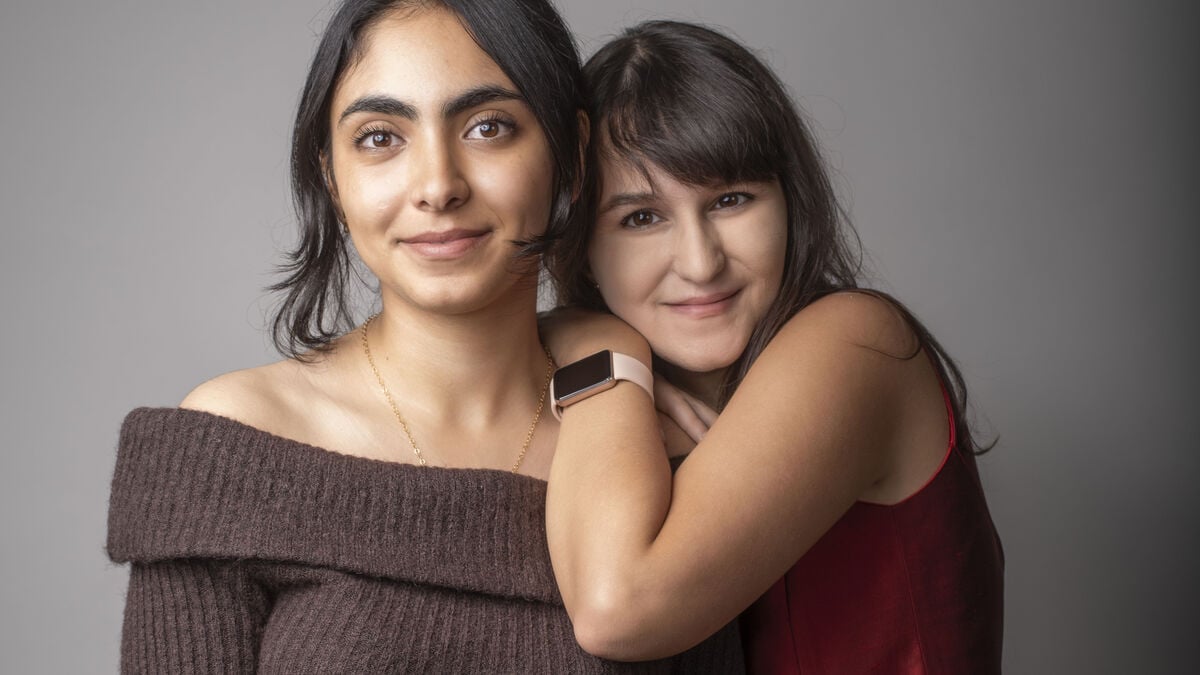
The book "Under the Same Sky" is an initiative by French journalist Dimitri Krier who brought the two writers together.
No Israeli publisher wants to publish it, and so far none in an Arabic-speaking country. However, if it is translated into English, it will reach both Gaza and Israel, which scares the authors.
Michelle Amzalak, who started studying for a master's degree in international law in Jerusalem this fall, would probably still say yes to an edition in Hebrew.
But I would put myself in a vulnerable situation, she says, recounting the brief notice about the book that her father's wife posted on an Israeli sociology institution's Facebook page.
“Okay with me”
The comments were incredibly harsh, mean. If this book gets any recognition in Israel, I imagine I would get a lot of negative reactions, and that's okay with me. But sometimes I worry that the university professors wouldn't want to work with me.
Tala Albanna, in turn, notes that many Gazans would also be opposed to their book.
But if they read it, they would see that I am with them, not against them.
“Michelle, what are you doing while my people are being killed by the bombs? Does it make you sad?” she writes in March 2024. But she also notes that no one in Gaza has Israeli friends to talk to.
Michelle was living in Sderot, just a few kilometers from Gaza, but like so many other Israelis, she had never spoken to anyone from there before. Now she realizes that much of the world knows more about what is happening in the war than she does.
Alone in Ireland
Tala Albanna, also a law student, is celebrating Christmas alone in Ireland this year. On August 28, she managed to leave Gaza for the first time thanks to a scholarship and an agreement between the Irish embassy and the Israeli government.
But it's not about generosity, it's our right to come out and study, she says, emphasizing that the vast majority of students remain and that her own university in Gaza has been bombed to pieces.
Like Michelle Amzalak, she hopes the letters will make readers feel more empathy, but according to Tala Albanna, more than that is required.
Communication is not enough. As long as Gaza is occupied and as long as the Israeli government is unpunished, there is no peaceful solution.
Tala Albanna and Michelle Amzalak corresponded for a year and a half. The war was going on in Gaza and their correspondence took place on WhatsApp via the French journalist Dimitri Krier at Le Nouvel Obs who first published the letters. The book will be published in French, the Nordic languages and Spanish, possibly also in the USA.